


How the Martini glass became more than the Martini
Think of a Martini, and what do you picture? We bet that it’s the classic V-shaped cocktail glass that immediately comes to your mind.
It is reported that the V-shaped Martini glass we know today was first unveiled to the public in 1925 at the International Exhibition of Modern Decorative and Industrial Arts in Paris, designed as an angular, Art Deco update to the traditional, rounded Champagne coupe.
A century later, its silhouette has become instantly recognisable around the world, and the Martini glass no longer simply signifies a drink; it signals cocktails, nightlife, glamour and adulthood itself, becoming one of the rare household objects to outgrow its function and become a cultural icon.
But how did a single piece of glassware come to stand in for an entire drinking culture?
The making of an icon
The Martini isn’t the only cocktail that has been assigned its own style of glassware. Old Fashioneds, Collins, Margaritas and Mint Juleps all have their own dedicated vessel, but none have reached icon status in the way the Martini glass has.
For Wendy Hopkins, beverage director at Hakkasan Group, the glass’s shape is a “masterclass in functional design”.
“Its anatomy tells you exactly how to drink,” she explains. “The long stem keeps your hands from warming the liquid, and the steep angle delivers a sharp, cold hit straight to the palate.
“Its true DNA is inherently nostalgic and alcohol-forward. It was built for a shorter volume of liquid so you can finish the drink while it’s still cold.”
Some argue that it’s the glass’s silhouette, with its dramatic proportions, that makes it instantly recognisable, and for Elvis Zeneli, bar manager at The Clumsies in Athens, Greece, it has become a universal shorthand for cocktail culture, and is “a cultural symbol in its own right”.
In fact, its silhouette is so distinctive that it can be reduced to three simple lines and still be easily identified, putting it in the territory of great logo design. Even the emoji symbol is now universally used to represent cocktails as a whole category.

Zeneli says that at The Clumsies, the choice of glassware is equal to the drinking experience enjoyed by the customer: “A glass shape, proportions and presentation can shape perception before the first sip, becoming part of a cocktail’s identity and story.”
He explains that for concept-driven cocktails, his team often goes further by creating bespoke glassware designed specifically for the serve. “These custom pieces help communicate the drink’s narrative more clearly, strengthening the connection between the cocktail, the guest, and the overall experience. The Martini glass is a perfect example. While not always the most practical option for service, still, its striking and lasting significance has secured its status as an icon of cocktail culture.”
But for many, the glass is more famous than the drink, and typically, most cocktails served in it today aren’t even Martinis. In fact, at some point, the glass stopped meaning ‘Martini’ and became a representation of nightlife, going out, and drinking culture as a whole. As such, today you’re more likely to be served an Espresso Martini or Pornstar Martini – which are distant cousins of the classic Martini at best – or even a prawn cocktail or dessert in a V-shaped Martini glass before you are served a true straight-up Martini.
This ‘misuse’ of the glass has led to mixed feelings about it for Adam Montgomerie, general manager of London bar Equal Parts: “For a long time I associated it with bad drinks; think mid-2000s cocktails where the word ‘tini’ was added to anything, usually drinks that were super sweet and fruity.”
However, he notes that the resurgence of the classic gin and vodka Martini over the last few years “has been great to see, and I’ve now discovered a whole new appreciation for the glass. Seeing well-made Martinis fly out from bars in the classic V-shaped glass taken straight from the freezer is a thing of joy.”
‘A prop for adulthood’
The Martini glass has benefited from a powerful presence in pop culture thanks to its ability to quickly communicate character. By the late 20th century, the vessel had become a form of costume design in film and television – a visual cue used to establish character before a line of dialogue is spoken – with certain archetypes returning again and again with a Martini in hand.

In The Wolf of Wall Street, Matthew McConaughey’s hard-driving, reckless executive downs Grey Goose Martinis with ritualistic (and reckless) intensity; in A Simple Favor, Blake Lively’s seductive, murderous antagonist is rarely seen on screen without an exceptionally strong Martini beside her. Then there are the Manhattan singletons of Sex and the City, regularly seen gossiping over cocktails in the middle of the day, or the impeccably controlled British spy of the James Bond films, whose Martini order has become as recognisable as the character himself. Put someone on screen with a Martini glass in hand, and audiences can immediately start filling in the blanks about who that person is.
This has translated into real-life culture, with the glass becoming a status symbol and a prop for adulthood. The halo effect of being linked to characters such as James Bond has meant the drink has a perceived value; being seen with a Martini offers up the appearance of elegance and class, while suggesting the bearer also boasts a refined palate that can effortlessly stomach a glass of pure alcohol. Of course, we’re not saying it looks cooler to nonchalantly hold a Martini glass at a cocktail party than a Hurricane with a party umbrella and a straw, but others might make their own judgments.
The glassware evolution
But the classic V-shaped Martini glass isn’t the most practical of vessels for the modern drinker.
While it is said that speakeasy-goers of the Prohibition era favoured these glasses as it meant they could easily dispose of their drinks in the event of a police raid by allowing the liquid to slop over the edge of the rim, today that ‘quality’ is seen as a fundamental flaw in the glass’s design, especially when it comes to navigating your way through a crowded bar with your freshly ordered cocktail in hand.
Mandy Naglich, author of How to Taste: A Guide to Discovering Flavor and Savoring Life, defines this as one of the major flaws of the glass’s design. “It’s very, very easy to spill, so your brain is actually putting a lot of effort into holding the glass and not spilling it, focusing on that rather than what you’re tasting or what’s going on around you.”
She adds that if there is any small flaw in the liquid itself, such as a temperature change or flavour inbalance, placing focus on not spilling the drink over the taste is going to provide a less enjoyable experience overall.
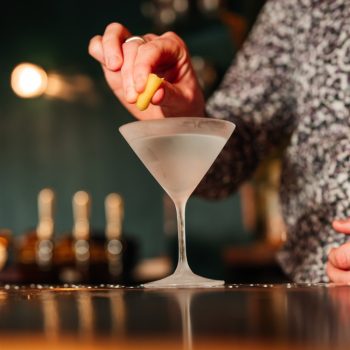
She also notes that a Martini glass, with its wide open rim, “does nothing to steer the aromas of ethanol – that sharp alcoholic aroma that makes you think ‘oh, I’m drinking something too strong’.
“I’m a flavour person,” she adds, “I’m always thinking about how you can make something taste better. Basically, in a Martini glass, the ethanol aroma is just going to roll off the top of the open glass and mix with all the other aromas [particularly the botanical or citrus notes of the gin], and you’re going to kind of lose them.”
There is no arguing with the science, and the lack of practicality for modern-day drinking is hard to ignore. As such, an evolution has been witnessed in recent years across the on-trade, and the classic Martini for which the V-shaped model was originally designed has begun to step away from those iconic sharp angles to embrace a more practical design.
Hakkasan’s Hopkins shares: “What I find truly beautiful is how glassware evolves alongside our drinking culture, especially the Martini glass. We’ve watched the vessel transform from the traditional, elegant coupes of the Prohibition era, to the distinctive, sharp V-shape introduced at the 1925 Paris exhibition [International Exhibition of Modern Decorative and Industrial Arts] and now to the revival of smaller, delicate Nick & Nora glasses. This evolution mirrors the incredible creativity of the modern drinks industry.”
Naglich also points to Nick & Nora glasses as a great choice of glassware for Martinis. “They will actually steer those ethanol aromas into the bell shape and out of the centre of the glass, so you can get a nice clean central sniff while you’re taking a sip.”
Nico de Soto, founder of acclaimed Parisian bar Danico, shares that the glassware’s evolution is a refined statement of identity, with every curve, proportion, and detail speaking of a bar’s philosophy, a bartender’s craft, or a fleeting moment captured in time.
“I’ve spent much of my life tracing the world through its bars, and among the many rituals I’ve come to admire, none has evolved more gracefully than the Martini glass.

“Much like the cocktails they hold, Martini glasses have grown more considered, more distinctive, and infinitely more compelling – quietly telling stories before the first sip is ever taken.”
No.3 Gin has embraced this evolution by teaming up with glassware brand Nude to create a glass specifically for the No.3 Martini.
The exclusive glassware is described as a perfect balance of form and function. Alicia Stark, No.3 Gin global brand ambassador, explains: “Half of the Martini experience comes from the glassware. The No.3 Gin glass differs slightly from the traditional Martini glass, which was developed using scientific expertise and design savoir-faire.
“It has been specially crafted to keep liquid cooler for almost twice as long as a classic glass, which is ideal for protecting the cold, clean smoothness of a high-quality Martini. Handblown from crystal, this glass is a perfect balance of form and function: simple yet elegant, with a subtle turquoise base that takes cues from and complements the No.3 bottle.”
Tomorrow (20 June) marks World Martini Day.
We recently explored whether the moderation movement is an opportunity for the lower-ABV 50:50 Martini, and asked bartenders: has the Dirty Martini gone too far?
Related news
SB meets… the founders of World Martini Day