


Do cocktail bars take allergens seriously enough?
Allergens can prove fatal to consumers, but many bars do not list them on their menus, and staff often do not understand them. We speak to some bar teams that are making real efforts to protect and inform their customers.
*This feature was originally published in the May 2026 issue of The Spirits Business magazine.
The London bar scene was up in arms in March when it was revealed that Margot Robbie’s gin, Papa Salt, featured oyster shells as a botanical, causing chaos and panic for those with shellfish allergies. Well, not quite.
As anyone with distilling experience will know, most spirits are allergen-free. Allergenic proteins are not vapourised during distillation, and get left behind when the spirit moves onto the condenser – that’s why whisky is gluten-free, despite being made from barley. Of course, those with a potentially fatal allergy might prefer not to take the risk, which is why Papa Salt comes with a warning label for molluscs.
It seemed to be a lot of fuss over nothing, but the incident fed into something I’d already been mulling over. Do cocktail bars take allergies seriously enough?
A brilliant op-ed by Becky Paskin in Class magazine in 2025 posed the question: why is there meat in my cocktail? She’d noticed that animal products had begun appearing in drinks, often without a warning on menus or from bartenders. It’s an issue I’ve seen in real life, with one head bartender unsure which cocktails were suitable for vegetarians as he presented them to a group of journalists.

If bartenders are unable to identify which cocktails their team has fat-washed with bacon, what hope is there for those with allergies? In the UK, restaurants have made huge strides with allergen awareness since the death of Natasha Ednan-Laperouse, who had a fatal reaction to sesame seeds in a Pret a Manger sandwich in 2016. You’ll generally be asked about your allergies by a waiter when you arrive, with most teams having a solid knowledge of what’s on the menu.
The law in the UK requires the same of cocktail bars, but in practice, staff members are often less than familiar with drink allergens. Recently, a friend decided to keep her sulphite allergy a secret from a bartender, because she would rather deal with the (admittedly mild) consequences than receive another blank stare.
While bartender knowledge is one thing, consumer knowledge is another. Full recipes are rarely presented on menus these days, with bars instead prioritising flavour profiles for descriptions. But it’s worth remembering that the average drinker is likely to be unaware that a Sour usually features egg, or that a crystal-clear cocktail is made so by adding milk.
How can bars make their guests aware of allergens in their drinks? In Madrid, Angelita is showing how it can be done. Its new menu, released in February, opens with a key of 16 allergens, ranging from the common – gluten, nuts and molluscs – to those some of us rarely think about – sulphur dioxide, fungi, and pollen. “Putting allergens front and centre honours the guest’s trust,” explains bar manager Massimiliano Berardi. “We believe that a high-end experience should never be clouded by anxiety; by being explicit about allergens, we allow the guest to focus entirely on the sensory experience rather than the potential risks.”
No guesswork
The same view is shared by Oslo bar Himkok, with Paul Aguilar, its head of research and development, saying listing allergens is “just part of running a serious bar. Guests should not have to guess.”
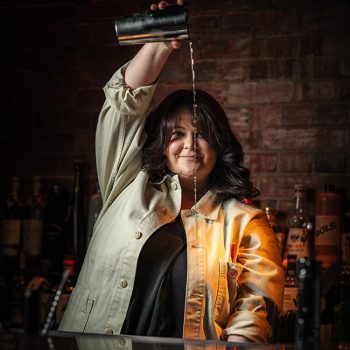
For Laurie Howells, head bartender at Archive & Myth in London, understanding allergens has to go beyond printing them on a menu. “We take allergens seriously through training and service rather than relying solely on the menu,” she explains. “Our team is highly trained, and it’s built into our steps of service to always ask guests directly.” This approach requires each bartender to first know exactly what goes into each drink, as well as understanding how an allergen might present itself. Take sulphites. “They’re commonly used as preservatives, particularly in wine, vermouth, and some cordials or dried fruits,” explains Howell. “They can appear in Spritzes, aperitivo-style drinks, or even house-made ingredients without being immediately obvious.”
Armed with this knowledge, a member of Archive & Myth’s team would immediately know not to recommend a Spritz-style drink to someone who has mentioned a sulphite allergen, without having to remember the full ingredient list.
Similarly, the team at Angelita is taught to understand each ingredient that goes into a cocktail, with the vast majority of cocktail components produced in house. It’s easier to understand where an allergen might appear when you can trace every step of the recipe. As well as having this practical knowledge, the Angelita team are armed with technical specification sheets for every drink on the menu, as well as a ‘cheat sheet’ for allergens.
Check everything
Cross-contamination is also a huge part of allergen management. At Angelita, the team ‘clean slate’ every machine, surface or tool after using it, and have dedicated equipment where needed. “And, of course, we double, triple, quadruple check everything,” says Berardi. “Communication is key.”
Himkok implements a high level of safety for particularly dangerous allergens, such as peanuts. “We use separate vessels, separate cleaning areas, and a separate serving station,” says Enrico Manfredo Mazzanti, Himkok’s head of lab. “If you want to take allergens seriously, that level of discipline has to be built into daily operations.”
Angelita’s Berardi says: “Underestimating an allergy isn’t just a safety risk; it’s a failure of hospitality. Mazzanti adds: “If you are serving people, you have a responsibility to know exactly what is in the glass and to communicate it properly. That is the minimum.”
Related news
Beluga illuminates on-trade with Noble Night