


Understanding alternative spirits distribution options
Spirits distribution is competitive. With large-scale consolidation, a reduction in alcohol consumption and saturated shelves, how else can brands grow distribution and find success outside of traditional models? Digital distribution platform Bemakers dives into the options.

“In the macro environment, yes, it’s a tough market, and the industry is struggling, but there is clearly still opportunity,” says Morten Stengaard, CEO of Bemakers. “Eight years ago, anyone could found a gin brand and get some traction, and maybe even some funding; that has clearly changed.
“It’s a much harder market for establishing a brand and getting traction. But it also means that the brands that know how to build and how to hustle, if you will, they can actually get traction and find revenue.”
In 2026, with the advancement of technology, including e-commerce and AI, and the growing availability of direct-to-consumer shipping, routes to market can look different today than they did even just five to 10 years ago.
For Stengaard and the Bemakers team, there remains a lack of understanding about how different distribution models can be utilised by brands and companies of all sizes. Stengaard is forthcoming in stressing the Bemakers model, for example, is not suitable for every brand, but he believes there should be more conversations about education and alternative options to successfully build distribution in the modern era. With experience in both brand building and distribution (through co-founding Andersen Winery in Denmark and Bemakers), he has a broad understanding of the challenges facing both parties – and also how to potentially alleviate some of those issues.
“Many traditional distributors are struggling with making profit. And why is that? That is obviously a consequence of the whole value chain being down, where consumers are buying less,” he explains. “If [distributors] already have eight gins, for example, they’re not buying number nine and number 10. They’re probably buying less. They have enough stock already.
“It’s the same with off-trade channels. We work with a lot of speciality stores. They have downscaled their listings, so they have fewer gins, for example, but also in whisky and other categories. They’re taking, generally, slightly cheaper products because the market is not there for the €100+ [US$118] whisky to the extent it was five years ago.
“That leads back into the change because then you have distributors that might have bought in on that expensive whisky and have a pallet in stock, but now suddenly they cannot sell it, which again means they’re not interested in taking in new suppliers and buying new products. That trend goes down the whole value chain and ends with brands having difficulty selling a quarter pallet to to a distributor because [distributors] don’t have the cash to buy, and [brands] don’t have the traction on the sales side.”
Alternative avenue
The backlog of stock Stengaard alludes to has been evident in recent results, particularly in the US where several financial reports over the last two to three years have seen sales in the States on a downward trend due to overstocking during the pandemic years. “There’s consolidation on the distributor side because of all of this and that then leads to less distributors and a decline in opportunities with traditional distributors,” Stengaard adds, noting the likes of Republic National Distributing Company (RNDC) pulling out of multiple markets in the US in the past year.
This is where companies like Bemakers can potentially offer an alternative avenue for newer brands struggling to cut through traditional distribution channels. There are risks and rewards, of course, but for the right brands the latter could be huge, with Stengaard noting that some brands working with Bemakers almost doubled their sales during the first quarter of 2026 compared with the same period in 2025.
But how exactly does Bemakers differ from traditional distribution and empower such success?
With a particular focus on Europe, Stengaard explains: “The whole point with Bemakers is that brands can take control and sell directly to customers in other markets, whereas in the old world, you had to find an importer in European markets.
“The importer is basically doing three things: one, they are handling excise duties and VAT rates; the second purpose is to have markets available locally in the market, so the importer buys the product; and number three is doing the actual sales of the product, going out and finding customers.
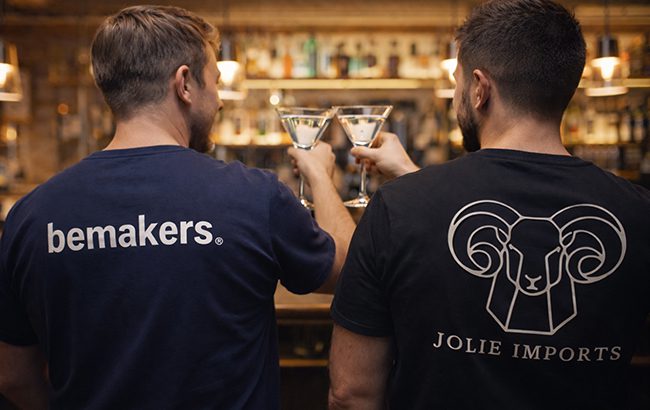
“What we try to offer brands is that they can do the exact same thing with Bemakers. So, a US wine brand could send their products to our warehouse, let’s say in the Netherlands, and store them there. They still own the products – but they can sell locally in the Netherlands. We fix the VAT, the excise, we do all of the compliance as the distributor can, and we help you store your products. Now, with the acquisition of Jolie Imports in the Netherlands, we have also added sales people so brands can now also subscribe to our sales consultants that then go out and sell to the customer. We can offer all three things that a traditional distributor can but the brand can pay for this.”
There’s also no need for producers to convince Bemakers about why they should take on their products. They simply pay the subscription fee to Bemakers to look after the aforementioned trio of responsibilities of a distributor. But the brands remain hands on, and success comes to those who put in the hard work after signing.
Stengaard continues: “With Bemakers you can just ship a pallet to our warehouse. It’s still your pallet. You pay rent, basically, for storing that pallet, and then you can either go out and sell it yourself, or you can use our sales consultants. So you basically fund the growth yourself. But you also have full control. You can do e-commerce or Amazon, but you can also sell directly to restaurants and bars – you could even put a pallet in our warehouse and sell to a distributor in Slovakia, for example.
“The main difference here is brands have much more control with Bemakers, but it also means they have to invest more upfront; in that sense they share some of the risk.”
An added benefit to exploring a distribution model like Bemakers is real-time access to data, Stengaard notes. Another big reward is that building distribution and product demand through Bemakers can lead to interest and listings with bigger, traditional distributors.
“There’s a hybrid world, right, where in certain markets, it makes a lot of sense to go with this importer or distributor, and in other markets, it makes sense to go direct for whatever reasons. So, of course, that’s also what we see among our brand partners,” Stengaard explains.
“To add to that, the good distributors have a huge inflow of brands because exactly that: they are good.
“But to get to the point where one of these guys maybe finds you attractive as a brand, it’s very clever to build it yourself, to get the first accounts going and then at some point, you could switch over from Bemakers, for example, to a traditional distributor.”
E-commerce alone ‘not a strategy’
Stengaard doubles down on the importance of distributors and importers in all guises. With the advent of e-commerce and direct-to-consumer (D2C) shipping in many markets, one might assume the role of distributors could eventually become obsolete.
But it cannot, as Stengaard explains: “Direct to consumer and e-commerce [alone] is not really, in my mind, a strategy. There are very few brands that can be successfully only doing D2C. It simply does not make sense. It doesn’t add up.
“You need the B2B [business-to-business] part as well either via traditional distributors or via a model where you sell directly to restaurants and bars, as we do.
“Then you need the sales consultant because the D2C, e-commerce game is still only 6%/7% of the entire alcohol beverage market. You need omnichannel.”
Neither option is a quick and easy fix for business growth, and Maria Eriksen-Jensen, chief marketing officer at Bemakers, weighs in on this further.
She says: “Brands take responsibility for themselves for basically getting the market started. They can invest and put resources into building from there.
“They do a lot of the hard work themselves. They give a lot of themselves because that’s especially what the trade is asking for. They want to be under the skin [of the brand].
“The brands that are most successful that we work with are realistic, ambitious. There’s dedicated focus, there’s close dialogue, and they take responsibility as well. It’s more of a partnership, working together, sharing insights, and adjusting as we learn new things. It’s a long-term focus.”
She continues: “I’m sure you’ve seen, there has been a lot of brands just building for exit. It never works. But if you’re focused on the journey, on growing the brands for the long term, then you might end up selling at a good price at some point.”
Related news
Beesou expands European distribution