

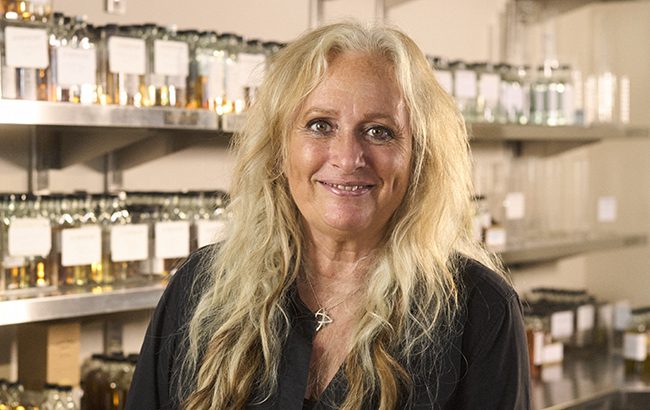
Angela D’Orazio takes Compass Box in new directions
Having made her name at pioneering Swedish distillery Mackmyra, Angela D’Orazio is now creative director of whisky making at disruptive Scotch producer Compass Box. She reveals her plans for the brand.
*This feature was first published in the April issue of The Spirits Business magazine.
For more than three decades, Swedish-Italian Angela D’Orazio has been honing her craft in the whisky industry. Her first gig was a sales campaign for Glenmorangie in 1992, and the rest, as they say, is history.
“Then I went to Scotland to learn more about whisky, and this happens to a lot of people, but I just hadn’t realised how lovely it was,” D’Orazio says. “I fell in love on so many levels. There was so much pride, connection, it was so genuine – and, of course, the flavours were fantastic. So then I became the brand ambassador, and loved my job. I was one of the first brand ambassadors, and one of the first females to do that at that point.”
Some of D’Orazio’s most notable achievements that followed included co-starting the Scotch Malt Whisky Society in Sweden. “In there, I met the Mackmyra people, who started the first Swedish whisky distillery [in 1999], and I started working for them, first doing tastings, a bit of consulting. Then in 2004, I became part of their staff,” D’Orazio explains. “In 2005, we started blending and I was the person in the company who knew about sensory things so it was quite logical that I would take that on.”
Mackmyra was an indisputable pioneer of the Swedish whisky category. Famed for developing its smaller 30-litre cask, designed to mature a more intense whisky flavour, D’Orazio played an instrumental role in the distillery’s establishment in the growing world whisky scene. Her roles at Mackmyra spanned head of development of whisky, and eventually master blender/chief nose officer.
“I continued to work there for nearly 18 years,” she recalls. “I stopped working for them at the end of 2021, and I did at least 80 bottlings for them during those years. That was a great learning period. I had my mentor, Jim McEwan [former master distiller at Bruichladdich]. I had Richard Paterson [current master distiller at The Dalmore]. I was very fortunate to have really good mentors, I could ask a lot of questions.”
Some of her most notable whisky developments included creating Sweden’s first smoky whisky. “Testing all the different kinds of woods that would be available, the difference between peat and old wood; that was really fun,” she recalls. “Then coming to the conclusion that we would add 1% of juniper twigs to the Swedish peat, it came together really beautifully. It just gave that different DNA; everybody could sense, yes, this is peat, but it’s something else.”
D’Orazio was also ahead of the curve when it came to AI. The Swedish distillery partnered with tech giant Microsoft and Finnish consultancy Fourkind to create the ‘world’s first’ whisky using AI. Mackmyra created machine-learning models that were powered by Microsoft’s Azure cloud platform and AI cognitive services, which were fed with the distillery’s existing recipes, sales data and customer preferences.
“It was a very nice confluence of us working in the same offices as Microsoft in Stockholm, D’Orazio recalls. “This was in 2017 and was very much regarded with suspicion. Now, AI is something else completely. I thought it would be a really great learning experience and also cool to do the first AI whisky. You need thousands of parameters to make an AI product, the age of the various casks, the size, was it first-fill or a new cask, and so on.
“So, we did Mackmyra Intelligens AI:01, we released it and people loved it. So we did a couple more batches of that. We had five million clicks because of this, but we did not become extremely successful for one reason: we didn’t have the distribution system. So the years after, when the pandemic came, Mackmyra developed the e-commerce so that they could sell all over the world.”
With the rapid advancement of AI today, could more distilleries adopt technology to create whiskies? D’Orazio contemplates for a moment, and answers: “I had a question from somebody once who wanted me to make an AI whisky for them, but I said, you’ve only made three whiskies. There are too few parameters for it to be valuable. But if you’ve done whisky for a while, have a good track record, a lot of money, you can do a whole AI setup.”
D’Orazio continues about her time at Mackmyra: “We did our malt whiskies a bit more freely because we were not in Scotland, so we could do bottlings that were a bit more outside the box. Since I had freedom to play, I really loved digging into that, being inspired by Scotch whisky at the time, but I could do other things. And that’s also part of what Compass Box has shown me: I like to play on the edge of what’s possible.”
Push the boundaries
Compass Box is where D’Orazio landed last year when she joined the Scotch whisky maker as creative director of whisky making. Founded in 2000, Compass Box set out to explore Scotch whisky more deeply, and push the boundaries of the category.
All of this resonated with D’Orazio, as she explains: “The similarities in the DNA [between Mackmyra and Compass Box], the wanting to do more flavoursome whiskies, wanting to carve new parts – I’ve always admired Compass Box. When I got this opportunity, I couldn’t say no. I love how our new CEO [Nishat Gupte] is listening to us, listening to the market, and creating.”
Scotch whisky, of course, must abide by legal regulations – far more than D’Orazio faced at Mackmyra. However, she is enjoying exploring how to create new flavours and drinking experiences, while balancing tradition. “We have nearly 50,000 casks here at Compass Box,” she says. “We own casks from 90% of the Scotch industry. So we have a vast palette of colours to play with. The challenge is more that innovation should not be for the sake of it, but for the learning, for the greatness of giving away something that you have learned. It has to have meaning.”
Hammer price
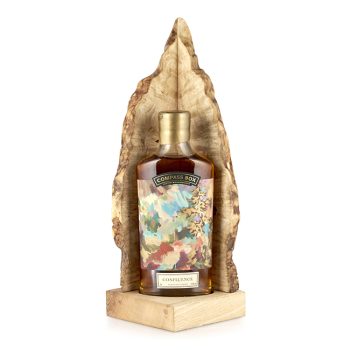
D’Orazio’s expertise in Scotch and Swedish whiskies collided last year with the creation of Confluence. The one-off Scotch and Swedish whisky blend from Compass Box was made in partnership with auctioneer Bonhams. Confluence was the star of the ‘Art & Alchemy of Spirits: Presenting Compass Box to Benefit the Wolfsonian’ charity auction, and coincided with Compass Box’s 25th anniversary. Compass Box Confluence had been forecast to fetch between US$10,000 and US$13,000 at auction, but more than doubled its lower-end estimate with a final hammer price of US$22,500. “The guy who bought it actually opened it,” D’Orazio reveals. “He opened it with his friends and shared it, and he wrote a fantastic tasting note after, and he said it was stunning. What more can I ask for?”
Pleasantly surprised that her whisky ended up in glasses and not just in a collector’s cabinet, D’Orazio shares more about the liquid that went into Confluence. “It was a one-of-one bottle, so I took some of the most amazing stuff we had in the blending room. I was just enjoying myself. Then we had an artist painting that then became the label, we had another wood carving from a craftsman. It was all a work of art.”
Star power
This year also got off to a strong start for Compass Box, which piqued the attention of trade and consumers in February when Jumanji actor Karen Gillan was unveiled as the ‘muse’ of Compass Box’s 2026 Hedonism blended grain whisky. Artist Emma Hack immortalised the Inverness-born actor on the 2026 label, reimagining the original Hedonism woman through a contemporary and layered perspective. It’s a celebration that links back to Hedonism’s launch in 2000 as the ‘first’ Scotch whisky to prominently feature a woman on its label. “This is actually a fresh little corner of the internet where it’s female-promoted without being icky or inauthentic,” D’Orazio says. “Karen really is the Hedonism woman brought to life. It was such a fantastic experience working with her and Emma to bring all of these different styles of art – whisky, design – together.”
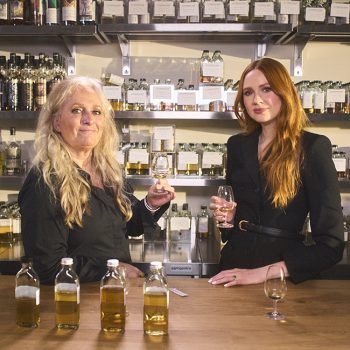
While the partnership became the talk of the town, D’Orazio also champions the liquid blended inside the bottle. The 2026 edition comprises a 30-year-old whisky from Strathclyde Distillery, along with whiskies aged 20-24 years from Port Dundas and Cameronbridge distilleries. Additionally, the blend includes some blended grain parcels and a new Sherry-cask component.
“Even in Sweden, transparency was very important to us. So for me, it feels very natural to share as much information as we can with people who like our whiskies,” she notes in regards to Compass Box’s long-running commitment to transparency in Scotch. “It’s always a very positive reaction. When I go to tastings where I get to meet our customers and their friends, I can show them our tasting wheel, and they can see what type of cask, the percentages, the aroma descriptors, how we have used the cask, the ages of the whisky on the wheel. We’re not allowed to put that on the label, but you can ask and you can read it here.”
Stay focused
Less than a year as creative director of whisky making at Compass Box, D’Orazio, alongside her team, has made exciting strides in whisky. At a time when the whisky industry is facing several global headwinds, she remains focused on and assured about what needs to be done to safeguard the category’s long-term future.
“If I look ahead, I foresee a lot of new whisky lovers who learn about Compass Box and enjoy trying our whiskies,” she notes. “For other whisky companies, I think remaining relevant will be what’s most important – remain relevant to whomever they are targeting.
“To be relevant, and to realise when you’re not, you need to have people at the top who are in contact with that. The old type of boardroom people who aren’t in touch with what’s happening on the ground are obsolete. In these times, you have to be really relevant all the way through.”
Related news
The big interview: Bryan Cranston and Aaron Paul tackle Tequila