

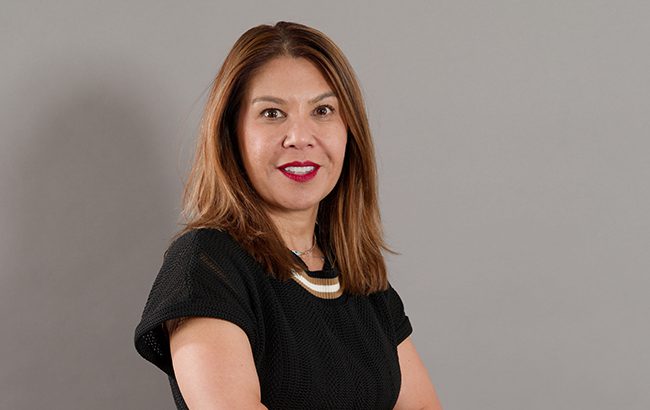
The big interview: Helen Medina on leading the WSA
Helen Medina, the first CEO of the World Spirits Alliance, explains how the organisation is helping global policymakers understand why following the data, fair taxation, and public education are essential to supporting responsible drinking and informed consumer choices.
*This feature was first published in the March issue of The Spirits Business magazine.
“One thing that’s concerning to us is the demonisation of the alcohol industry. That’s something that we want to make sure that we fight against, in the sense that it’s important people realise that we can be part of a balanced lifestyle,” explains Helen Medina, CEO of the World Spirits Alliance (WSA).
In 2023, the World Health Organization (WHO) claimed there was “no safe limit” of alcohol consumption. Then last year, health, wellness and warning label recommendations were once again keenly debated.
The year began with the outgoing US surgeon general, Vivek Murthy, calling for cancer warnings on alcohol bottles. The heated headlines at the time soon simmered down, and the notion seems to have dropped down the priority list under the current US administration, much to the trade’s relief. But Ireland has stated it will move to include warning labels, though the decision on doing so has been delayed until 2029.
But follow the data, and the statistics show efforts across the drinks industry to reduce alcohol-related harm are working. WHO data released in 2025 showed total alcohol-per-capita consumption worldwide dropped by 12% between 2010 and 2022 – on track to meet the WHO’s target to reduce alcohol-per-capita consumption by 20% by 2030, compared with 2010.
Key challenges
This cyclical conversation is one of several key challenges for the WSA, as Medina highlights. The trade association was officially inaugurated in 2019, grouping together an international collective of spirits producers and organisations from around the world to be the common global voice for the distilled-spirits industry.
Today, the WSA comprises 13 spirits companies and 21 national and regional associations. Members include Brown-Forman, Diageo, Pernod Ricard, Suntory Global Spirits, Spirits Canada, the Scotch Whisky Association, and Spirits & Cocktails Australia, to name a few.
“The WSA had been a loose alliance for about two decades, and that was because the spirits industry leaders would come together in Geneva and also host a cocktail for government officials,” Medina explains. “What they realised was that global issues are getting more and more important for the industry to keep an ear to the ground about, and they needed to be able to interact with these government officials not just once a year, but throughout the year.”
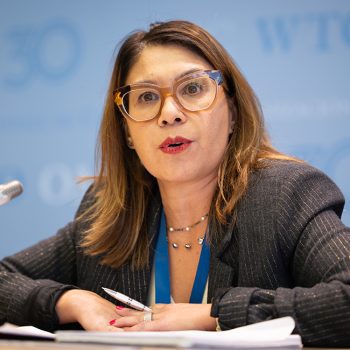
Several years later, and it also became apparent the association would benefit from having a central representative – and Medina was recruited to take up the inaugural CEO role at the WSA, which she started in April 2024. This is her first stint in the distilled spirits space, but her 15-plus years of experience working in global public policy processes made her the ideal candidate for the job. “I’m a global citizen, half-Filipino, half-Greek, and growing up in an American system,” Medina proudly says. “I always wanted to work in a place that was international and focused on international issues.”
She credits her time at the International Dairy Foods Association in Washington DC during the early stages of her career as being a “defining moment in my trajectory”. As associate director, international affairs, Medina’s role involved building relationships with US and foreign government officials to promote US exports, and grow dairy interests in bilateral and multilateral trade negotiations. She also spent nearly nine years as vice-president, product policy and innovation at the US Council for International Business, before landing at Nestlé as senior public affairs manager, government, and multilateral relations.
“The reason why I love [working in global public policy] is because it’s the intersection between politics, economics, and business,” she explains. “When countries come together to talk about trade issues, health issues, or environmental issues, they have to deal with politics at home, and also deal with various economic interests. So, how do you balance all these factors on a global scale? How are governments talking to each other to tackle various big global issues, like the environment and health? And how do you balance politics at home and your business interests, your country’s interests? I find that so fascinating; it’s a truly global discussion.”
Medina’s role at the WSA is two-pronged. Internally, she prioritises creating a space for the members to come together formally to exchange ideas, and listen to their needs. “I also want to understand what they want from me as a chief executive,” she says. “It is learning, understanding what’s happening at a global level, sharing best practices of how to engage, learning what countries are doing to reduce harmful drinking versus another.”
She continues: “The second one is the outward-looking one, which is the role I have in engaging at the multilateral level. Whether it’s the WTO, the United Nations, even the OECD [Organisation for Economic Co-operation and Development]. The private sector has a role when it comes to engaging and contributing to big global challenges, or addressing global challenges. For us, it’s the harmful use of alcohol and tackling that, and for us to continuously be seen as a credible partner in doing that.”
Medina meets with the WSA members approximately every six weeks. She stresses the approach of the WSA is to work on a global scale, rather than nationally. Tackling harmful drinking might be the leading goal of the WSA, but there are many other challenges at play.
“We really elevate the importance of tackling illicit trade because we know that’s a really important issue for the industry,” she says. A 2023 study calculated that fake wine, beer and spirits costs the EU €3 billion (US$3.2bn) in lost sales every year. “It’s thought one out of four bottles [of alcohol] are illicit,” Medina says, speaking about the issue on a global scale, and noting some markets face a more serious problem with counterfeit products than others. It is a big problem. It invites crime, and it’s also serious because, well, people can die from it. There are a lot of health concerns around this. And then governments are not getting taxes. So in many ways, this is the place for us to work with governments and a lot of customs officials to tackle the problem.”
For the WSA, making sure illicit spirits trade remains high on customs and enforcement officials’ priority list is critical. “For example, the OECD, which is the club of 38 countries, they have elevated this discussion on illicit trade and are looking to do more work in this space to find out how governments can tackle it better,” Medina adds.
“One of the things we’re doing in that conversation is making sure the private sector has a role to play in private-public partnerships, to make sure customs officials can learn from the things we’ve learned as an industry.”
The issue regarding fair taxes for spirits and other alcohol is also connected to the issue of illicit trade. “At the WSA, we also talk about the importance of having a tax regime that is fair and appropriate for both the industry and governments,” Medina says. “A lot of tax regimes are what we consider to be not appropriate because sometimes the tax on spirits is much higher than other alcohol products – and that invites illicit trade; that invites crime.”
A study by Oxford Economics and data analyst IWSR on behalf of the WSA showed the global spirits industry injected US$730 billion into global GDP in 2022, and supported more than 36m jobs worldwide. Spirits generated US$390bn in tax revenue, comparable to the intake of a top-20 global economy.
The WSA is keen to highlight how category-based policies, including taxation, can do harm to both the industry and drinkers. With its higher-ABV strength, the spirits industry has often found itself at the higher end of tax levels – but actually, the WSA wants to stress how risks are dependent on consumption levels. Education at all levels will be key to sharing this message, as will the WSA’s ‘Measure What Matters’ campaign.
The WSA wants to shift the focus from ABV to units in a drink. A key example the campaign shares is that a 50ml pour of a 40%-ABV Gin and Tonic contains approximately the same amount of alcohol as a 500ml glass of 4% beer or a 150ml glass of 13% wine.
The WSA hopes that by helping consumers and policymakers to better understand units of drinking, it will be able to counter misinformation about all beverages, and empower people to make more informed, healthier decisions regarding consumption levels, guidelines, labelling and communication. “There shouldn’t be discrimination [against spirits] because there are measures called the ‘standard drinks approach’ in various countries,” Medina explains.
“What we’ve been seeing is people don’t really understand that a glass or wine, or a beer, or a mixed drink have the same alcohol. We want to help people understand that no one option is ‘better for you’; the alcohol content is the same. There’s a lot of education that needs to go into this.”
Medina is proud of the steps the industry is making to ensure it continues championing responsible drinking, and working towards reducing harmful behaviours. “No business wants to have their reputation tarnished. You want your consumers to have a good experience with your product,” she says.
This work will continue for the rest of 2026 and beyond. “Our work this year won’t differ much from the last, which is making sure we are protecting the industry, promoting the industry, and also really promoting its strength when it comes to the global economy, its importance to agriculture, its importance to the social fabric of communities.”
I ask Medina if she could snap her fingers and make one immediate change for the better of the industry, what would it be?
“It’s not one thing,” she replies, “but the most important thing for me is for people to really understand the heart and soul of the industry and the people behind it. Because once you see the craftsmanship, care, the history, and knowledge of the industry, you really understand the hard work these people put into their products, their communities, and how seriously they take the responsibility of caring for their consumers.”
Related news
The big interview: Bryan Cranston and Aaron Paul tackle Tequila