


SB visits… Volcan de mi Tierra
Our most recent pilgrimage to the land of Tequila was to visit LVMH-owned Volcan de mi Tierra and its state-of-the-art distillery in Jalisco, Mexico.
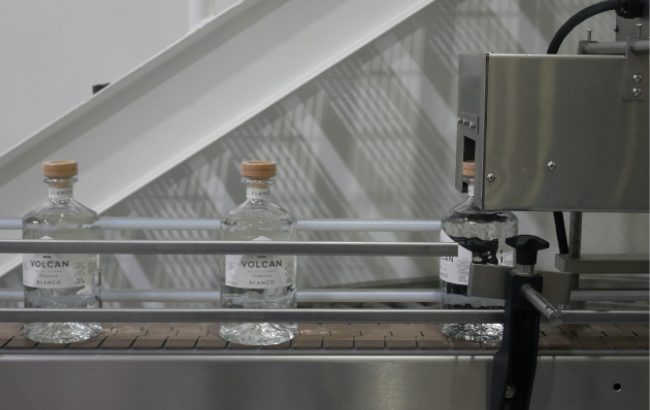
LVMH took on the Volcan brand in a 50-50 ownership deal with the Gallardo family, fifth-generation Tequila makers, in 2016, after they acquired the distillery Nom 1523 in Jalisco.
The distillery is a single Nom, meaning it makes Tequila for Volcan, and Volcan alone. The brand is part of an exclusive club of 20 single Nom distilleries, out of the thousands of Tequila brands floating around today.
Co-founder Santiago Cortina Gallardo, who became CEO in early 2023, was kindly on-hand to play tour guide, as was general manager and chief commercial officer Carlos Pechieu.
LVMH: why? How? The story behind the French connection was explained to us by Pechieu, who said Don Juan, Gallardo’s uncle, met with the French firm’s executives in Paris. Pechieu recalls that through “a very cordial and transparent conversation”, Don Juan queried how LVMH – a leader in luxury with Dom Pérignon and Moët & Chandon in its portfolio – did not have a Tequila. Tequila was the hot thing in the US at the time, so this felt like an oversight on LVMH’s part.
LVMH agreed to get into Tequila with Don Juan under two conditions. The first was they needed to do it together because LVMH is French and therefore lacking the five generations of Tequila-making the Gallardos could call upon, and the second was a mandate to make the best Tequila – “because a luxury brand starts by being a quality product”, Pechieu says.
“In those early days of partnership the agreement was that the family was responsible for crafting a great Tequila and LVMH as partners were responsible for the brand building, strategy and business deployment of Volcan around the world,” he adds.
Gallardo notes the business model has evolved since: “The actual story is we’re not in it for a quick buck either because it could be seen as an opportunity of, ‘Hey, let’s sell this to MH [Moet Hennessy] as soon as we can, scale and get out of it’; no. The family is 100% responsible for every decision made through the process.
“Volcan is uncompromisingly crafted Tequila that pays homage to the Tequila Volcano that gives name to the region, to the spirit, to everything my family has been around since 1774, and a commitment to talking about an undiscovered Mexico.”
The term ‘additive-free’ currently takes up much of the Tequila discourse, but Pechieu would rather steer the conversation to the idea of craftsmanship: “There are more and more consumers in the US recognising additive-free as a standard of better quality, right or wrong, or at least there’s more of an appetite from the consumer to drink additive-free Tequila.
“Our view is that it’s not enough to be additive-free, and that’s why we want to promote the story of crafting our Tequila,” he says.
Walking the fields
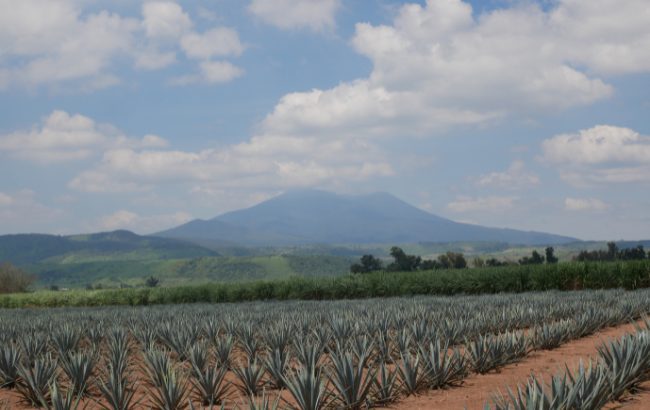
As the sun was out (not a guarantee, as it had their rainiest season in a long time in 2025), Pechieu led us to Volcan’s agave plot, which sits in view of the Tequila Volcano. The volcano’s eruption some 200,000 years ago left much of the valley in prime shape for growing Blue Weber agave and its soil is dispersed with traces of obsidian rock.
Pechieu points out that not all of the land in Jalisco has the right minerality to plant agave though, with Volcan’s maestro tequilero, Marcelino Lucke, in constant monitoring mode: “That is why our Blue Weber has a beautiful blue-green colour to it,” he says, also noting that Volcan doesn’t harvest in the rainy season as there’s too much water in the land and the piñas are swollen.
Regarding the distillery’s best Tequila mandate, like a good restaurant, Volcan first needs to get the best out of its raw materials. Volcan procures its agave from both the highlands and lowlands of Jalisco, which form its trademark blend and flavour profile. “In expressing what Tequila is about, we couldn’t just focus on one or another, so we thought to blend the two,” Pechieu explains.
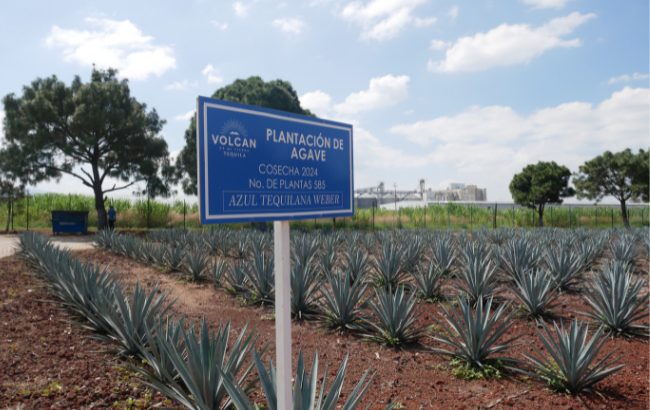
Volcan’s distillery is located in the lowlands (the highlands is a three-hour-plus drive away), so the team have recreated the two terroirs in separate plots due to the specific differences in soil. The highlands is softer and richer in iron for a sweeter profile, while the lowlands is darker volcanic soil, richer in minerals for an earthier profile.
Pechieu stresses the importance of treating the plant during the jima process, or the harvesting of the agaves. He says six to eight years is the usual timeframe for Blue Weber harvesting, but Volcan doesn’t get tied up in this. “It’s not just about the size and getting kilos, it’s about the maturity and quality of the plant – and making sure we have the right level of sugar content [from 32% to 36%],” he says.
The agave our group walked among had just finished its first cycle and were planted less than a year ago. When asked how Volcan always ensures it has always new agave, Pechieu calls forecasting a delicate and tricky thing. “You need to forecast today how much you will need to buy in six years, which means you need to know how much you’re going to be selling next year. You cannot buy if you’re not selling,” Pechieu notes.
Inside the facility
As deep as Pechieu could have gone into the agave harvesting hole, it was getting hot. So, after the mandatory poses for photos with the volcano in the background we were taken under cover for the production part of what makes the brand tick.
As you’d expect from a Hennessy-backed venture, the facility is an impressive specimen. The distillery is operating at 30% of its capacity and ships nearly 50,000 nine-litre cases annually. There are 240,000 cases ready in waiting for the right markets, and Gallardo believes Volcan is one of the few Tequilas that can “really scale consistently”.
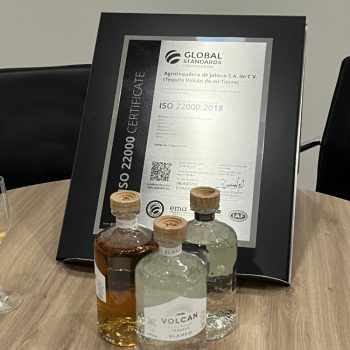
At Lucke’s insistence, the distillery is also ISO-22,000-certified. The audit is a big deal in the food industry, though distilleries are not normally subject to it. Gallardo says obtaining the stamp was “very complex”, but it offers traceability and the platform for consistent scaling.
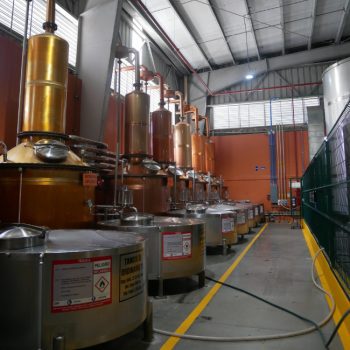
The distillery has three hornos (traditional brick ovens) and two autoclaves (modern stainless steel tanks). Whether the piñas go old school or new school depends on their origin. If it’s from the highlands it’s the autoclave; for the lowlands it’s the hornos. Highland agave is said to be more fruity and floral, even peppery, while the lowlands brings minerals and spices to the fore.
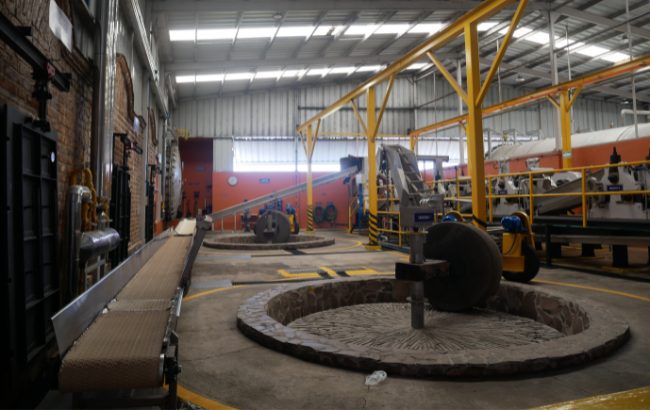
This sets the stage for the brand’s blanco, which is like no other – a blend of three different blanco liquids that also each provide a base for everything else the distillery does. One is Lowlands agave roasted in a horno, pressed through a roller mill and then fermented in stainless steel tanks; the other, Highlands agave cooked in the autoclave, pressed through the roller mill and transferred to the steel tank for fermentation; and the third, slow-cooked, or just steamed in the horno for 24-36 hours, then crushed via a tahona wheel before heading to open-air wood tanks for fermentation.
Everything is double-distilled at 55°C in one of the site’s 17 copper stills, hand-built at the distillery – “best stills in the industry”, as Gallardo says proudly – with the three liquids lastly blended together for the final blanco.
While the initial idea for the blend came from Ana Milena Romero, a well-known figure in Tequila who was quality assurance manager for Volcan in 2016, Lucke has since come in as maestro tequilero (master distiller) to execute and perfect it.
Unlike many in his position, he doesn’t hail from a long line of Tequila makers that stretches back hundreds of years. Lucke previously worked for PepsiCo in Mexico, which Pechieu believes has been advantageous for Volcan. “He came here with a very unbiased approach to Tequila-making, with no old habits or established behaviours in making Tequila more efficient, or more tricky,” he says.
This ties into Volcan’s vision for Tequila. “We had a white canvas from LVMH,” Gallardo says. “The blends are used across the entire portfolio, meaning we have different agave – Highlands and Lowlands – that by itself gives you a different profile. We have different cooking or processes. We built it purposely incorporating different terroir and different processes in the craft world, and then in different oak in the blends. That is unique. No one else is doing this today.
“I sometimes think we like to just complicate our lives,” he says jokingly, but with a sprinkle of truth.
As a side, Volcan does offer a Tahona Blanco for the purists. The volcanic stone wheel might yield less liquid than modern milling machines but “the purity is insane”, we’re told. “It stays in the mouth for way longer, it is very rounded, complex and the acidity that you get is crazy,” Gallardo says.
Ageing and tasting
The next stage of the tour would lead us down a tunnelled path to the distillery’s cellar, revealed dramatically via a huge sliding wooden door by the hornos.
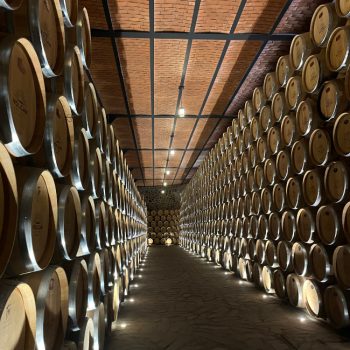
The ageing room is lined with thousands of new American oak and European oak barrels. Ex-Bourbon barrels are common practice in Tequila, but Volcan uses fresh first-use barrels. “When you make tea, after you use the bag once you can still get a good tea, but you need to keep it in for longer,” Pechieu explains. “Often in the world of Tequila, you don’t only buy the used cask, but you use it thousands of times, by which the cask gives you almost nothing.”
This makes Volcan’s reposado bolder and darker in colour than the average reposado, appealing to whisky, Cognac and even rum drinkers. The reposado will be a focal point for the brand in 2026.
Volcan also doesn’t age from its blanco blend. Its reposado features Highland agave aged in both American Oak and European Oak, its X.A (Volcan’s prestige Tequila) features Lowland agave aged in reposado, añejo, and extra-añejo and its cristalino features lowlands agave aged in American oak before charcoal clarification. The latter is also finished in Cognac casks for 15 days to recuperate what was lost in the filtering process.
Gallardo also highlights the significance of diluting before they age. “It makes it a lot more expensive, but everything we put in casks is at 43% ABV. We don’t put the liquid in the casks at 55% because if you don’t dilute in the moment, you lose most of the profile.
“It means you need a lot more casks to age if you’re doing it this way because, depending on the period of time in the cask, it’s going to lose a bit of ABV. The dilution is done with reverse osmosis water, which doesn’t affect the profile at all.”
We also previewed the brand’s yet-to-be-released añejo (to be trialled for Mexico duty free this year, with a potential wider rollout earmarked for 2027). “I think it’s about time we have an añejo that wasn’t the añejo cristalino in the lineup and see what we do with it,” Gallardo remarks about the expression.
Also spied was the distillery’s special cask-finishing programme, which had names in Glenmorangie and Ardbeg attached to some of the steel tanks, indicating more cross-collaboration from the French company.
Now involved in Formula One and fine art (the brand released a marble Tequila bottle in December), Volcan wants no part of the piñatas and plastic red sombrero hats, or the salt, lime and shot culture of past years.
“We wanted to get away from what is Mexican cliché at its best,” Gallardo says. “Mexico has evolved in sophistication where you have some of the best bars and most amazing restaurants in the world.”
The team has a tagline, ‘Tequila should taste like Tequila’, which Pechieu heard “some guy” say once, looking at Gallardo.
“The first time I heard that I thought, ‘That’s the silliest thing I have ever heard’, but to give him some credit, this is how many brands think now, and Volcan is what we believe Tequila should truly taste like,” Pechieu reiterates.
Related news
Has Tequila peaked in travel retail?