


Are NFTs still relevant to the spirits industry?
Digital technology is being used to maintain the integrity of the supply chain in the spirits industry – without a single ape cartoon in sight.

*This feature was originally published in the December 2025 issue of The Spirits Business magazine.
In 2021, rarely a day went by without a news story about cryptocurrency or non-fungible tokens (NFTs). And while crypto bros may not want to admit it – heaven forbid their cartoon ape loses all value – interest has certainly cooled since then. While the spirits industry isn’t always on the ball when it comes to technology, in hindsight, its slower approach to NFTs may have been a blessing.
Patrón, Hennessy, and Johnnie Walker released NFTs in 2022, all partnering with online marketplace BlockBar. The platform allows consumers to choose between owning a physical bottle authenticated digitally, trading a digital-only asset, or storing their purchase in a virtual ‘bar’. For those hoping to collect limited edition bottles without any plans of drinking them, the service streamlines the purchase, sale, and certification processes.
While these may have been released at the peak of NFT mania, the sector has quietly continued exploring its digital options. Last month, Suntory’s Bowmore Distillery sold a single bottle of its rare ARC-54 series via NFT. Priced at US$120,000, the release included both a digital bottle and a physical one, the latter of which was fitted with a near-field communication (NFC) tag. This would signal when the bottle had been opened, and allow the owner to then claim a proof-of-consumption NFT.
Digital solution
While these launches grab headlines, ultra-rare – and expensive – NFTs aren’t particularly relevant to the majority of spirits brands. However, London-based platform Proof 8 believes the blockchain can be used as a practical, purpose-driven digital solution.
Rather than hyped-up NFT bottle drops, the company focuses on connecting physical assets – such as whisky casks – to their digital counterparts in a practical way. Proof 8 co-founder Nimantha Siriwardana explains that this can be done in a number of ways – whether by using NFTs, NFC tags, or using radio-frequency identification (RFID). However, in his experience, whisky warehouses aren’t a great environment for these options – the liquid can absorb the signals, making them difficult to scan. “We’ve gone with the most pragmatic way of tagging these barrels, which is to use a QR code,” he explains. It might sound lo-fi in comparison with flashy NFTs, but practically, the QR code can be stapled to the barrel, making it long lasting. “These other kinds of new tagging technologies make it very difficult to ensure that the tag actually works for the length of time we need it for,” he adds.
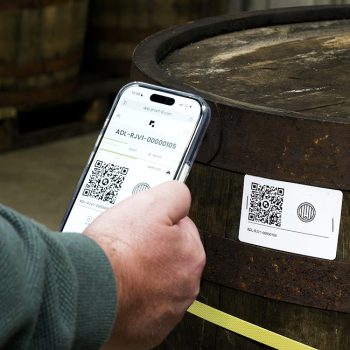
Once a barrel is tagged, it has a digital twin with a unique identity – much like an NFT. Where it differs from an NFT is how and when the digital identity is created.
“Typically with NFTs, you’d mint, like, 10,000 pictures of monkeys or whatever,” Siriwardana explains. “We obviously don’t have monkeys – we have barrels of whiskey.” Proof 8 takes the practical route: when a distillery fills a barrel, it issues a digital identity through its inventory-management system, which the distillery uses to manage its warehouse.
This approach keeps the technology behind the scenes. “If you take a distillery manager or operations person, what are they going to know about blockchains and minting NFTs? It’s a completely different world,” he says. “We hide that complexity behind the management platform.”
While the company began with casks, Proof 8 has experimented with bottle ownership, using NFC tags to link individual bottles to tokens on the blockchain. But Siriwardana believes the cask-level approach lays a stronger foundation for distilleries, enabling future features such as fractional ownership and enhanced traceability.
Ultimately, he says, Proof 8’s goal is to create trustworthy digital records anchored by the “source of truth” – the bonded warehouses and distilleries themselves. “If you’re operating a bonded warehouse, you’re doing all the reporting for HMRC, you’re the trusted party. That’s who we work with,” he explains. “We start by ingesting their existing inventory, creating the digital assets, and as they fill new barrels, new digital deeds are automatically generated.”
That focus on practicality, says Siriwardana, is what separates Proof 8 from the NFT boom that dominated headlines a few years ago. “One of our original investors predicted that about 99.9% of the NFT projects that were coming out around that time would go to zero,” he recalls. “All those things were just real hype-cycle stuff.”
The problem, he says, wasn’t the technology itself but how it was used. “The real pity is that the underlying technology is super-useful, but people really didn’t cotton on to how to use it properly.”

Eoin Bara, founder of digital infrastructure firm Tipple, agrees that digital technology – whether NFTs or a digital twin model like Proof 8’s – can be great for whisky cask ownership. “It’s clear and transparent, it can’t be modified, and it replaces paperwork,” he says. However, he’s less convinced about the benefits of using an NFT as a certificate of authenticity for bottles. “I’ve seen counterfeit bottles of rare whisky – it happens a lot at auction houses, even when they’re certified,” he explains. Where NFTs fall down for authentication is if someone owns a real, rare bottle, but then drinks it or empties it. The bottle is still certified by the NFT, but the liquid is long gone.
He thinks a more interesting use of digital technology for spirits lies in NFC tags, and points to a company called Departmnt. Although not limited to spirits, Departmnt attaches NFC tags to products, and they can’t be copied or counterfeited. The benefit is that NFC tags can be used to provide information about a product – including a Digital Experience Product Passport, which can display details about ownership, authenticity, and history.
But his main problem with the NFT conversation is that people are purely interested in the hype, without considering the practicalities. “NFTs attract global interest, but nobody considers the infrastructure of how to get [the product] to those places – and that’s where we come in,” he explains.
While it might sound less sexy than a shiny digital asset, Tipple handles things like tax and compliance for alcohol brands, and operates bonded warehouses around the world, from New Jersey to Paris and Amsterdam, with one coming soon in Australia. That means it’s able to legally and safely get those bottles from seller to purchaser – a part of the journey that is often forgotten by NFT fanatics.
Bemakers is another company hoping to demystify the direct-to-consumer (DTC) journey, with its CEO arguing that the biggest challenges for brands selling online are regulatory. “The first issue is compliance across markets, which means reporting and paying excise duty when selling online,” says CEO Morten Stengaard. Digital sales traditionally required a distributor, adding cost and complexity. Removing that dependency is often the key to healthier margins. “Regulation changes constantly,” he says, adding that recent changes include the extended producer responsibility scheme in Denmark, potential updates to VAT in Switzerland, and revisions to the pricing model in Swedish alcohol monopoly Systembolaget. “If a single brand were to stay up to date on all of this, it would require a very large team (or deep pockets) to be compliant. This is what we solve, and is part of the core of the Bemakers distribution platform and infrastructure.”
The second issue is that once a brand is compliant, it still needs to be visible. “Building a profitable DTC [direct-to-consumer] channel takes time, patience and resources. It cannot be achieved in isolation – a brand is not built online alone,” he explains. No matter how digital the path to market becomes, “liquid to lips will always be a key element of any successful go-to-market strategy”.
No magic wand
Bemakers offers brands a licence to operate across borders, paired with alcohol-specific e-commerce infrastructure, Shopify integration, fulfilment support, logistics, and customer service. “We don’t provide the magic wand to open up a revenue stream, but we provide the toolbox and instructions so brands can get going,” he says. “Ultimately, the game changer is that we are enabling this through technology, ensuring workflows are automated and made scalable.”
Stengaard says established producers are increasingly embracing DTC as they look to regain control over brand positioning and price. “The more established brands are seeing that getting close to the end customer is key,” he notes. Hybrid models, where distributors remain part of the mix but work with brand-owned DTC channels, are becoming more common. But for many, direct distribution is still unfamiliar territory.
That said, Stengaard doesn’t believe DTC will replace retail. “Multichannel is the way forward; channels complement each other,” he says. And the speed of digital adoption varies widely between markets, particularly those with alcohol monopolies. What’s clear, though, is that the long-term future of spirits commerce will blend online and offline rather than choosing one over the other.
Related news
Laser technology could combat deadly fake alcohol