


Trade tensions tank Brown-Forman’s Canadian sales by 61%
Jack Daniel’s owner Brown-Forman has continued to feel the effects of Canada’s removal of American spirits from stores as second-quarter (Q2) sales plunged by 61% in the market.
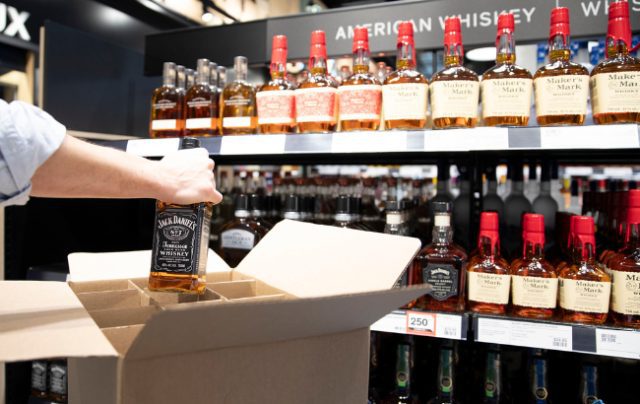
During the three months ended 31 October 2025, Brown-Forman saw organic sales drop by 2% to US$1 billion. It followed a first-quarter increase of 1%.
For the first half (H1) of the group’s fiscal 2026 (the six months to 31 October), the company’s reported sales fell by 4% to US$2bn but were flat on an organic basis.
Lawson Whiting, Brown-Forman’s president and CEO, said the group’s H1 results “unfolded largely as we expected”.
He pointed out that the firm’s Q2 sales “reflect a continuation of the themes we saw in the first quarter”.
The Canadian market suffered a 61% organic sales drop after American spirits were pulled from shelves in most Canadian provinces due to trade tensions.
Brown-Forman’s biggest market, the US, was flat in terms of organic sales for H1, which it attributed to lower volumes of the core Jack Daniel’s and its Honey flavour, and Herradura Tequila.
The UK, the second-largest market for Brown-Forman, was down by 13% during H1.
France and Germany were also in decline, falling by 2% and 8% respectively, over the six-month period.
Australia, on the other hand, managed to grow by 1%, while the ‘rest of developed international’ markets were up by 3% in H1.
All of Brown-Forman’s emerging markets were in growth (up by 12%) except for Poland, which was flat. Emerging market growth was led by double-digit gains in Brazil (up by 21%) and Mexico (up by 18%). Turkey posted growth of 8%.
Sales in the travel retail channel rose by 8%.
RTDs up as whiskey and Tequila struggle
In terms of brand performance, both the flagship Jack Daniel’s Tennessee Whiskey and the Honey flavoured variant declined by 6% in H1. The core Jack Daniel’s whiskey was impacted by lower volumes in the UK and Germany.
The apple-flavoured Jack Daniel’s managed to grow by 14% but the Tennessee Fire line extension decreased by 8%. The higher-end Gentleman Jack whiskey was flat.
As a whole, the Jack Daniel’s family of brands fell by 2%. The group’s total American whiskey portfolio was flat.
Meanwhile, in terms of premium Bourbons, Woodford Reserve grew by 6% and Old Forester rose by 2%.
The ‘rest of whiskey’ portfolio soared by 54%, which includes brands such as Slane Irish whiskey, and Scotch whiskies Benriach and Glenglassaugh.
Brown-Forman’s Tequila sales decreased by 3% due to a 11% decline for Herradura in a ‘competitive’ US market.
El Jimador Tequila rose by 2% as a result of higher volumes in Colombia and an increase in distributor inventories in the US.
The ready-to-drink (RTD) business saw a 5% increase after Tequila-based New Mix soared by 30%. New Mix was led by growth in Mexico where it gained share in an ‘accelerating category’.
However, the Jack Daniel’s RTD portfolio fell by 4% due to their removal from Canadian retail shelves.
Brown-Forman recently spotlighted Mexico as a key growth driver for RTDs, according to its Americas vice-president.
The ‘rest of portfolio’ division – which includes Gin Mare, Diplomático rum, Chambord liqueur and Fords Gin – increased by 22%.
Gin Mare performed well, rising by 33% in H1, while Diplomático grew by 12%.
Organic sales of ‘non-branded and bulk’ plummeted by 61%, driven by lower used barrel sales. This division includes used barrels, contract bottling services and non-branded bulk whiskey.
Fiscal 2026 outlook
Brown-Forman expects challenges to continue for the rest of its fiscal year, citing ‘low visibility due to macroeconomic and geopolitical volatility’.
The US firm said it faced headwinds from consumer uncertainty and lower sales of non-branded used barrels.
Brown-Forman stressed that it would ‘unlock future growth’ through its US distribution shake-up, restructuring initiative and product innovation.
For fiscal 2026, the company expects both organic sales and operating income to decline by low single digits.
In January this year, Brown-Forman reduced its 5,400-strong global workforce by approximately 12% and announced it would close its Louisville-based barrel-making operation.
The site was purchased by the Independent Stave Company for US$13.66 million in June.
Related news
‘Good day for Scotland’: US lifts tariffs on Scotch