


The Busker: ‘next year we go up another gear’
The Spirits Business dropped by The Busker’s home in Ireland to chat with head blender David Elder about the Irish whiskey brand’s plans ahead of its ‘new journey’ in 2026.
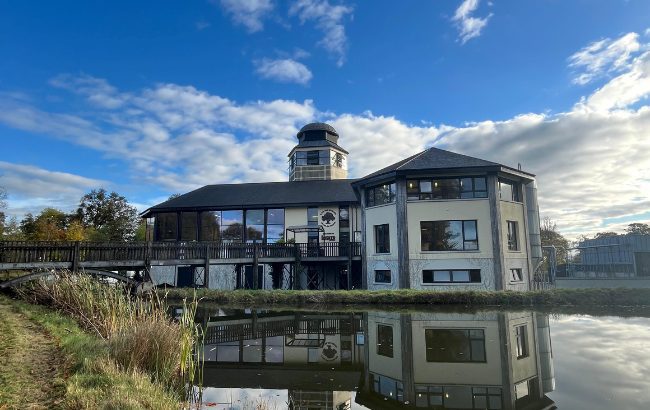
“Next year is one of those years whereby everything really starts to get exciting,” The Busker’s head blender David Elder reveals on a trip to the brand’s home at Royal Oak Distillery in Carlow, Ireland.
Elder was on-hand with The Busker’s global brand ambassador Woody Kane to explain – and demonstrate – how this relative newcomer in Irish whiskey is making a name for itself in the category, populated by historic giants like Jameson.
The Busker is unique in that it distills, matures and bottles the country’s three main styles or Irish whiskey all under the same roof at Royal Oak – single grain, single malt and single pot still.
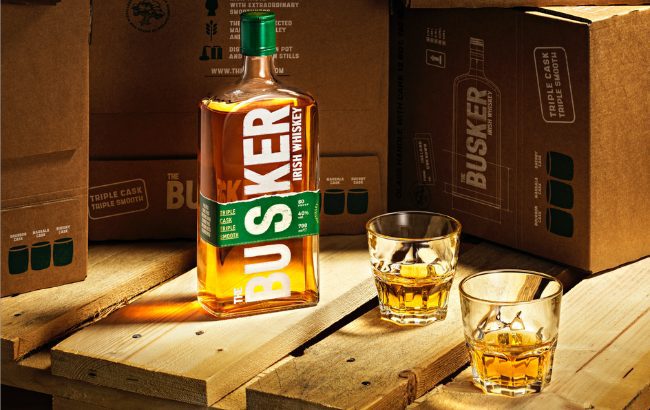
The brand is also known for its trademark blend, The Busker Triple Cask Triple Smooth, which combines the three styles together and matures them in a three-cask combination of Bourbon, Sherry and Marsala. The first two are widely used in Irish whiskey, but the latter not so much.
The brand sources its Marsala casks from the Cantine Florio vineyards in Sicily, Italy, which it does its though parent company and the winery’s owner Illva Saronno.
The Royal Oak Distillery became operational in 2016. “It was 22 March – Easter Sunday – when the very first liquid flowed from the stills,” says Kane, to be precise.
The distillery is located near Kilkenny, the birthplace of Irish whiskey on account of it containing the first record of distillation in the country (as per The Red Book of Ossory). Though there’s plenty of heritage and tradition woven into the area, as a new and modern brand, Kane notes they operate under no pretences – no old stories of yore with generations of distilling.
“If you go back in the past of anybody who’s Irish, you’ll discover there was always a distiller in the family – legal or illegal,” he jokes.
“Our focus is we stand on the shoulders of the giants that went before us that had made whiskey from the get go, like how whiskey started off here in Ireland – and that’s been accepted now due to the oldest reference in the whole world now coming from Kilkenny.”
Is Irish whiskey on the comeback trail? Elder says: “I think you’ve got to look back in history and understand that the Irish were probably leading the whiskey industry in the early 1900s. Unfortunately, we lost out when Prohibition happened, so the Scots took over. But the renaissance piece is over and we’re coming for everything.”
Coming of age
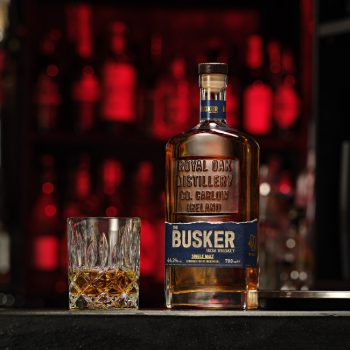
The Busker was introduced to the market in 2020. There are now approximately 70,000 casks maturing in Royal Oak warehouses, and the brand has sold 140,000 cases so far – with an achievable output of 450,000.
In total liquid terms, it can produce two million litres of pure alcohol a year.
“When we talk about the innovation for the Busker, the journey has already started,” Elder says.
Elder joined the brand as head blender in April 2024, following years as distillery manager at Bushmills where he also oversaw the development and progress of Conor McGregor’s Proper No. Twelve.
“On the history side of things, we’ve developed and set down what we have, with the casks and different finishes and all the rest of it, but ultimately, I’m looking towards exploring age statement releases,” he explains.
Elder says there are long-term plans in place for beyond 2035. “What I see happening within 2026 and 2027 is that those exciting projects that I know we have started, will now start to come to fruition,” he adds. “Not to give away too much away.”
As the brand is entering its next evolution, Elder is excited for its single malt journey. “We have our standard products and Busker is a great base point of a whiskey and provides so much flavour into what it delivers, but single malts do provide an edge in regards to being really perfect.
“We’re looking at what can we do now? Where does the age profile start, what finishes can we look at, and what case numbers can we achieve? That journey already started two years ago and is what we’re going to continue on for the next number of years.”
Illva Saronno support
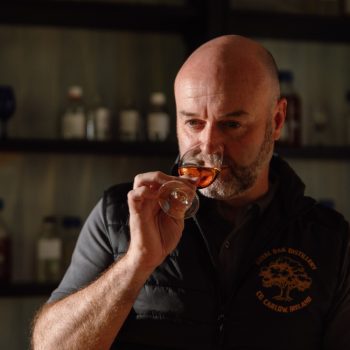
The brand is owned by Illva Saronno, who assumed sole ownership of Royal Oak Distillery from former joint owner Walsh Whiskey at the start of 2019.
Having the Italian firm’s infrastructure behind it opens up more than a few doors, including being able to use the firm’s rare Marsala casks for finishing. “We can develop that further into different categories, be it grain or single malt, so that’s a fantastic piece,” Elder adds.
Then there’s the financial muscle that Illva Sarrono brings. Elder details some of the backing that the brand has been afforded. “In 2021, we were able to approach Illva Saronno and seek further investment of another €6.5 million to upgrade the plant and also bring in automation,” he says.
Since Covid, materials and costs of wood have risen, but Elder maintains Illva Saronno has allowed it to continue its cask programming as usual. “There are not so many distilleries out there as lucky to have a group behind them who are willing to invest continually in the future.”
He also touches on how receptive the company has been to his ideas. “When I’m looking for casks and cask investments, I’m putting down what I’d like to do, the numbers of casks, and also putting down the value behind that. The wonderful thing is that they’re saying: ‘Great, go for it’.”
To add to that, the benefits of working with Illva Saronno goes beyond drinks expertise. “They’re also a food business,” Elder highlights. “And they’re also an ingredient business, so we have the ability to lean on a team that’s already part of an innovation and new product development programmes for ingredients and foods – and that really help us whenever we want to reach out and think differently.”
Housekeeping
While The Busker has world-class whiskey-making equipment at its disposal at Royal Oak – with three pot stills and four columns stills – alongside the advanced tech is a commitment to its surroundings that the team wears with pride.
In the drive up to Royal Oak, the barley fields, crops and ponds en route all play a part in production – everything that is used for the brand’s whiskeys is from within a 30km-35km radius of the distillery. The idea is to keep things as local as possible.
The distillery’s water source is the natural Barrow aquifer, located directly under the distillery, which is said to be the largest underground lake in Leinster. To save on the amount of natural water it has to use, the distillery installed a cooling tower in early 2022, which created a closed-loop system that recirculates water to be cooled and reused.
The brand doesn’t use maize, a common ingredient in Irish whiskey (Elder explains that the climate at the distillery’s location isn’t the best for maize), and instead it uses local wheat. In fact, all grain it uses is local and Irish. It gets its malt from Minch Malt, which has been running since 1847 and is considered the country’s oldest malt producer. The barley is sourced from the fields around the distillery.
“The great thing is that we actually sit within the bread basket of Ireland when it comes to being able to produce grain,” Elder says.
He also notes the brand is certified under international organisation for standardisation (ISO) standards “First and foremost within our journey we started with those standards,” he says.
Royal Oak Distillery officially joined Bord Bia’s Origin Green Irish sustainability programme this year, allowing it to build sustainable goals around energy, carbon footprint, and waste management.
“It also helps us with biodiversity,” Elder adds. “We have our own little biodiversity happening around the distillery. There’s the E-pollinator and forestry programmes, whereby for the latter we have a reporting mechanism within the trees – our natural habitats. We have champion oaks on the site that we’ll continually monitor to make sure those are still growing and there’s no diseases – that’s very important to us.”
Some of the trees are estimated to be around 250 years old.
“These are elements that we hold dear in terms of driving quality,” Elder emphasises.
Popular in Japan
Elder names Japan as a bright spot for the brand away from home, after Irish whiskey exports to Japan rose by 35% in 2024.
The Busker has carved out its own fanbase in the country. In an interview with SB back in July, Illva Saronno’s CEO Marco Ferrari revealed it is the fifth-largest Irish whiskey brand in Japan.
“Triple Cask Triple Smooth is selling phenomenally within Japan,” Elder says. “But the single malt is right behind that, and then it’s the pot still.”
The Busker is launching a limited edition of its single malt in Japan in collaboration with Aeon, one of the country’s biggest retailers. Elder believes the brand’s single malt success in Japan is helped by the prestige and familiarity of the ‘signal malt’ phrasing. “It has almost a universal understanding,” he says.
Additionally, during our tasting at the distillery, Elder identifies another reason: how well it links up in a Highball.
“The triple-cask, triple-spirit style of whiskey that we’re using, and its lightness, provides a greater backbone on the Highball than most of our competitors,” he feels.
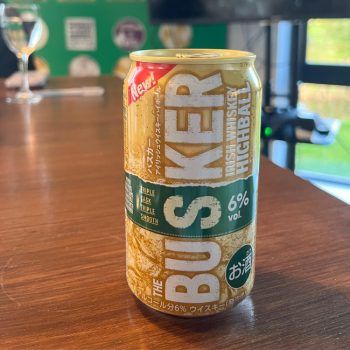
Speaking of Highballs, outside of the big bottles, the brand has entered the canned Highball game in Japan, like other Scottish companies such as Douglas Laing, with its Big Peat Highball, and Bruichladdich with The Laddie Highball – both taking cues from the Suntory playbook.
Last December, the brand released Highball cans in Japan at two different ABVs, 6% and 8%, in collaboration with convenience store chain Lawsons.
“500,000 cans were produced for the launch, but they were gone within a month,” Elder says. “So we’ve created a demand for something [and] we now got sales into a position to allow growth, and backfill it into making sure that the teams have something that will continually reach the market.”
He believes this is a win-win scenario for the brand: “When you create such a demand for something, and all of a sudden you need the supply to catch up – I love that. What’s great for us is that we’re actually feeding into one of the markets that’s really high within the ready-to-drink segment.
“Japan and Asia is our real ‘go to’ at the moment. It’s not to say that we don’t want to take over the US like anybody does, but we’ve ultimately proven ourselves in the Asian market to where we can stand up against everyone.”
New chapter in 2026
“I think from a Busker perspective, we’ve got to highlight the Busker blend in itself,” Elder responds when asked how best to sell Irish whiskey. “It’s a unique case in the fact that it’s got the three main whiskeys in there. It’s got grains, pot and malt, and it comes together as a blend.”
Pot still will always be the poster child for Irish whiskey, with Elder noting: “It’s important to educate people about the Irish pot still, what it means for people, the ingredients, the recipes, and really the uniqueness about the mouthfeel in and around what a pot still is.”
However, The Busker is coming at from a different angle, with its big selling point being that it is home of the three spirits being produced, a process that gives Elder and the team full control over the creation of the whiskeys.
“The uniqueness of what we are is triple-distilled, triple-cask, triple-spirit coming through within the Busker Blend,” he continues. “The Busker Blend and our single malts deliver exactly what they need to do, because Irish whiskey, and in particular for Royal Oak, is a triple-distilled fine-art sort of spirit that then gets a lot more wood interaction for us and how we’re finishing those spirits, and then blending them together to basically produce single malt.”
To conclude, Elder reiterates next year is when fans can expect the brand to really go up another gear.
“We get to press buttons on the capital investment programmes from Illva Saronno, as we start to look at the investment for Royal Oak. What will build upon that will be further investment into what we can achieve on-site.
“That means seeing if we’re able to turn ourselves into that brand home experience. We do have that, but we’re now looking to develop that even further.
“2026 will start to see a change for us – in opening up channels, working with the global marketing team from Illva and spreading out what we can do.”
Related news