

How art inspired Paradiso’s new cocktail menu Oltre
Giacomo Giannotti explains the curiosities behind Barcelona bar Paradiso’s latest menu, which approaches cocktails through surrealism.
Barcelona-based cocktail bar Paradiso has unveiled its first menu in two years with Oltre, which takes after the Italian word translating to ‘go beyond’, founder Giannotti tells The Spirits Business.
Inspired by Spanish artists like Salvador Dalí and Joan Miró, and the surrealist, dreamlike worlds they are known for creating through their work, Giannotti also intends to capture a similar immersion in Paradiso’ latest menu.
“There’s a lot of connection with art in Spain, especially here in Catalonia where we have artists that play with the surrealist dream spaces of our brains, like Dalí and Miró,” he says. “We always want to push creativity and the wonders of the cocktail scene. I see every menu we do as a step forward in our style with technique and the proposal of our cocktails.”
The menu features 18 new cocktails, four of which are non-alcoholic, to go alongside seven of the bar’s mainstay serves such as the Super Cool Martini. The concepts, glassware and ingredients were collaborated on with local artists, artisans and producers across Catalonia.
Giannotti says Oltre’s development began last August, making it a 10-month turnaround for the menu to surface at the venue itself, which was named the World’s Best Bar in 2022.
Paradiso currently sits at number four on the annual ranking and was also awarded two pins by The Pinnacle Guide when that list launched in 2024.
The first four months of Oltre were mostly meetings about the concept and research and development, connecting surrealism with traditions, and then bringing glassware and techniques into the fold.
From here, meetings every week analysed the prototypes, and then work started on the recipes and ingredient selection before the menu was ready to launch at the beginning of June.
He adds: “This is our eighth menu in 11 years. Getting a return on investment for research and development (R&D), where we spend 10 months on a menu, it should be available for at least 18 months. There is a lot of work, but this is part of the core of Paradiso, pushing creativity, and so if you want to make something new, you have to invest.”
Cocktails
Of the new cocktails, a headline serve that Giannotti highlights is the Piccolo e Grande, which was made in collaboration with culinary innovation centre Food Lab Barcelona.
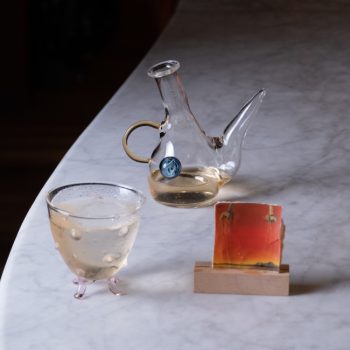
The cocktail combines Tanqueray No. Ten Gin with St-Germain, Campari, manzanilla Sherry, fig leaf soda and clarified grapefruit juice and is served in a hand-blown vessel, alongside an edible rice paper 3D-printed with imagery of Dalí’s The Elephants painting.
“In Italian Piccolo e Grande means small and big, and Dalí would say sometimes in the smallest things you’ll find the biggest value, such as with his elephant painting, which is the biggest animal in the world but has little legs,” Giannotti notes of the inspiration.
The team takes the concept starting with a small porrón (a traditional Spanish drinking vessel), which the cocktail is served with. “These have been used forever in Catalonia to drink wine in the summer,” he says, “so we’re touching on some of the local tradition.”
The garnish is based on gildas, which is the first tapas invented, Giannotti says of the Spanish skewer with red pepper, olives and anchovies.
When asked on the biggest challenge behind Oltre’s creation, he says the garnishes were “some of the hardest parts”.
He also notes that he doesn’t actually refer to this part of the drink as a ‘garnish’, instead he’d call it a ‘food pairing’.
“A garnish in a cocktail for me is something like a flower, but these are literally a small bite that work in contrast with the flavour, which you need to eat together with the drink to have an overall better flavour experience in your mouth,” he explains.
In the Asparagus, which is akin to a clarified Tequila highball, made with Patrón Silver, Koch Mezcal and Yellow Chartreuse, goat cheese, herbs and asparagus (white asparagus is used here), the drink is served with an edible obulato paper.
“We fill it up with some goat cheese cream, which is just delicious, because the paper is very crunchy with a floral note,” Giannotti adds.
Beyond the obvious
The principle of Oltre with everything working in tandem – food pairing, drink, glassware and presentation – is designed to turn the cocktail itself into a surrealist work of art. “Inspired by the world of dreams and by what exists beyond the obvious,” the bar puts it.
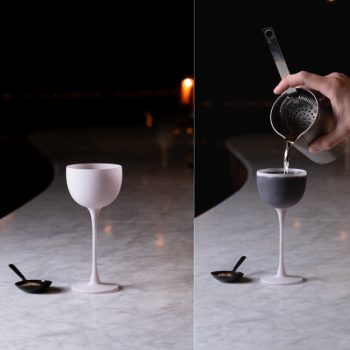
The Illusion is described as one of the menu’s ‘most visually striking serves’, containing Johnnie Walker Gold whisky, as well as banana, coffee, sherry and topinambur (Jersusalem bitters.
The serve is presented in a glass that changes colour from white to deep black as part of its ritual, creating a sensory trick on the palate.
“This is the one that will give a ‘wow’ on the menu and I can already see that on our guests’ faces every night,” he says.
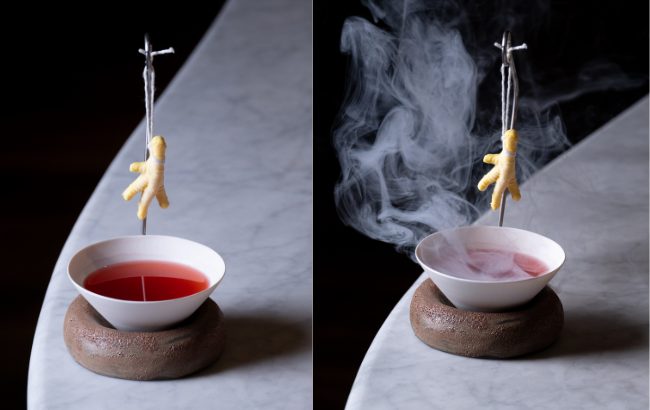
The Pimpollo, meanwhile, is made with a sweet lineup of pisco, fig, salted pistachio syrup, mandarin and grapefruit; however its presentation, with a ‘chicken foot’, may entail a different savoury expectation.
“We have a chicken foot garnish and its ice cream, but the smell is chicken soup, so it’s quite playful,” Giannotti says.
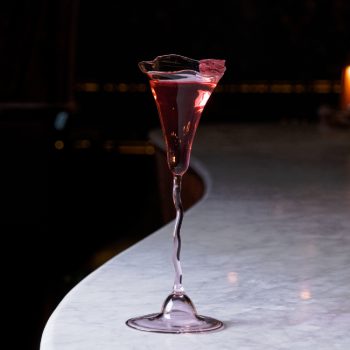
Other cocktails he addresses include the Fantasy, which is presented in a tall glass reminiscent of a flower with pink colour. The cocktail has a citrus-forward profile and is made with vodka, peach, yuzu, St-Germain and verjus.
The Perception is another cocktail that guests “first drink through their eyes”, Giannotti notes. “We serve it with a little light thin ice layer on top and we also place it with different aromatic flowers.”
The drink itself is described as ‘savoury and gastronomic’, combining hoclo corn-infused Singani 63 with tomato, celery water, lulo, pickles and fruit mustard.
Storytelling aspect
For the first time Paradiso will also offer four non-alcoholic cocktails on its new menu, having typically incorporated two booze-less additions on previously menus.
One of these non-alcoholic serves is called Source, which combines fig leaf distillate, white tea and Vichy Catalan mineral water.
Giannotti stresses that water does indeed have a taste and he wanted to showcase this through Source, which is inspired by his visit to Scotland in January, where he tasted water from The Macallan distillery, and then another “famous source of water” near Florence in Italy.
The concept for the cocktail was also inspired by an artist Giannotti met in Barcelona, whose work explored being connected in the moment, in a time where Giannotti says: “We are always on our phones, and sometimes a guest is in my bar, they are talking with someone and you may be present with your body, but you are somewhere else in the mind, or on Instagram.”
To demonstrate this in the cocktail, the Source is served in a glass that has a hole near its top that needs to be covered by a guests finger, or else the liquid will leak.
“So you have to pay attention,” Giannotti laughs. “There is a storytelling aspect here where you can reflect on being in a bar, but instead of socialising with people, you are close to your phone. The opening is close to the top of the glass, so the idea is just for the first two-to-three sips, so the concept doesn’t get too much.
“At the end of the day, coming to a bar is about having fun.”
Related news
Beluga illuminates on-trade with Noble Night