


Are RTDs a threat or necessity to the gin category?
Is the ready-to-drink (RTD) category an opportunity, a necessity, or a threat to traditional gin? Industry figures shared their views on the category’s evolution and future prospects during Ginposium.
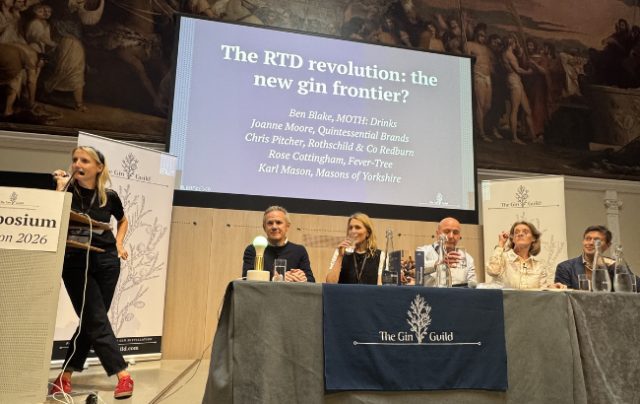
At The Gin Guild’s Ginposium conference last week (13 June), a panel of speakers discussed the booming RTD sector, exploring how innovation, convenience, and consumer trends are shaping it as the next frontier for gin, and what distillers need to know to capitalise on this rapidly expanding market.
The panel included Chris Pitcher, partner at Rothschild & Co Redburn; Joanne Moore, master distiller of Quintessential Brands; Ben Blake, UK managing director of Moth Drinks; Rose Cottingham, director of global innovation at Fever-Tree; and Karl Mason, co-founder of Masons of Yorkshire gin. It was moderated by Dr Anne Brock, member of The Gin Guild board and former master distiller of Bombay Sapphire.
The panel was asked whether they see RTDs as an opportunity, a threat, or a necessity.
Blake, who oversees the UK operations for canned RTD brand Moth, said: “I genuinely do see it as an opportunity, it’s well enough established to say it’s not going away. There’s a value equation to that, but I think it’s accelerated in recent times; you’ve also got the convenience that RTDs offer, and access to variety. That portability takes it into new locations, and I think all of those represent real opportunities.”
He also noted that more higher-quality RTDs are hitting the market, adding that RTDs can reach consumers on different occasions.
Pitcher highlighted that consumers are more willing to try new drinks, particularly in the single-serve RTD format, enabling drinkers to sample spirits in mixed drinks without purchasing a full bottle. “The can is so critical here in terms of convenience in the fridge and recyclability. People want to chop and change.”
Cottingham believes it comes down to affordability and experimentation. “It’s a change in terms of how we all socialise,” she said. “People were category-led but are now choosing for occasion, barbecues or hosting outside. That has been a shift.”
However, she believes there are still “moments where you want that ritual” of making a drink, selecting the glassware, garnish and mixer.
She adds that RTDs are “obviously a category of interest” and remains a space where Fever-Tree continues to “explore opportunities”. She highlighted previous collaborations, including its Blood Orange Spritz RTD with Papa Salt Gin, and a partnership with Maison Mirabeau.
Moore also weighed in with her opinion: “To keep gin alive, I don’t see anything wrong with having an RTD.”
Mason was more apprehensive about the category, viewing RTDs as a “marketing expense”.
“It’s not the best way to serve your product,” he says, adding that it “dilutes margins and has a shelf life”.
The panellists were also asked for their thoughts on the best way to enter the RTD category and whether collaborations present a lower risk.
Masons of Yorkshire has an RTD product with mixer brand Franklin & Sons. “I wanted to make sure to partner with a premium mixer,” Mason explained.
At Moth Drinks, Blake explains that for some brands, there is no choice but to work with a partner. “It made sense for us to create a brand and product portfolio that allows us to do that,” he says, adding that the business uses Tarquin’s as a gin partner for its RTDs.
Moore highlighted that Quintessential Brands’ Greenall’s was “one of the first gins in a can”, which it had produced using co-packers for 20 years. “Then we brought canning in-house,” she explained. “Having that flexibility means we can control what we do. We learnt all of our mistakes.”
Bottles or cans?
Cans versus bottles were also debated among the panellists, with Pitcher noting that the RTD sector is “driven by cans and convenience”.
He notes that one of the biggest shifts in the industry is the move away from malt-based products (like Smirnoff Ice and Bacardi Breezer in the 90s) to spirits-based RTDs.
Back in the day, he says these malt-based offerings were “a great way for spirits companies to take their brands and get them into the beer aisles”.
Pitcher also noted that the RTD sector was “structurally very different for spirits companies to get into it” due to the supply chain differences in shifting from glass bottles to cans.
He added: “The can is critical, the craft beer industry legitimised the can. Before that, it was not seen as premium. Once the can became premium, it opened the world. Packaging is so critical in understanding how the industry works. If you can get stuff into a can, the convenience of that is brilliant.”
In answering the cans versus bottles debate, he said: “It’s absolutely critical around the can, it’s why people sell multipacks. It’s about really thinking about how you get your brand into single-serve.”
Cottingham noted that in Australia the established RTD category a decade ago focused on bottles, which were the “driving force” behind premium prepared cocktails. “Now what you’re seeing is those players switch to cans as it becomes more acceptable.”
Pitcher also addressed the lack of data for canned RTDs versus ready-to-serve (RTS) products – a category that typically sells pre-mixed cocktails in larger formats and works well in the on-trade.
“It’s not been sliced and diced to that degree at the moment because the category in itself has just grown like a juggernaut. Because of the tax structure, it’s a premium product anyway.”
He added: “I think this [RTD] wave is coming in at a premium level.”
During Ginposium, Pitcher also presented a seminar on the state of the gin industry, revealing that the category’s global volumes fell by 1% last year.
Related news