


Mother’s ruin: is the drinks industry leaving working mums behind?
Being a mother is one of the hardest jobs a woman will ever undertake, but that role becomes exponentially harder when she already has another baby to care for: her business.

A recent report by social enterprise Careers After Babies found 85% of women leave the full-time workforce within three years of having their first child, while 19% leave work altogether due to a lack of flexibility.
Entrepreneurship is often framed as a solution to that problem, offering mothers greater control over their schedules. Yet a 2024 study by Valentina Rutigliano at the Vancouver School of Economics found women are 42% less likely to launch a startup in the year after giving birth. The research also revealed that in the five years following childbirth, female-led businesses experienced an average decline of 21% in sales, 17% in assets and 21% in profits compared with companies run by women without children.
Rutigliano found that the impact of childbirth affects businesses of all sizes, though newer companies are particularly vulnerable. “When you are at the beginning, these companies are really, really dependent on the founder,” she told Forbes in 2024. “So if the founder is distracted, nobody else can take over.”
Much of that vulnerability stems from financial instability. In the UK, self-employed mothers and business owners typically rely on Maternity Allowance rather than Statutory Maternity Pay (SMP), receiving up to £194.32 (US$260.37) per week for 39 weeks – around 59% less than the UK’s full-time minimum wage. Mothers running limited companies through PAYE can access SMP at 90% of average weekly earnings for the first six weeks, before payments drop to the same statutory rate.
In the US, the picture is even more bleak. Paid maternity leave is not guaranteed at a federal level, and as a result, mothers in the US typically return to work within 10 to 12 weeks of giving birth. For self-employed mothers, that timeline shrinks to just three to four weeks postpartum, according to Dr Emily Oster’s The State of Parental Leave report.
For mothers running businesses, the combination of inadequate parental support, unstable income, and rising childcare costs often leaves mums with little choice but to return to work early, with many juggling childcare and business ownership simultaneously.
As Forbes contributor Kim Elsesser argued, mothers need both childcare and opportunity to succeed at work. Yet in conversations I’ve had with parents across the drinks industry, those two things are rarely offered. Instead, there is a growing feeling that mothers within the sector are being left behind.
The juggle
Juggling motherhood and parenting while working within the drinks industry is a niche and complex problem. The sector doesn’t operate on a nine-to-five basis like much of the corporate world and typically, working with spirits calls for unsociable working hours or environments – at least in the context of navigating the routine of a small child.
When adding to that the adult nature of working with alcohol, the complications increase. Health and safety become more complex, and provisions for mothers working within the sector become harder to navigate or even provide.

“Juggling running a business and trying to be a good parent is really tough,” says Katherine Saunders, co-founder of Doghouse Distillery in London. “When [my son] Chase was three months old, our office manager handed in her notice and I had to come back to work much sooner than anticipated.” She explains she would bring her son to the office and sit him in a rocker next to her desk while she worked, before eventually securing a babysitter who could look after him on site, allowing her to breastfeed and attend to him when needed while also being able to do her job without distraction.
However, last year Saunders’ role became more focused on sales and events, and there were more requirements for her to be customer-facing. “[My partner] Braden and I were constantly juggling who gets home to him and who is out working. We have no family in London, so the costs of childcare – not just during the day but in the evenings when we both have to be in the trade – have been astronomical. It actually doesn’t make financial sense for me to have been working, but it wouldn’t be business sense for me not to be,” she says.
Frustrating experiences
Saunders’ struggles in this regard are not unique. I have spoken to numerous women working in the drinks industry who have had to find ways of navigating returning to work either earlier than anticipated or without a childcare infrastructure in place on account of being fundamental members of their business. The most common issue drinks industry mums have raised in this regard is the inability to represent their companies at trade shows while simultaneously looking after their young children.
Attending trade shows as a drinks business or brand offers several tangible benefits, including generating sales leads, brand visibility, market research and networking. However, many fairs, especially in the UK, make no allowances for the attendance of children of any age.
Saunders shares: “I had one frustrating experience when we had a stand at Imbibe Live [in London] when my son was three months old. On the build day, when I needed to be inside overseeing the team and the stand, they would not let me in with him. I was so frustrated, he was little and in a pram, but they would not let me in. I ended up having to pay a sitter with money I did not have to walk him around outside Olympia whilst I worked, and I kept coming in and out to feed him and see him.
“I really tried to reason with the organisers but they would not budge. I know they have their health and safety rules to adhere to, but he was not a toddler running around, so I just felt it was a bit ridiculous.”
Another Imbibe Live exhibitor, who wished to remain anonymous, had a similar experience: “I wanted to check on our team and stand with my two-month-old in a sling, but I was escorted out by security and had to spend the afternoon working alone from the pub around the corner with my son.”
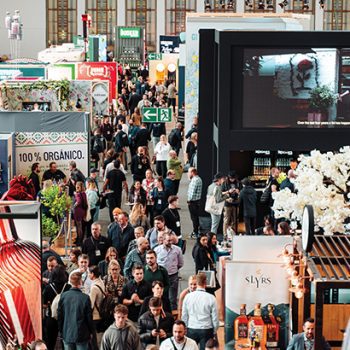
Imbibe Live rebranded to BCB London in July 2024, however, the rebrand did not bring with it a change in stance on working parents being able to bring their children to the show.
Sim Edwards, mother of two and one of the women behind Celebrate Mothers, a drinks industry community that seeks to raise awareness around the realities of parenthood, attended BCB London this year as a speaker. Her talk, Sazeracs to Sippy Cups: Raising the Bar, and Kids, focused on parenthood in the drinks industry and how to navigate returning to work from maternity leave. However, she was denied bringing her babe in arms to the show “for a series of reasons around licensing, booze without sales, and insurance”.
When questioned about BCB London’s stance on allowing working parents to bring young children to the show, Petra Lassahn, director of BCB London, explained that supporting women in the industry is hugely important to the organisation, and it has made an effort to explore how it can better support mothers in particular. “In an ideal world,” she says, “we would love to have facilities such as a crèche; however, BCB events are large-scale trade environments centred around hospitality and alcohol service, and there are significant health, safety and wider operational considerations involved in introducing children into that setting. For that reason, BCB London operates an over-18s policy in line with other BCB shows internationally.
“Whilst we cannot have children on site, we are always looking at ways we can better support women in this industry, constantly talking to our peers, network and audience, and welcome any feedback or suggestions.”
Baby steps
Other trade shows, however, have chosen to take on the challenge of tackling the operational and logistical challenges of offering childcare solutions.
For the first time this year, the Real Italian Wine & Food Experience (Wines Experience London), which took place at the ExCel London in April, provided a crèche service for both exhibitors and guests in a bid to remove a practical barrier for parents – “especially women” – and enable them to do business effectively.
“We made the decision to introduce a childcare offering on the Sunday [of the show] as this is typically considered a ‘family day’ across much of the UK hospitality and trade community,” says Molly Matelski, director of global programming and partnerships at United Experience. “We are very aware of how time-intensive this industry already is and wanted to explore ways to make participation more accessible and seamless for those with families.
“More broadly, this initiative is part of how we are thinking about evolving the trade fair format. Accessibility, diversity and inclusion are also important pillars for us, and this is one of the ways we are beginning to build that into the structure of the event. As this is our first year, we see this as an initial step, with the intention to learn, refine and expand these efforts over time.”
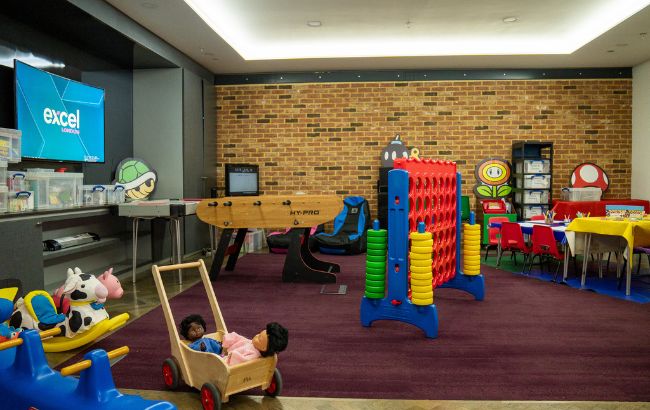
The company secured Nipperbout, a specialist childcare and play provider for festivals, conferences, exhibitions and other events, as the childcare provider for the Sunday of the show, and while the logistics of organising such a service can be difficult, the company’s founder and CEO, Janthea Brigden, shares there were no unique challenges created on account of the Real Italian Wine & Food Expo being centred around alcohol. “The obvious issue is that children should not be in the alcohol trade environment itself, so the childcare needs to be clearly separate from the show floor,” Bridgen notes.
“We do also have procedures in place for situations where alcohol is present, as we work at festivals and other events too. We would never hand a child back to someone who appeared to be under the influence or unable to care for them safely. At a professional drinks trade event, however, attendees are there to work, so the context is very different from a public festival.”
She adds: “I think some organisers assume alcohol and childcare cannot sit alongside each other. But they can, provided the childcare is completely separate from the trade environment and managed properly.”
She stresses it is not about bringing children into the show: “It is about creating a safe, professional childcare space nearby so parents can attend, work, exhibit or network without having to choose between the event and their family responsibilities.”
Matelski confirmed after the event that the implementation of the crèche service was a success, and despite limited preregistration on account of the service being signed off at late notice, the crèche allowed for at least one managing director to attend the show on Sunday specifically because childcare was available, which the team saw as proof of concept.
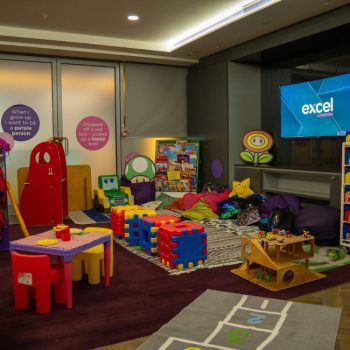
London Wine Fair has also taken steps to allow parents or carers to bring their babies and pre-toddlers to its venue, despite operating a strict ‘no under-18s’ rule.
Hannah Tovey, head of London Wine Fair, explains: “We recognise that some parents or carers may need to access the event with their babies. While no under-18s are allowed onto the show floor itself, for safety and insurance purposes, we have invested in a comfortable, dedicated parent and family room within the suite of organisers’ offices at Olympia. They can then leave their baby with their carer within this safe space, whilst they visit the show for meetings, tasting and sessions.
“We have been championing the right for parents to bring their babies to the show for the last couple of years, and welcome parents to contact us ahead of the show with any questions they may have.”
‘Lack of demand’
A spokesperson for ProWein, which hosts trade shows in Germany, Singapore and São Paulo, among other global destinations, says while there is currently no comprehensive, standardised concept in place for childcare at its events, the topic is part of an ongoing review and development process. However, one of the main reasons it has not implemented the service to date is a lack of demand.
They explain: “Such needs have only been raised in a small number of individual cases, where we have responded with pragmatic, flexible solutions. Against this background, there has not yet been a need to establish a standardised or large-scale offering. At the same time, many of our events – such as ProWein – are designed as international trade fairs with high visitor volumes, which must be taken into account when considering additional services.”

But events consultant Natalie McDonnell believes there is a demand for this kind of service, but organisers aren’t asking the right questions to their attendees.
This month (May), McDonnell launched Event Childcare Collective, a professional childcare service for corporate events. She recommends trade show coordinators take a proactive approach in assessing demand for childcare, as they may be surprised by how many attendees and delegates would find the service useful.
McDonnell says: “It needs to be thought about as soon as you know an event is happening and get that out in your marketing. When people register for an event, add a tick box: will you need childcare provision, yes or no? You don’t have to promise it straight away, but just knowing is the first step.”
McDonnell adds that offering childcare could also be commercially beneficial to events companies, as it opens the opportunity for events to be held during school holidays and on weekends, when commercial venue hire is cheaper. “I would typically never book an event during half-term because of holidays, but why not? Why don’t you book your event on the first Monday of half-term and get 50% off your venue costs? You could then afford to look after all the children because you’ve just saved yourself £50,000 on your venue in central London. And then you’re getting access to the best speakers because they’re not booked out, because they’re booked out next week at your competitor’s event. So, it’s just opening up all these opportunities that we wouldn’t have thought about.”
Related news
Desi Daru features at Sushisamba