

Campari CEO plots Aperol push in US
After a “solid” first quarter, Campari Group is working to boost Aperol in the US, where “half of America” are unaware of the brand, according to CEO Simon Hunt.

The Aperol maker saw organic sales rise by 2.9% in the first quarter (Q1) of 2026, which Hunt felt was a “solid performance” considering the difficult operating backdrop right now.
Hunt also said of Campari Group’s performance that it “remains one of the only spirits companies delivering sustained growth against this challenging backdrop”.
For 2026, the group has outlined several key growth drivers: a focus on its core brands, winning the ‘first shared drink’ with new formats and occasions, and accelerating geographic expansion.
Looking across regions, Campari’s biggest base, Europe, saw 1.9% organic growth with positive showings in the UK, Italy and Germany.
France was the only key European market not to see growth, “due to a high comparison base from relisting of Campari a year ago”. The Spritz trend was also alive and accelerating in France, with growth in Aperol and the company’s sparkling wines division.
Sales grew by 2.2% in North America, its second biggest market, which the firm put down to ‘solid underlying trends’ in the US and recovery in Jamaica following the hurricane that hit the region in October last year.
In the US, both Aperol and Espolòn Tequila recorded positive growth with the company’s sales in the on-trade said to outperform the total market.
As a result of its strategy to bet on its core brands, Skyy (up 22%) Aperol (up 15%) and Campari (up 21%) all showed double-digit growth in the US on-trade, described as a “strategic channel” by Hunt.
Speaking to investors after the results were revealed on 6 May, Hunt said the strong on-trade performance “is exactly what we aim for – to build awareness and trial”.
“The fact that the on-trade is growing faster than the off-premise, but with smaller ticket sizes, solidifies our belief that social interaction and the role of alcohol in consumers’ lives is still very much relevant and the current pressure is cyclical,” he said.
“We are investing for the long term as we execute our strategy to ensure that we are strongly positioned for when the environment improves, and it makes sense to do that now.”
Since February, the group has deployed 21 people as brand activators across four key states in the US to strengthen Aperol in the market. “We are already seeing encouraging early progress on velocity and distribution,” Hunt said of Aperol, noting that based on eight weeks of data, “we are seeing velocity at nearly three times the rest of the market in those target accounts”.
Innovation pipeline
When asked about his confidence in delivering the 3% guidance the company set for the year, despite a tougher second half comparison base to work from, one aspect Hunt highlighted was the company’s innovation with new formats.
“The innovation pipeline is accelerating rapidly to ensure we tap into occasions where we were not able to play in the past,” he said.
Hunt noted the launch of its bottled Campari Spritz has helped the brand in its home base in Italy, which has seen “more innovation going into [it] than we’ve had in prior years”.
“Given the size of the Campari brand here, the initial results are encouraging,” he said. The product was also launched in Austria and Germany near the end of Q1.
Hunt also pointed to Aperol Spritz on tap, which has enabled the group to “really get into some of the higher volume accounts where previously we were a bit challenged in there because other people had gone in”. “We’ve now been able to go in and regain some of our real estate for the brand and accelerate the growth,” he said of the format.
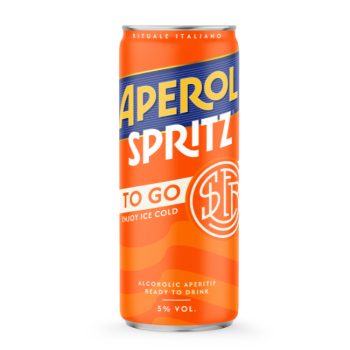
Campari Group also introduced a canned Aperol Spritz To Go in the UK in April, with Belgium, Switzerland and Austria following, and more markets to come in the year. Though it’s still very new, Hunt said the company was making good progress on the product’s margins and those will “continue to improve as we scale this opportunity.
“They [margins] are broadly in line with the company average,” he said. “We’re targeting specific occasions that we cannot compete in today with our existing format. Whether that be in cash and carry or whether that be in convenience stores.”
In terms of making Aperol Spritz To Go available in the US, Hunt said that “at this stage we’ve recognised that half of America doesn’t know Aperol at all, so we have a job to do in terms of building that”.
“That’s why we put more people on the street. That’s why we’re getting into the accounts, and why we’re focusing on those target accounts,” he added of the increased investment in the brand in the States. “To make sure that we turn the neighbourhoods orange and then we move to the next one.
“We’re looking at it. We’re having a look at what that could mean. Unlike some of our competitors, for us this is delivering a finished drink in an occasion we can’t compete in today.”
Pricing strategy
Hunt was asked about the group’s approach to pricing, specifically in the US, where competition in categories like Tequila may force the company to lower the pricing of brands such as Espolòn.
His stance was that “pricing is always relative to our competitors and how our consumers actually see the value in our brands and whether or not those values actually support the price that’s being charged”.
Hunt also doesn’t believe that reducing price long term builds equity. “I think it will give you a short-term lift, and that’s part of what you’re seeing,” he said.
“Building the price of these brands and building the value into these brands takes a lot longer than a couple of quarters,” he explained.
“Our focus is reinforcing the value with our consumers for our brands, so they see the value when they’re feeling the pinch, and they feel good about purchasing the brand. That’s the overriding point.”
Hunt was firm that Campari Group will maintain its shelf pricing, but it will also make sure to optimise promotional pricing, so it is “picking up those incremental opportunities”.
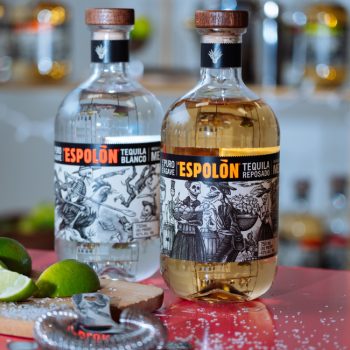
“I think that’s really what you see on our sell-out data,” he said. “If you look at the promotion volume, we’ve seen a bit of movement on a couple of the brands, but ultimately on this, you look at the performance, whether it’s in off-premise on Espolòn at plus-5%, or on Courvoisier at plus-14%, or in the on-premise at plus-22%.
“That’s not all driven by price, that’s driven by consumers and customers seeing value in Espolòn.”
Geographic expansion: ‘making good progress’
In January, Campari Group established a new region for its business under ‘developing markets’ which lists countries such as Brazil, Argentina, South Africa, Peru, Poland, and Nigeria.
The region recorded 12.7% growth in Q1, which Hunt did admitted was “off an easy comparison base of minus-4%”.

The region’s two biggest markets – Brazil and Argentina – drove growth with the former “positively impacted by increasing Aperol penetration”, and the latter “due to the ongoing popularity of Skyy Cosmic” – a 29% ABV flavoured ‘vodka’.
Hunt maintained that while the geographical expansion strategy was in its early days, the company was “already seeing some of the benefits of this increased focus”.
“We formed this region at the beginning of the year to become more agile and benefit from a repeatable playbook across some of our seeding markets,” he said.
The main growth driver in developing markets was Aperol, which Hunt said “once again demonstrates the power of the brand and the benefit of our increased focus on fewer, bigger bets”.
Elsewhere, Asia Pacific (APAC) fell by 1.6% in Q1, which Hunt said was entirely led by a 13.5% decline in global travel retail (GTR).
Of how much a factor the Middle East conflict played in this, Hunt noted that nearly two million passengers will be cut out [of these travel hubs] during May, but “no one’s quite clear what that means yet because it depends on which routes, which consumers, how much brands they’d normally be picking up in GTR”.
He also contended that while Campari Group’s GTR arm is “healthy”, it is still only a “small part” of the overall business.
In the rest of Asia, the company’s presence in Japan and South Korea has been strengthened with new management teams, as well as finalised acquisitions of its distribution companies in both markets.
Just before the results reveal, the group also revealed a leadership restructure in travel channel with Satya Sharma taking on an expanded role as business unit managing director for Asia Pacific and GTR.
Hunt said: “Supported by our new regional setup, we are progressing with a clear playbook and already making good progress. In fact, in quarter one, we had broad-based growth across our houses and regions with 18 countries all in growth.”
US destocking of non-core brands
Away from its key brands, Campari said inventory optimisation in the US was undertaken on its lower priority brands in Q1, impacting sales for these products.
Hunt explained that the clean up was primarily with Skyy Vodka and Grand Marnier and a “couple of other brands”, which was reflective of a downturn in the US and that inventory needed to be responsibly managed “down at the right level”.
“None of the brands that we have prioritised, we are doing this on”, he clarified, adding that he doesn’t anticipate significant movement in the second quarter.
When asked about Grand Marnier having a tough time, Hunt said the Cognac-based orange liqueur was seeing more encouraging signs in the US on-trade, and the off-trade is where the brand is facing difficulty. “I think that’s where consumers are being quite careful with where they spend their money at the moment,” he said.
“As we see trading down to small sizes, trading out of the category into ready-to-drink continues to be a broad trend.”
Regarding Courvoisier, Hunt said the Cognac brand showed small but positive growth in a number of European markets, but the US “still remains quite challenged”.
Campari is working on a relaunch for the brand in second half of 2026 and, as he noted after the company’s full-year 2025 results, Hunt said again: “We’re making sure that given what’s happening in the [Cognac] category, we’re going to get one shot at this, we want to make sure we get it right, and as a result, we’re not rushing it.”
Ultimately, Hunt reiterated that group’s confidence in meeting its full-year guidance of 3% organic growth.
“We’ve had a solid start to the year despite the backdrop, and we are on track for the full-year target,” he concluded.
Related news
Campari Group appoints new HR chief