


Volcan de mi Tierra: additive-free marketing ‘out of hand’
The CEO and co-founder of Volcan de mi Tierra weighs in on the additive-free discussion and tells us why the brand is moving away from ‘prestige’ Tequila.
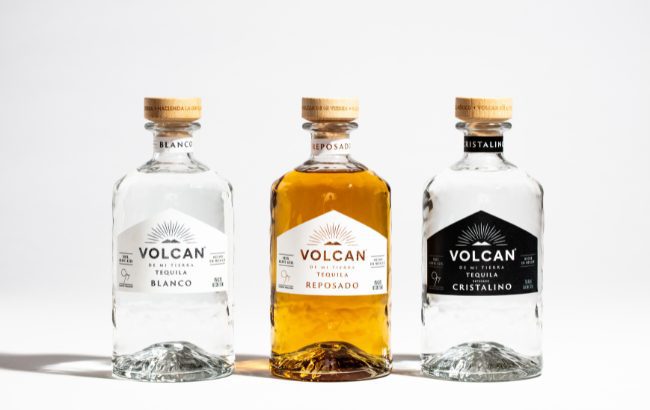
Volcan de mi Tierra has made a handful of moves in the luxury lifestyle space recently, releasing a marble vessel in collaboration with Arca earlier in the month, and signing a deal to be the official Tequila of Formula One in October.
The LVMH-owned brand has a unique positioning in Tequila where it is in both the lifestyle and craft space. “We’re a hybrid there,” Volcan de mi Tierra CEO Santiago Cortina Gallardo tells The Spirits Business of how the brand distinguishes itself. “We can be drunk by connoisseurs, but there will also be people that just want to drink it because it’s the official Tequila of F1, or because it looks cool.”
Currently Volcan moves around 47,000 nine-litre cases a year, but Gallardo says the brand has negotiated with its distribution partner around the world, LVMH, for an increased budget of around 60,000 cases. There is also “significant growth” in the US, with the total in the US rising from 18,000 to 30,000 cases in the budget, which is a “big step” in terms of percentage, though still really small in the industry,” he says.
Despite IWSR reports of Tequila stalling in the US, Gallardo notes the slowdown isn’t where Volcan plays. “Last I looked, Tequila was growing 35% in super-premium-plus,” he says. “There you have the Ocho, Lalo, Mijenta, ourselves and others. We were growing 28% in Nielsen. I believe it’s how you want to look at it in the numbers, but in the spirits category, super-premium-plus for Tequila is the most resilient.”
Along with the craft space, he highlights reposado’s growth. “Those are still growing [craft and reposado] and that’s where we are. The Tequila category is huge in the US, but the rest of the world keeps on growing. If we’re able to win market share, even one point in market share, you’re talking 300,000 nine-litre cases, IWSR. People are going to keep drinking Tequila, but it’s just about making more of them drink options that are more craft.”
The brand has 240,000 nine-litre cases installed at its distillery in Jalisco and is operating at 30% capacity. “We also have a lot of Tequila already produced in bulk, waiting in stainless steel tanks, and with maybe 150,000 nine-litre cases worth of Tequila there. This gives us enough lead time to scale quickly with the liquid we have,” Gallardo says.
He feels it’s Volcan’s time because “the craft additive-free space is growing a lot faster in Tequila, and in that space, we’re one of the few brands that can really scale consistently”.
Gallardo is in discussions with US distribution giant Southern Glazer’s Wine & Spirits over a boost plan, which would see the brand looking at 85,000 or even 90,000 nine-litre cases next year. “If that happens, it is a complete game changer for us,” he says, adding this would mainly be for the US.
For Gallardo, the most exciting thing in Tequila is the appetite to know more about the spirit.
“You’re seeing people talk about additives, the processes, ageing and all sorts of technical aspects. Now there’s this question of who’s producing your Tequila? What NOM? Who’s the master distiller?
“When we started in 2017 it was all about the established brands. Today, you’re seeing smaller brands that do take care of quality gain traction because consumers are getting interested in nuances around Tequila.”
Shifting priorities
As single malt, Bourbon and Cognac face some turbulence, Gallardo senses an opportunity for Volcan. He notes the sway of Diageo-owned Don Julio Reposado in migrating drinkers towards aged Tequilas.
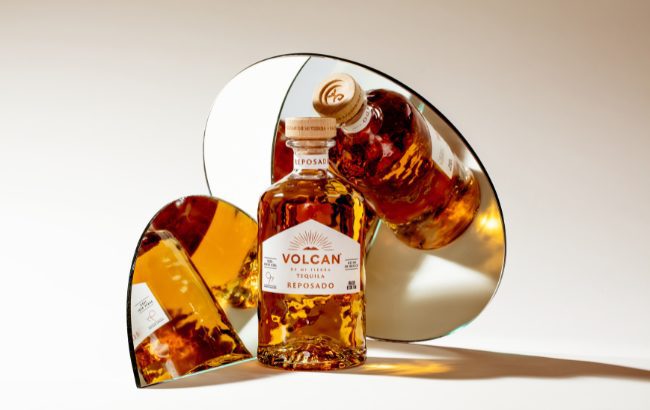
Volcan can find success here too, he feels: “We have a great amount of reposado at our facility and part of our plan next year is to really push it.”
He believes that recent awards at blind tastings could help the brand maintain traction.
When The Spirits Business caught up with Volcan’s chief operating officer and general manager, Carlos Pechieu, in mid-2024, Pechieu spoke about how the brand was betting on prestige Tequila, however Gallardo explains priorities have shifted.
“We were really focused on our prestige range – our X.A and Blanco Tahona – where the price point is high,” he says. “They’re amazing liquids and they have a role to play, but we need to focus now on growing our core range, mainly the blanco and the repo in the US, and the rest of the world where the cristalino can have a role.
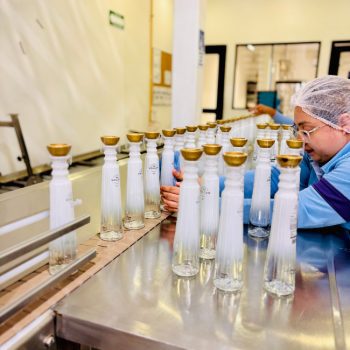
He notes that the Tahona and X.A are still important in providing an option for consumers “looking for tall, pretty bottles that also hold an amazing juice.”
Another significant change the brand will make next year is repositioning its pricing in Mexico. “To give you an idea, Volcan Blanco was MXN1,200 pesos, which is like US$70, and now it’s going to be 690 pesos [US$38],” Gallardo says, adding: “We’re doing the same with the rest of the portfolio, because we were at a price point that wasn’t aligned with our competitive set.
“Mexico is the second-largest Tequila market. We’re not putting any volume next year as a possible upscale, but I hope we can get to 5,000-10,000 nine-litre cases next year from the 3,000 that we’re selling today. Those are realistic volume targets.”
Volcan alters cristalino recipe
Mexico will also get a new Volcan cristalino next year, which will be the brand’s third recipe for the expression since the brand was established in May 2017. Explaining the change, Gallardo details: “The initial cristalino was a blend of añejo and extra añejo, charcoal filtered, and it was finished in the same old-world casks we’re using for the current cristalino, but the base was añejo and extra añejo that we had already in the factory.
“As time went by, we realised we really didn’t have to put añejo into the cristalino. We decided to move towards a reposado in the cristalino. Same finish, but in these two initial versions, we have always kept colour in the liquid – a straw colour – and because our reposado was really dark, our cristalino was a bit yellow-ish.”
It was from here that the Consejo Regulador del Tequila (CRT) began regulating the expression as in some cases it was darker than a reposado, Gallardo says. “They asked us to make our cristalino actually a cristalino, so Marcelino [Marcelino Lucke, Volcán de mi Tierra’s Maestro Tequilero] started experimenting more because he wasn’t very keen on stripping the whole colour out.” Gallardo explains that the brand had to do a new profile for it to be a completely crystalline cristalino.
“It’s the exact same recipe, meaning lowlands Blanco, finished in old world casks of Cognac and whisky, the liquid is the same – it just has that additional filtration.”
Gallardo adds that ABV-wise, “we already had the cristalino in Mexico at 35% ABV – the common ABV in Mexico – but now we’re doing 35% ABV for the rest of the world, excluding the US.”
Defining craft
Volcan is one of only 20 distilleries in Tequila to have a single NOM (1523), which equates to one brand for one distillery, and it’s also one of the only five to be additive-free, Gallardo claims.
He contends that “probably narrows it too much” as there are third-party distilleries that make good Tequila, but those brands themselves are not making it.
“You’re not there every day, not able to scale consistently, or quickly. You don’t own how that’s being produced. You might be building your distillery if you’re successful at one point and trying to replicate some of that, but it’s the other way around because a quality product by a luxury brand starts by a quality product – and that starts by you doing your own liquid.”
Emphasising the brand’s quality standards, Gallardo notes Volcan’s distillery as the only one in Mexico with a verified ISO 2200 Food Safety Management certification. “We have our own distillery and we have only craft processes inside that distillery, with an ISO certification that goes all the way through harvesting the agave to bottling.”
While Gallardo doesn’t like using the word luxury too much, being in control of the amount of Tequila produced in a facility that it owns, is crucial to being seen as a craft brand. Otherwise, he says. “You’re outsourcing one of the main things you’re selling. You’re selling quality Tequila that you are not producing, and that knowledge on producing is not yours. There needs to be some craft and that starts with that definition of craft as an activity involving skill in making things.
“You can’t be crafted and outsourced, I think, as a concept.”
Gallardo believes Volcan can lead the conversation in the craft segment. “We have the credentials to do it, we have a great story and now we also have a great price.
“I think it can be a winning horse that can be around, as we would love, for the next hundreds of years, as a global brand. It takes time and a lot of effort, but we’re on the right track.”
Additive-free: kill the conversation
Gallardo also offers his view on the use of additives in Tequila, which has dominated the discourse in category this year. Volcan is an additive-free brand, but he feels it’s misleading to say one brand is good and one is not because of additives.
First and foremost, he believes there needs to be regulation of the term. “It has gotten out of hand and we need to kill the conversation, so we can get back to talking about ‘where do you get your agaves? What kind of processes are you using? What facility? What equipment?
“It’s the production process, the single NOM, and other things that really make a difference in the liquid.”
“There’s so much more to talk about than additives for quality, and to be fair, Tequila is also where it is today because of additives. The category became a lot more approachable.”
He notes the law which stipulates a producer can include up to 1% of additives in dry extract for 100% agave Tequila without having to disclose it on the label. “Somehow this and the use of mellowing agents became a bad thing.”
He feels the question should first be asked of ‘why would a producer use mellowing agents?’
“To my knowledge, a lot of categories use these mellowing agents in their liquids. For Tequila, there are two reasons: You are being co-packed in a facility, as most brands are, and you need to differentiate your liquid.
“And also, if you’re going to be producing more than a million cases, or selling more than a million cases, how do you really scale that consistently in a way that’s not really overly complicated?
“It’s a lot of Tequila. We would probably be able to do it but it will be a massive operation. One million maybe in the next 10 years. If you want to scale like this, there’s no other way to still have a consistent Tequila profile. You need to use them. That’s why they are being used.”
Addressing the additive-free confusion
He again points out that the term, additive-free, isn’t regulated. “What I think is bad is we’re leaving the industry in the hands of marketers.
“In the US, the largest Tequila market, you go to a store like Total Wine and there’s an additive-free Tequila space, which no one is regulating. Now it’s cool to be additive-free and everyone says they are additive-free – but there’s no one regulating it. You’re gonna start confusing everyone between what’s additive-free, what’s not, and then what’s the implication? If you ask American consumers, they always take quality as the main purchase-driving factor and quality is the perception. Now consumers are perceiving that Tequilas with additives are not as good.”
Gallardo suggests this is unfair: “In the additive shelf, I think some are overpowered, and I personally don’t like them because I still like cooked agave in my Tequila, but there might be some products that use mild mellowing agents that are not bad.
“Being additive-free doesn’t automatically make you good and I think it shouldn’t necessarily be viewed in a way where one is positioned as bad, and the other is good. This is where they’re taking you with the marketing and it’s gotten out of hand.”
Bacardi-owned Patrón has doubled down on its additive-free nature in its marketing, despite a dispute with the CRT over the topic.
Gallardo notes regulating the term is difficult, but offers a solution. “When we think about the different options, obviously no one’s gonna want to make 99% agave category, that’s going to confuse the hell out of everyone because now everyone believes 100% means quality.
“But you could do: There’s 100% agave, you can use the 1% as you’ve always used it and you just need to disclose ingredients in the back label. And the CRT, or someone else does random tests of products in stores to determine your complying with what you said. If you’re not, you get a bad section.
“That needs to happen sooner rather than later, because if not, we’re making additives look like the bad guys when they’re not necessarily any sort of bad guys, they are used everywhere.”
He compares the evolution of the Tequila consumer – upgrading from sweeter more mass-produced variants to craft types like Volcan – to how people grow with coffee.
Using Starbucks as an analogy, he says: “When you first start drinking coffee, you might go to Starbucks and put caramel, sugar and all sorts of things into it. As time goes by, you then start enjoying black coffee. Black coffee is what you call a craft Tequila in that evolution.
Gallardo likes espresso, for instance, while there’s always people who will drink their pumpkin spiced lattes.
“We can’t keep on just letting things happen like this [in Tequila],” he adds. “Where there is this perception that one thing is good and the other is bad.”
Related news