


Inside Angelos Bafas’ newest venue Cato
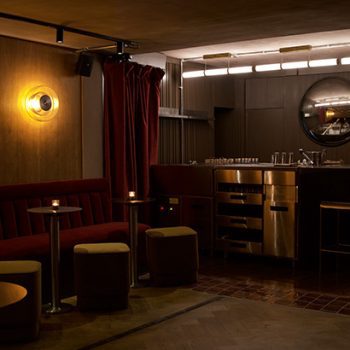
With Cato – a Covent Garden venue that features two bars, including the House of Julep – acclaimed bartender Angelos Bafas has created his dream space.

*This feature was originally published in the April 2026 issue of The Spirits Business magazine.
Is anyone trying to define the great British cocktail quite like Angelos Bafas? It’s somewhat ironic, given he was born and raised in Greece, but Bafas is one of the few figures in the industry fully dedicated to British produce and spirits.
That was the ethos at Nipperkin in London, where Bafas cemented his mixology reputation during his tenure from 2023.
He’s taken that mission a step further with Cato, his first bar since departing the Creative Restaurant Group (CRG) in September 2025.
Cato is a partnership with hospitality group Bart & Taylor, with Bafas leading the day-to-day operations, supported by Bart & Taylor’s beverage manager Yaw Asante.
After leaving CRG, Bafas planned to focus on consultancy. The reality, however, is more focused. “Cato has become my life,” he laughs. He’s now a co-owner – something he describes as a “privilege”. “I’m spending every minute of my life in here at the moment. I’m trying to get it right, and it has started very nicely, so I can’t complain.”
This is almost exactly how he’d hoped it would play out. “My goal was to open my own place – even if it was a tiny place with five seats in southeast London,” he says. Unsurprisingly, given the size of Bafas’ ambitions, that ended up being far from reality: Cato is a five-storey building in central London’s Covent Garden.
In that building are two bars: Cato in the basement and another on the ground floor, called the House of Julep. The team are also looking to open a new area called the Study, which will be an omakase-style bar for 10 people. This will also be used for collaborations with chefs and other bars, offering seminars and masterclasses.
The bar’s inspiration comes from Cato Alexander, a freed slave who in the 19th century created one of New York’s most popular taverns. What appealed to Bafas and his partners was the atmosphere Alexander’s venue seemed to foster. “Everybody could be together, from politicians to the average Joe,” he explains. That egalitarian spirit is a guiding principle. “Our first rule is that there are no VIPs. Everybody who walks in is treated the same.”
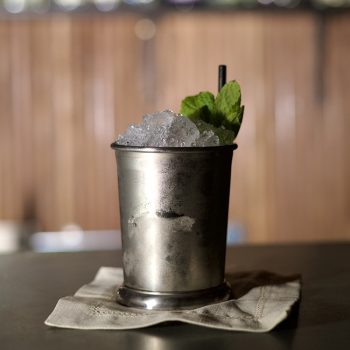
While Alexander didn’t invent the Mint Julep, he earned a reputation for making a very good one, which is why the cocktail has become the focus for Cato’s ground-floor bar. However, Bafas admits that the team weren’t keen on the traditional recipe. “It was barely drinkable,” he says. “It’s like 70ml of Bourbon and a lot of mint, bitters, ice, and sugar – everything to the extreme. Our mission was to balance it.” The key changes were adding a house-made mint tincture and extra dilution, while keeping the iconic elements of the metal cup and crushed ice.
Signature drink
The response to the House of Julep’s signature drink has surpassed Bafas’ expectations, with the team serving 160 on the Saturday before we speak. While that’s great for Cato’s bottom line, it has created a challenge for one of Bafas’ desired USPs. “The ideal scenario in the beginning was to become self-sufficient [in terms of herbs and fruits],” he says. “But it can’t happen. We can’t maintain this amount of mint in house.”
Bafas has found a middle ground. The team will grow their own herbs and turn them into tinctures, ensuring every drink has a homegrown element. These include niche herbs, such as a Thai basil and mint hybrid and a strawberry mint, which could be used for weeklong activations. “We’re as close to being self-sustainable as we can be, with foraging and the number of speciality herbs that we grow,” he explains.
The basement bar of Cato allows Bafas to stick solidly to his mission of using only UK produce and spirits. Citrus fruits are replaced with fermented and acidified gooseberries designed to mimic the brightness of lime. He finds these constraints to be liberating rather than restrictive. “If you can use anything in the world, it becomes overwhelming,” he says. “Putting limitations on yourself actually helps creativity.”
It also, he says, gives cocktails a stronger sense of place. “If I blindfolded you, put you on a plane, and dropped you in a bar somewhere, would you know where you were?” he asks. “Probably not, because most bars use the same ingredients – coconut, pineapple, mango, lime. Using British produce creates identity.”
While Bafas’ personal mission is to use British produce, he stresses that this isn’t Cato’s identity. “Using seasonal, local ingredients shouldn’t be a concept,” he says. “It’s something you either do or you don’t. For me, it’s the only way forward.”
Instead, the concept in Cato’s basement bar is synaesthesia: the neurological phenomenon that causes senses to overlap. Since he was little, Bafas has assigned various things – days of the week, for example – to colours. This has inspired Cato’s basement bar, which serves the Colour Has Flavour menu.
Each drink corresponds to a colour and flavour profile, with the intention of helping guests connect with the idea even if they’ve never encountered the term before. For instance, the colour green is represented by a cocktail with The Botanist Islay Gin, English wasabi distillate, a ginger and honey shrub, foraged mustard greens, and a wasabi and mustard leaf tincture. White, meanwhile, is represented by Another Hendrick’s Gin, foraged sweet woodruff, a koji and butter cream liqueur, and cultured cream.
Damage and floods
While translating colour to flavour comes naturally to Bafas, the road to opening Cato was less straightforward. Plans for the bar predate his involvement by a few years; once he was on board, it was intended for Cato to open in November 2025. “Anything that could go wrong went wrong,” Bafas says of its eventual launch in February – a story likely familiar to anyone who’s opened a bar.
Issues with licensing, structural damage to the building, floods, and even a few trips to the hospital pushed back the opening, but the founding team weren’t deterred – even whipping out the tools themselves. “We decided the only way to open was if we made it ourselves,” says Bafas. “We rolled up our sleeves and we cracked on – we spent the whole January in here.”
Going that extra mile is reflective of Bafas’ new position as co-owner. “I’ve changed so much. Now it’s all about the money,” he jokes. “I need to keep my ethos unchanged; that’s what I live by. But the goal is to get this place up and running, and be financially sustainable.”
It hasn’t been an easy start to his first independent venture, but the work has been worth it. He says: “I’m really proud to see people coming into my place, created on our terms. It’s the proudest moment of my career.”
Related news
Cocktail bar Nancy's to open in London Bridge