

Perfect storm: the mental health of the drinks industry
As the UK endures a lengthy period of miserable weather, we conduct a temperature check on the mental health of industry professionals.

*This feature was first published in the March 2026 issue of The Spirits Business magazine.
“When we closed, it was like someone had been standing on my chest for two years, and they finally took a foot off it,” says Stevie Aitken, co-owner of Edinburgh bar Ruma, which shut its doors for good on 4 January this year, following a maelstrom of tax liabilities, high staff and maintenance costs, and a lack of footfall – a storm that had been brewing since March 2025.
In those nine months before Ruma’s final service, Aitken was running the bar while also working full-time with a spirits distributor, often clocking in 100 hours of work a week. On his rare days off, his phone would constantly ping with messages from his staff. “It was the only thing my fiancé and I ever argued about,” he says. His desire for his team to know they could always contact him clashed with her request for better work-life boundaries.
Unfortunately for many business owners in the drinks industry, work-life balance is simply not a luxury afforded to them. When the going gets tough, switching your phone off and pretending it isn’t happening isn’t an option. According to the Mental Health Foundation, mixed anxiety and depression is Britain’s most common mental disorder, but in hospitality, the numbers are even higher, with four in five experiencing high levels of stress and poor mental health.

For approximately half of those in the industry reporting mental health problems, financial worry is the greatest burden, as rising costs from business rates, duty, employment expenses, and cost-of-living squeeze margins across the board.
Last month, data from restructuring firm BTG Begbies Traynor found that 69 distilleries in Scotland are facing “significant or critical” financial distress, while a further 217 in England, Wales, and Northern Ireland said they were facing financial difficulties.
“Distilleries in Scotland, where the majority of the UK’s whisky production is based, are facing a perfect storm of lowering demand, rising production costs, and increased tariffs in key markets, factors that have already cost numerous brands their businesses over recent months,” said Thomas McKay, managing partner of BTG in Scotland.
The past six years have given the drinks industry quite a beating, from broken government promises for spirits and hospitality to job losses at every level. “All the rising business costs are putting huge amounts of pressure on businesses, and we as a charity are seeing a lot of really good people being made redundant as a result of necessary restructures,” says Nicola Burston, CEO of The Drinks Trust. “One in seven young people are unemployed, and that is because, as predicted, the balancing of the National Insurance contributions means they no longer have that cost advantage. So, if you’ve got an option between choosing someone older and experienced or a young person in their first role, it’s a bit of a no-brainer really.”
Burston explains this has resulted in businesses running on lean or skeleton staffing, asking fewer people to do the same or more work to save money. This is resulting in absenteeism running at an all-time high, costing businesses roughly £5,000 (US$6,764) per annum, while presenteeism – people at work but not functioning well – accounts for an estimated 43 days per business, per year.
Increase in burnout
According to Mental Health UK’s Burnout Report 2026, 63% of UK employees show signs of burnout, a significant increase from the 51% reported two years before. Burston notes that remaining employees are anxious about career stability, while also being pushed harder, compounding stress. “The irony is that employee wellbeing is one of the first things to be cut from the bottom line because businesses are trying to save money, and they’re taking out anything they don’t see as necessary.”
Tim Etherington-Judge, founder of non-profit Healthy Hospo, highlights the commercial benefits of keeping a healthy and happy workforce: “Your staff are your biggest cost centre, but also the most important part of your business. If your staff are stressed and struggling with depression or burnout, that’s having a negative impact on your business.”

Looking after staff is a top priority for Rachel Bailey Palumbo, director of Edinburgh bar Hey Palu. While its sister venue, Chancho, shuttered in December 2025, Bailey Palumbo says her focus before the closure, and now, is on shielding staff from the stresses she feels as an owner. “What was really important for us was to make sure that their jobs were protected,” she says. “We’re helping them pay their rent, so it’s important that they don’t worry about their jobs. It’s not for them to worry about; it’s for us to worry about.”
However, she explains that the pressure she has felt as a result has been challenging, and has taken some of the joy out of working in hospitality. She says these stresses, combined with the additional dark clouds hanging over the industry, have been “really demoralising”, and “make the business suddenly feel really tough and not very fun – and you don’t do hospitality for it not to be fun”.
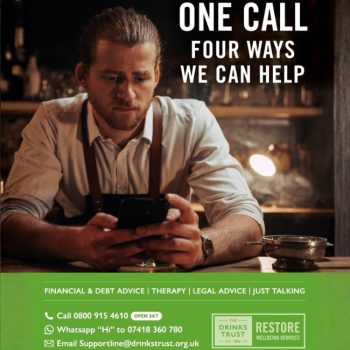
Some employers lack awareness of the resources available to maintain a healthy outlook for their staff, and, more importantly, for themselves. The Drinks Trust provides an online platform with financial, emotional, and training resources, as well as an advice line for managers and business owners who are worried about staff or feeling isolated and want guidance. The charity has also developed the Business Advisory Program (BAP) to help drinks industry organisations design and execute well-being strategies. The BAP helps businesses assess employee wellbeing through surveys, identify where to spend money, and train wellbeing champions to execute the strategy from within.
“The strength of our industry relies entirely on the wellbeing of our people,” says Burston. “We’ve got to make sure we keep the workforce happy, healthy, and thriving so that when everything starts booming again, we’ve got people in the right place and the right headspace to take it forward.”
Mental health crisis
However, it is the drinks industry’s community that is heralded as the key frontline defence against its mental health crisis. “We’re all in the same boat, and if owners use each other as support, that community becomes one of our best protections against burnout and loneliness,” explains Etherington-Judge.
For Aitken, who initially struggled alone, it was discovering the strength of his wider network that enabled him to shed the weight from his shoulders. “I didn’t realise the support network I had. I’d finish my shift and go talk to another bar, and they’re like, ‘Oh, we’re struggling like hell as well’. So you realise we’re all in the trenches together. The most important thing is reaching out, not just taking it all on yourself.”
But above all, Etherington-Judge says while things may feel “relentlessly bleak” – economically and emotionally – it’s important to know it won’t last. “It will stop raining at some point – it will,” he says.
Related news
Timmy Mallett joins Diageo's mental health campaign for men