


South America: where can spirits find success?
While South America faces a host of problems – some local, some global – it boasts spirits producers that aspire to greatness.
*This feature was originally published in the November 2025 issue of The Spirits Business magazine.
During what is undoubtedly a tough time for spirits around the world, parts of South America are among those offering hope, with Brazil in particular showing promise. But the region has its challenges, some reflective of global factors, others specific to local considerations.
A report this year from IWSR listed Brazil among the developing markets expected to contribute towards value growth over the next decade, alongside India, Mexico and South Africa. Mordor Intelligence, meanwhile, forecasts that spirits in South America will expand at a compound annual growth rate (CAGR) of 5.48% to the end of 2030. The latter’s report attributes this to factors such as the expansion of cocktail culture, premiumisation trends, and brand positioning targeting aspirational consumers.
“Whisky has always been a strong category in South America, followed by vodka and rum, as these are easy to mix in cocktails, which are popular at the moment,” says Veronica Huber, founder of Huber Brands, which represents producers throughout the Americas. “In general, requests for premium and craft alcohol products are on the rise.”
Lissa Barquero Carranza, co-founder of Costa Rica’s Locoto Imports, is similarly optimistic. “The spirits market in South America is in an exciting transition, with a clear movement toward authenticity, origin, and craft processes – a response to years of dominance by big industrial brands,” she says. “Even in markets facing economic pressure, there’s strong consumer curiosity for products that feel rooted in place.”
A host of challenges
Barquero Carranza says challenges include currency fluctuations and import tariffs, not to mention logistical ones. “Even within South America, moving a pallet from one country to another can be more complicated than shipping it to Europe,” she says.
André de Almeida is director at drinks consultancy Inside the Cask, as well as an exporter of spirits, mainly whisky, from UK producers to Latin American countries. He says: “The main structural challenges in the region are the high taxation levels, the high logistic cost to move stock, and the red tape that spirits brands have to navigate to enter the domestic markets in South America.”
Huber confirms these challenges, listing “increased tax and regulations to import and register brands locally, competition among brands leading to price wars, and informal trade at the borders across the region”.
Despite all of this, markets such as Brazil are showing promise. In May IWSR reported 1% growth in the country’s total beverage alcohol volumes in 2024, with value up by 5%. While beer was the main driver, it was helped by ready-to-drink (RTDs) offerings and brandy. In the year to June 2025, Diageo saw sales rise 18%, thanks to “premiumisation and strategic pricing actions, supported by a more stable consumer environment and targeted investment”. Growth was led by Scotch, with RTDs proving successful too.
The picture might be different for smaller brands, however. “The biggest challenge to the sector’s growth in Brazil is, and always will be, excessive bureaucracy, and high taxation,” says Rafael Nardi, co-founder of Brazilian independent whisky bottler Lunatic Asylum. “It’s practically impossible for small producers to export their products to Brazil in small volumes. We’re seeing more products from large conglomerates, and almost no independent distilleries entering our market.”
De Almeida is optimistic about Brazil’s whisky scene in general, though. “It continues to mature beyond the dominance of Scotch whisky, with consumers widening their repertoire to include Brazilian single malt whiskies, and whiskies from other regions of the world, such as Bourbon, which has grown significantly over the past few years,” he says. “The expectation is that there will be a slight volume decline in the near future, especially with younger consumers switching to beer and RTDs, but value will continue to grow as Brazilians trade up to higher-priced blends and single malt whiskies – as long as the economy remains strong.”
Alongside Brazil, Argentina is an important market for Chilean pisco, according to Claudio Escobar, manager of Pisco Chile. “These are priorities for the industry, and where the category is quite well known due to the significant flow of tourists from both countries visiting Chile,” he says.
Compañía Pisquera de Chile, owner of leading brand Pisco Mistral, confirms the promise shown by Argentina, as well as Paraguay, for its spirits. “Despite the challenges posed by the local economic environment in Argentina, in 2024 the market positioned itself as one of the top global destinations for our piscos,” a spokesperson for the company says.
For spirits in general, conditions in Argentina are indeed far from favourable. “The country is facing massive economic headwinds, with consumer confidence collapsing,” says Spiros Malandrakis, head of alcoholic drinks research for Euromonitor International. “That economic situation is not conducive for alcoholic drinks.”
That said, it’s not just pisco achieving success in this market, with certain categories overcoming the current obstacles. De Almeida says: “Argentina, where recent economic volatility has limited the variety of imported whiskies, has experienced a positive outcome, with the local distilling of quality domestic whisky.”
The rise of gin
Gin has also seen an increase there in recent years, says Charly Aguinsky, co-founder of cocktail bar Tres Monos in Buenos Aires. But the situation on the whole is challenging. “Argentina is undergoing a very difficult year financially, with heavy drops in sales in almost every category. Bars, restaurants, wine shops are at their lowest in years, if not decades,” he says. “The main challenge now is how to recover customers, where people can barely make it through, in a country that is now among the most expensive in the world.”
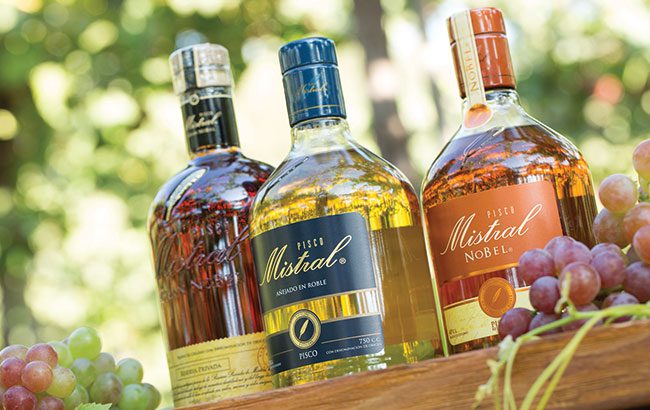
In Chile, overall spirits are on the decline, according to Compañía Pisquera de Chile’s spokesperson, who cites “a complex mix of economic, demographic, and regulatory factors”, but also adds that the domestic market for Chilean pisco remains an important one, accounting for 40% of total spirits consumption in the country.
Another factor specific to Chilean pisco, according to Escobar, is challenges surrounding water in the region where the spirit is produced. He describes the crisis as a “latent threat that could affect the production of pisco grapes, the raw material for production”.
Further afield, Colombia and Venezuela have proven to be strong markets for Diageo, according to its latest market report, with organic sales in the region rising by 21.5%, driven by its Buchanan’s and Old Parr whisky brands. Conversely, the combination of Argentina, Bolivia, Chile, Ecuador, Paraguay, Peru, and Uruguay showed a drop in sales of 6.3%, “driven by the volatile macroeconomic and the weakening consumer environment adversely impacting consumption”.
Premiumisation on the up
As with other global markets, discussions regarding the state of spirits in South America inevitably turn to premiumisation. Statistics from Euromonitor International reflect this, with Latin American spirits volumes forecast to increase by 1.1% and 1.8% over the next two years, respectively. But value, meanwhile, is expected to grow by 0.2% between 2024 and 2025, and then by 6.5% from 2025 to 2026.
“The spirits market, both in Chile and more generally in South America, is in a phase of consolidation and maturity, driven by quality,” says Compañía Pisquera de Chile’s spokesperson. “The super-premium segment – products priced between US$15 and US$60 per bottle – has been the key driver of both volume and revenue growth in recent years.”
There’s room to premiumise, says Nardi. “Brazil is one of the largest export markets for Scotch whisky in terms of quantity, but in terms of value, it doesn’t even make the top 10. Demand for single malts and more premium whiskies will likely increase in the coming years.”
Malandrakis believes that, while premiumisation is relevant, we will see some trading down, as well as trading across. “If you are, for example, a consumer of premium whisky, which is quite expensive, you might gravitate towards premium rum, or premium cachaça, which are, by definition, much more affordable. In trading across, consumers can save some money, but in terms of perception, in terms of aspirations, can still feel they are being more sophisticated.”
This presents an opportunity for local South American spirits. “During times of crisis, people tend to turn inwards. Local specialities are much more economical, and have the nostalgia factor, but they are also able to sidestep trade wars, embargoes, and everything in between,” adds Malandrakis. “There’s an opportunity for local products to actually look inwards, to improve their propositions, and come out of the crisis better, more sophisticated, and more generally authentically premium.”
Barquero Carranza is seeing this already. “There is a growing appetite for stories and transparency: who’s behind the bottle, where the ingredients come from, and how the product reflects local culture. There’s a regional sense of pride emerging, and consumers are looking within the continent for quality, not just to Europe or the US,” she says. “There’s huge creative energy, with young distillers, independent importers and bar programmes in Latin America building micro-ecosystems that prioritise local agriculture, sustainable sourcing, and storytelling.”
It’s one positive outcome, at least, amid an array of challenges faced by the region.
Related news
Global Bar Report 2025: South America
Tito’s makes headway in South America
Southern Distilling offers American single malt contract distilling