


What does it take to be Chivas Brothers’ master blender?
At the end of 2025, Sandy Hyslop retired from his role as master blender at Chivas Brothers, and in his place stepped Kevin Balmforth, a blending veteran with 27 years of experience. He gives us an insight into the scale of the role and shares the challenges of balancing traditional methods with modern innovations.
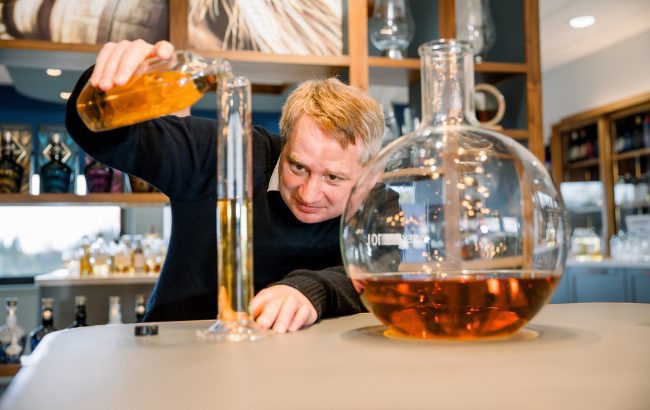
The role of master blender at Pernod Ricard’s Scotch whisky arm Chivas Brothers is a complex one, and certainly not a job to be taken on by someone with poor organisational skills.
When Balmforth took over the role following Hyslop’s retirement in December, he assumed responsibility for approximately 100 Scotch whisky brands, including bulk exports. This covers around 6.5 million casks, “more casks than people in Scotland,” he tells The Spirits Business.
“I dedicated my career to blending – working my way up through the ranks – and now as master blender it’s my role to look after the quality and the consistency of all of our Scotch whisky brands. It’s a huge, huge remit,” he shares.
He leads a team of eight, but those eight are the absolute authority on the company’s spirit quality from start to finish. “That’s not just from the maturation stage, but also right at the beginning of the distillation stage. We have the absolute authority through maturation, blending, bottling, and beyond. We’ve got lots of processes and procedures in place, and we’re very hands-on, traditional blenders, which ensures that the liquid quality is on the spec.”
This hands-on nature is not an understatement from Balmforth. “Every single drop that’s produced each week from all our distilleries is assessed. And we do it blind as well. Every single drop that goes into our casks has been rated and scored by us. I can say with a lot of confidence – going over the last 27 years – I’ve nosed and rated every single drop in our casks in that period.
“It’s quite a big job,” he confirms. “We normally insist on three people signing off on every sample. You know, we don’t take chances.”
All of that is just one element of Balmforth’s job. “That’s just our day-to-day core blending duties. On top of that, we have the innovation side. We have something like 50 new product developments underway at any given time. We could double that number again in terms of experiments – different cask types, different finishes,” he clarifies.
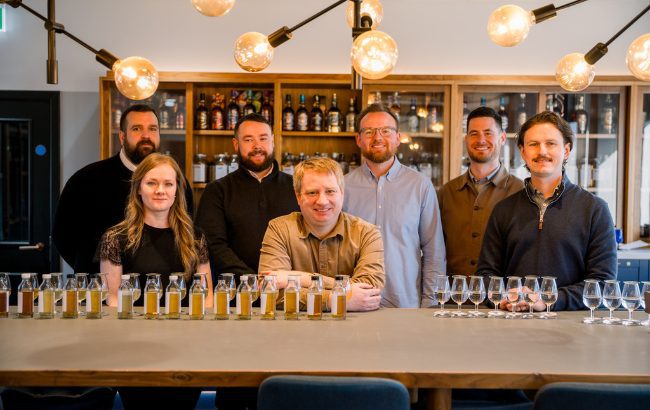
Flavour experts
At the heart of Balmforth’s role – and the role of his team – is flavour, and an expert understanding of how to create it.
“Everyone on the team is here because they’re passionate about Scotch whisky and passionate about what they do,” he says.
To get to the stage where his team are entrusted with signing off samples that cross their desks, between two and five years of training is required. “There’s no previous experience that can fast‑track that. You’ve got to have that hands‑on experience in the blending department – working with the team and me to achieve that level.”
So can anyone become a blender? “I think we, as humans, are quite good at discerning flavours – we’re all naturally quite good at it, and everyone can get better at it as well. Generally, what I’ll say is you get better with practice, and you get better with working with experienced people – that’s the best way to do it.
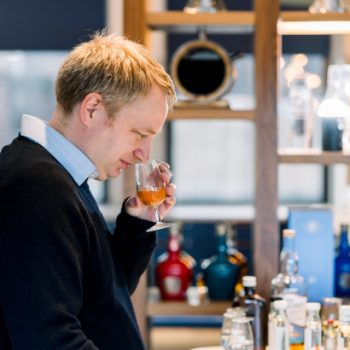
“I’m working with the team every morning when the samples are getting set. I’m there with the team nosing samples, and having that two‑way conversation.” He says that there is no discussion of the samples until everyone has nosed them and tasted them. “It’s that two‑way discussion that is the best way you can learn.”
To determine whether someone is ready for the role, Balmforth says he considers the words used to describe flavours, as they offer a good indication of how individual palates experience them. If the right language isn’t being used, then more training and practice are provided. “If they’re struggling with certain elements of any particular flavour, we can work on that. You can actually train yourself to see flavours that may be a little bit weaker.
“A lot of new people have come into the department over the years, and a lot of them come in with a certain amount of experience. They’re all into whisky, and they’ll have all their own opinions, but they’ll all tell you – every single one of them – their opinions change once they’re actually here working in the blending department, because you can’t really understand how it all works unless you’re here doing it. You can’t learn it in a degree or a course, or from a book. It’s got to be hands-on. That experience, that knowledge, has to be gained with that sort of sharing, working with a group or with other people.”
There is, of course, a nuance to flavour perception, and every individual’s palate is different, but Balmforth has methods of ensuring alignment across his team.
He explains: “We have a standard for every single sample. We never nose without an approved standard that we’ve pre‑approved.
“One of the hardest things as a blender is not being influenced and keeping an open mind, but we try to make it as easy as possible. So we have these tulip‑shaped glasses, cover slips, and we cut them down to 20% ABV. The environment is perfect. You know, we do everything we can so that we can serve as many flavours from any particular sample or whatever piece of work we’re doing.”
He’s adamant that, with all these measures in place, the team does not make mistakes, which is why the company can boast a consistent level of quality across its portfolio.
New product development
Across the Chivas Brothers stable of brands, there are numerous core expressions that maintain a consistent and much-loved flavour profile. However, leading new product development is also a key element of Balmforth’s job, which, he says, is not an add-on to the role, but rather runs in parallel with core quality control.
“Marketing will come to us saying, ‘We want to put a new product together’, and then it’s a conversation on what that product looks like. They might have a particular flavour target in mind, or they might just come to us and say: ‘What do you think? What can you do?’”
He explains that while some briefs do originate with the marketing department, especially those that lean into trend forecasts, the liquid ideas and prototypes overwhelmingly originate in the blending lab. “We’re the flavour experts. If we got left our own devices, everything would be flavour‑led.”
The team is restricted by limitations in terms of stock and inventory, “because they never give us 12 years’ warning to do a 12‑year‑old,” he notes, “but fortunately, we do have quite a large inventory, above what we need to support our main brands.”
Creating and blending new products is one of the ways Balmforth says he is able to flex his creative muscles, and new product development and experimental casks are the canvas where his own blending stamp really shows. “I guess I can express myself in the new development side. I do have such a huge knowledge of different types of casks and things like that, and that’s an opportunity I’ll look to leverage going forward.”
Ultimately, it is Balmforth’s understanding of cask varieties and finishes that will continue to fuel Chivas Brothers’ future commercial releases, while his grasp of flavours will run the engine of the company’s R&D.
He adds that constant experiments are being carried out with casks and finishes, and that “most of the new whiskies and new products have come from experimentation, or the sort of development we’ve already done.” As such, he notes that it is quite rare for the marketing team to approach him with something they haven’t previously explored.
However, he explains that working with cask finishing “is not as easy as it sounds”, with numerous pitfalls and a lot of traps. “You don’t want to overpower the whisky,” he shares. “You have to monitor it very carefully [and] the oak itself has to be good. If the oak is not good, then it doesn’t matter how good your red wine was; you’re not going to get a good result.”
He adds that overpowering is something they never do at Chivas; instead, they use finishes to add a new dimension of flavour while keeping the whisky recognisable as a Chivas release.
Exceptional casks
Throughout his 27 years as a blender, Balmforth says there is much he is extremely proud of.
One standout release he defines as a career highlight is The Glenlivet 200th-anniversary release – a 55-year-old whisky that combined deep technical work with bespoke Sherry seasoning and decades of maturation, and was paired with a highly emotional and historic tasting experience at the distillery.
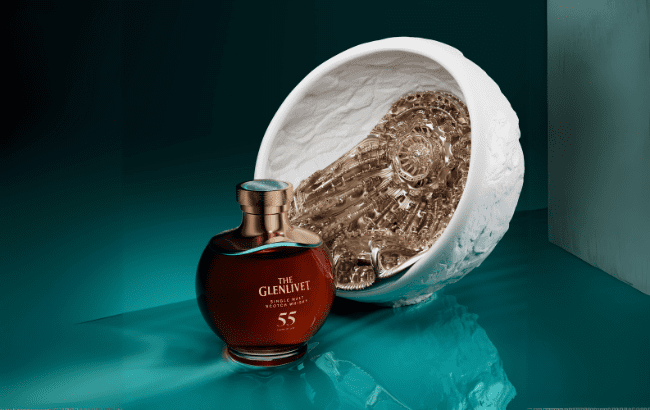
“We had this amazing two‑day event at the distillery. Maybe 100- or 200-odd people each night with this amazing long table in the still house that wound like the River Livet. And the amazing thing is, despite the number of people, everyone got to taste it. We all had this shared moment of tasting the 55-year-old on the 200th anniversary in the still house at the distillery. So it was quite a big moment.”
Looking ahead, he shares that there are casks earmarked for future anniversaries and special events that are selected through a deliberate ‘strategic reserve’ system based on continual tasting and ring-fencing.
“We’re sampling the inventory hundreds of times, thousands of times each year. You almost need to get a reaction when you nose it. You hear someone shout across the room, ‘Come on, come on, come on, nose this. This is incredible.’”
Once they identify a standout cask, “one that is especially special”, the team locks it away in the system so it can’t be used in regular blends: “We’re very active in creating a strategic reserve, and we have various other holds – we can put an allocation on the cask, which means it doesn’t get touched.”
He explains this has been the procedure for years, and so they have built up a selection of casks deemed potentially worthy of a special release. When such an occasion arises, they pull out the list and pick out the worthy casks.
However, if a special occasion hasn’t yet presented itself, Balmforth ensures the casks are managed correctly and carefully to avoid it spoiling. This doesn’t mean dumping it into a vat and forgetting about it. “I’d rather it was in the cask,” he explains. “If I thought the cask was starting to overpower the whisky, I would probably rack it into a different cask – a third‑fill – that will slow down the maturation process. You can keep a cask for quite a long time in that scenario.”
“If I wanted to keep that single cask status, I would just bottle it into like unmarked labels – much safer sitting in glass than it is sitting in a vat.”
Related news
Sandy Hyslop to retire as Chivas Brothers master blender