


SB visits… Loch Lomond Distillery
On the Highland-Lowland border of Scotland sits a distillery that, from the outside, is nothing special to look at; inside, however, it holds some of the most exciting and unique whisky-producing machinery in the world.

Some distilleries are shiny, polished and primed for visitors, while others require you to wear a hi-vis jacket and ear defenders, and are typically closed to the general public. Loch Lomond Distillery falls into the latter category, making the Highland-Lowland boundary-based site one of the most unique we’ve visited.
Founded in the 1960s by two former owners of Littlemill Distillery, the Loch Lomond Distillery in Alexandria, near the southern edge of the loch, has since built a reputation for doing things its own way.
Formerly a dye factory, the site is unique for producing both grain and malt whisky under one roof. As such, while many Scotch distilleries stick to one style, Loch Lomond practically runs a whisky laboratory. In fact, the site can create more than a dozen distinct whisky styles, from light fruity drams to smoky, peaty monsters. For comparison, most distilleries make only one or two house styles.
As Loch Lomond Distillery isn’t open to the public, tours here are a rarity. Gary Mills, the global brand ambassador for Loch Lomond Group, who was recently named Best Scotch Whisky Ambassador at the World Whisky Awards, guided us around.

Throughout the tour, Mills demonstrated the myriad ways in which Loch Lomond approaches whisky production differently from other Scotch distilleries. One of the key differentiators here is the use of long fermentation times.
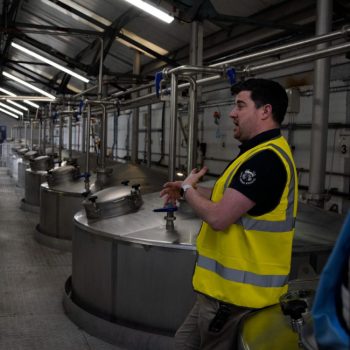
Loch Lomond Distillery is home to 21 stainless steel washbacks, 10 of which reside indoors and hold 25,000 litres. The remaining 11 hold a generous 50,000 litres each, and are located outside. One single batch of wash can fill either two interior or one exterior washback.
While many distilleries ferment for 48 to 60 hours, Loch Lomond does a minimum of 92 hours. This extended period allows the wort to linger in the washbacks and begin a secondary fermentation. While this doesn’t increase the alcohol content, it does craft longer-chain alcohols or esters for a more flavourful wash. The fruity notes that define the brand’s signature style have this process to thank.
The site also experiments with different yeast varieties, including Chardonnay wine yeast, to create unique flavour profiles.
Now, we’re no strangers to a whisky distillery, but it’s still exciting every time we step onto a still room floor and witness where the magic happens. But it becomes even more exciting when we get to see something we’ve never seen before.
Distillery-exclusive distillation methods
At Loch Lomond, the still room floor has a unique design with a combination of swan-neck stills – a style we’ve seen many times before – and straight-neck pot stills – unique to this distillery – which allow for more control over the spirit’s character.
Mills explained that these straight-neck stills increase copper contact and reflux, due to the perforated copper plates in the rectifying heads. This forces heavier vapours back down into the pot and makes it harder for heavier, oilier compounds to reach the top.
It also boasts a cooling ring around the top, filled with cold water. This further increases reflux and “effectively elongates” the still, making the distillation lighter and more refined.

Essentially, Mills explained, this creates a triple-distilled-style spirit using only two stills, as each plate acts like a mini distillation stage. Duncan Thomas, an American chemist who owned Littlemill Distillery and was often described as “a bit of a mad scientist”, invented this type of still.
Mills explained that “when the distillery opened, we only had the straight-neck stills. This was all we’d known for 30 years. We know these inside and out.”
While these stills were patented, Mills estimates that the patent likely expired about a decade ago. However, this hasn’t led to any other distilleries turning to straight-neck pot still distillation. The reason, Mills speculated, is that this style introduces many more variables to the process, from plate number, spacing, height and column size, to cooling configuration and cut strategies. This is risky for a new distillery that has to wait years to see the outcome. Most new distilleries, he explained, prefer known factors, which is why standard swan‑neck stills designed to target a specific style are often preferred.

By using these stills, and by altering cuts and using the plate setup, Loch Lomond is able to fundamentally change the character of its new-make spirit.
“The straight-neck still allows us to create five distinct new-make spirits,” Mills explained. “Combine that with the three we make from the swan neck, and you’ve got the ability to make eight distinct new-make spirits from one still room.”
On-site cooperage
The distillery uses 23.5 tonnes of Scottish barley daily and has an annual capacity of 25 million litres of pure alcohol. Such high production levels require a lot of space; as such, the site has 28 warehouses that together hold 500,000 casks.
With half a million casks comes a high level of maintenance. Loch Lomond is one of only four whisky distilleries in Scotland to have its own on-site cooperage.

The cooperage exists to inspect, repair, and rejuvenate casks, ensuring structural integrity and consistent whisky quality at scale. By managing defects, extending cask life, and tailoring ex‑Bourbon barrels in‑house, the coopers give the distillery tight control over one of its most important flavour variables while supporting long‑term self‑sufficiency and craft skills.
As we toured the cooperage, Mills explained that the team of eight full-time coopers and one apprentice repairs and maintains approximately 25,000 to 30,000 casks per year, while rejuvenating a further 25,000 casks annually.
On average, the coopers find that around 20% to 30% of casks arrive with some defect. Repairs are made via the replacement of defective staves to avoid leaks, collapses and product loss. The techniques have remained largely unchanged for 150 years, with many of the tools passed down over generations.
Loch Lomond matures all of its whisky in ex‑Bourbon American oak, but it doesn’t rely on just one American distillery. Rather, casks are delivered from the likes of Heaven Hill, Wild Turkey, and Jim Beam, though Mills clarified that they no longer use casks from Jack Daniel’s on account of their ‘lesser quality’.
Key challenges and future plans
Mills shared that Loch Lomond’s main challenges stem from being a high‑capacity distillery squeezed into an old dye‑factory site, which creates pinch points for expansion. Plus, managing a vast stock of around half a million casks while maintaining quality and safety also has its challenges.
Future expansions of the site are therefore likely to be incremental and engineering-led. However, the constraints of the existing building mean any changes will need to be about optimising and upgrading rather than massive footprint growth.
What is easier, however, is to focus on deepening flavour innovation via fermentation and yeast. This can be done during the site’s two-week summer shutdown, but it is a long-term project, with a goal of pushing fruit and complexity via fermentation rather than relying solely on cask tricks. Ultimately, Mills explained, the goal is to keep Loch Lomond’s spirit profile distinctive as more distilleries adopt similar long‑fermentation ideas.
Beyond that, the distillery is grappling with the challenge of effectively communicating a very complex production set‑up into clear, simple messaging for consumers. While this might be easier if the site opened to the public, enabling them to see first-hand how this unique distillery operates, we’re quite glad to be part of an exclusive cohort given a rare behind-the-scenes look into how Loch Lomond Distillery operates. It makes us feel almost as special as the whisky produced here.
Related news
SB visits… Volcan de mi Tierra