


How Brandy Noble 1954 is shaking up the category
In Colombia, family-owned Picciotto Distilling Company (PDC) is drawing on decades of brandy-making heritage to bring Noble 1954 to international markets, combining the traditional solera ageing system with tropical maturation and local grapes to create a distinctive, modern interpretation of the spirit.
As producers around the world look to reposition brandy for the 21st century, new origins are reshaping the category.
“My grandfather became partners with the Domecq family in 1954. That’s really how brandy first arrived in Colombia,” says Jenny Picciotto, communications director at Picciotto Distilling Company. “From there it grew into something much bigger than we ever imagined.”
For Picciotto, Brandy Noble 1954 is not another premium brown spirit entering the international market. It represents more than seven decades of family distilling history, rooted in one of Latin America’s most established drinks producers and shaped by a long-standing relationship with the Spanish brandy tradition. “Brandy became our battle horse,” she says. “It became incredibly popular in Colombia, and over time it really became the heart of our business.”
Today, the spirit’s legacy is taking on renewed relevance as producers worldwide work to broaden brandy’s appeal to modern audiences, reworking what was seen as something to sip into a delicious cocktail base for younger consumers and new markets. As brandy has become more mainstream, it is names from outside the French heartlands that are beginning to play a larger role in the category’s evolution.
The Picciotto Distilling Company (PDC) is a family-run distillery that has been producing spirits for more than 70 years.
“We still produce these amazing spirits that come from Colombian land, made by Colombian hands,” Picciotto says. “And now we’re taking them to the world.”
In a category historically dominated by Cognac and Spanish brandy, Noble 1954 illustrates how producers from new regions are reshaping brandy’s global narrative, and bringing fresh terroir and a different value proposition to the category.
Picciotto Distilling Company’s story stretches back to the mid-20th century, when the family business first partnered with Spanish brandy producer Domecq. “At the beginning, it was really about bringing that expertise into Colombia,” Picciotto explains. “Through that partnership, we started producing brandy locally, and it quickly became extremely popular.”
By the 1960s, the company had begun producing brandy domestically, adapting Spanish production techniques to local raw materials and climate. Over the following decades, the family business expanded its activities across multiple drink categories, including rum, whisky and wine, while continuing to develop its brandy portfolio. “My father and my uncle joined the business in the 1980s,” Picciotto says, “and brandy just kept growing.”
Criaderas and solera ageing system
Today, the company operates a large distillery in Cali, while its corporate headquarters remain in Bogotá. The facility produces a wide range of spirits, but brandy sits firmly at the centre of the operation.
From a technical standpoint, Noble 1954 remains rooted in the traditions of Spanish brandy. The spirit is distilled in copper pot stills and matured using the criaderas and solera ageing system, a fractional blending technique developed in Jerez. “The solera system is one of the most elegant ageing systems in the spirits world,” Picciotto explains. Unlike static ageing, where a spirit matures in a single cask until bottling, the solera method involves a dynamic process of blending across multiple tiers of barrels.
The young spirit enters the upper layer of the system, known as the criadera. Over time, it gradually moves down, blending with older reserves as it progresses through the tiers. The finished brandy is drawn from the bottom row – the solera – while younger spirits replenish the upper levels.
“No barrel is ever fully emptied,” Picciotto states. “Every bottling carries the memory of every vintage that came before it.” For producers, this system delivers one major advantage: complexity. “The continuous blending of younger and older spirits creates a balance and layered aromatic complexity that single-cask ageing simply cannot replicate,” she adds.
While the ageing method reflects Spanish heritage, Noble 1954’s raw materials are anchored in Colombia. The brandy is produced using Isabella grapes grown in Valle del Cauca, one of the country’s most fertile agricultural regions. “Our Isabella grapes come from fields in Ginebra, Santa Helena, and Guacarí,” Picciotto explains. Beyond the grape variety itself, the tropical environment plays a crucial role in shaping the final liquid. “Our climate creates a dialogue between the spirit and the oak,” she says.
Higher temperatures accelerate interaction between spirit and barrel, leading to faster extractions of flavour compounds and more rapid maturation than in cooler European climates. Combined with pot still distillation and the solera system, this environment allows the distillery to create brandy with significant depth of flavour. “When someone picks up a bottle of Noble 1954 and discovers just how much character there is in it,” Picciotto says, “that’s the moment we work for.”
In a category often associated with high luxury price points, Noble 1954 deliberately positions itself differently. “Our greatest ambition has always been to craft a brandy of outstanding quality at a price that makes it accessible,” Picciotto explains. This approach reflects changes within the brandy category, where producers are increasingly emphasizing versatility and value. Compared with premium whiskies and aged rums, brandy can often deliver comparable complexity at a lower price point, an advantage that producers are increasingly highlighting. For Noble 1954, that balance between quality and accessibility has become central to the brand’s identity. “What makes it possible is the combination of Colombian terroir and a production process we have refined over seventy years,” Picciotto says.
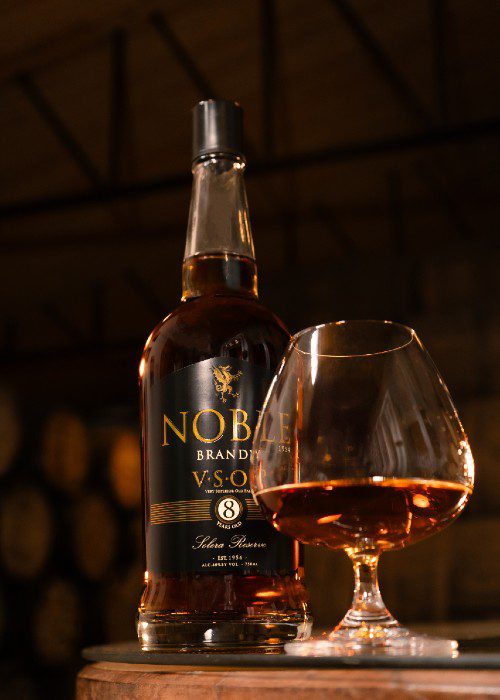
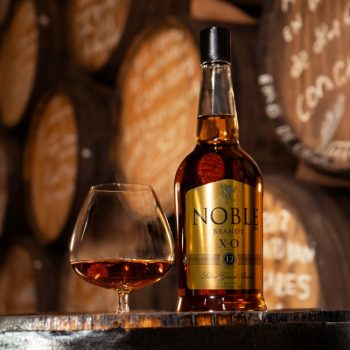
The Noble 1954 collection currently consists of three expressions, each aged using the solera system but designed to appeal to different occasions and drinkers. Noble VS serves as the entry point into the range and is particularly suited to cocktails and casual drinking occasions. Noble VSOP, labelled as a Solera Reserve, raises the minimum age of the youngest brandy in the blend to eight years old and comfortably sits between cocktail versatility and sipping quality. At the top of the range sits Noble XO, a Solera Grand Reserve with a minimum age of 12: “This is the brandy for moments worth remembering,” Picciotto smiles.
International opportunities for growth
While Brandy has traditionally been positioned as a sipping spirit, Noble 1954 is increasingly finding its place behind the bar. In the US, currently the brand’s key export market: “One of the most exciting things we’re seeing is bartenders gravitating towards Noble 1954 as the base for their Sangria,” Picciotto says.
Beyond Sangria, the company has also been promoting serves such as the Dragon’s Margarita, which combines Noble VSOP with citrus for a twist on the Margarita format. For the XO expression, Picciotto highlights the Carajillo, pairing the brandy with freshly brewed Colombian coffee.
The company is increasingly focused on international expansion, supported by Colombia’s extensive network of free trade agreements, which could provide a strategic advantage for Noble 1954. The immediate priority is the US, where distribution currently spans Florida, New York and New Jersey through two key partners. “These partnerships have been instrumental in getting Noble 1954 into the right venues and onto the right back bars,” Picciotto says. From there, the company is considering its next stage of growth. Asia, and in particular China and Japan, represents one of the most important brandy markets globally, and the brand sees potential opportunities there in the future.
Long overshadowed by whisky and premium rum, brandy is increasingly being reintroduced to younger drinkers through experimentation and new geographical narratives. Producers from Latin America, Asia and other emerging regions are playing an important role in that awareness. For Picciotto, the opportunity is as much cultural as commercial: “I feel incredibly proud that we’re finally getting the recognition as Latin Americans that we deserve,” she says.
With its combination of Spanish tradition, Colombian terroir, and family-run production, Noble 1954 offers a glimpse into how the category might evolve. In a global drinks landscape increasingly open to new origins and fresh perspectives, the next chapter of brandy may not belong solely to its historic European heartlands; it might be written in places like Valle del Cauca, Colombia.
Related news
Top 10 biggest-selling brandy and Cognac Brand Champions
Why Armenian Brandy is ready to join the world’s great spirits