


Grasmere aims to produce 100% Cumbrian whisky
English distillery Grasmere will begin malting its own barley at its production site in the Lake District in a bid to make the first 100% Cumbrian whisky.

Grasmere partnered with local farmer Jonathan Bainbridge of Thistlewood Farm in Cumbria to plant its first crop of Laureate barley earlier this spring, which is expected to be ready for harvest in late August or early September 2026.
Bainbridge’s family has owned Thistlewood for 25 years, producing barley, wheat and oats with consistently strong results. However, this is their first time growing Laureate – a spring barley known for high yields and approved for both brewing and malt distilling.
The initial crop of eight tonnes will support both brewing and early-stage whisky experimentation, including the development of a distinctive house style.
Bainbridge commented: “South of Carlisle, we’ve got some good fertile soil and good-sized fields for producing crops. It’s an ideal place to trial this. We grow barley, wheat, and oats, but this is our first time growing Laureate barley in particular. It’s something people grow for the market for distilling, and it has all the attributes you need to make the whisky taste good, so it’ll be interesting to see how it does.’’
This agricultural partnership marks an important step in the distillery’s long-term vision to work with growers across Cumbria to produce a series of individual whiskies that reflect the county’s diverse terroir and its six distinct regions.
Each harvest will allow the production of up to four barrels of whisky, with the first releases expected in 2032, following a minimum six-year maturation period.
In the meantime, consumers can expect to see malt-forward beers produced from the distillery’s own barley available later in 2026.
Grasmere head distiller and co-founder Paul Abbott will oversee the project.
He said: “We’ve always wanted, as an ambition, to make a whisky that was 100% Cumbrian – Cumbrian barley, Cumbrian water, distilled in Cumbria, stored, matured in Cumbria – everything from start to finish. We’ve been looking for a farmer who would take a risk on us to grow some barley for us, and we managed to find John.”
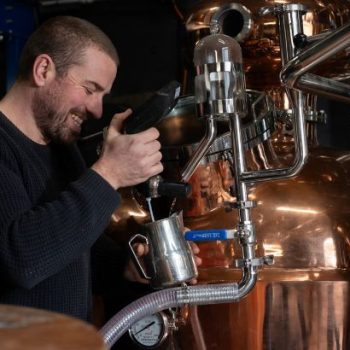
To support this next phase, the distillery has invested approximately £10,000 (US$13,505) in new equipment, including a stainless-steel immersion tank, a mash tun with heat jacket control, and augers for handling malt.
Plus, in collaboration with a local blacksmith, the team has also built a bespoke kiln, enabling them to complete the traditional malting process on site.
Abbott added: “We’re installing a maltings in Grasmere – probably the smallest maltings in the UK, which is hilarious, because most people are trying to be the biggest.
“Malting Cumbrian-grown barley here is a huge step towards creating something genuinely rooted in this place. We’re working on a very small scale, which gives us the freedom to focus on quality and individuality. Every batch will be different, shaped by the barley, the water, and the conditions of that particular harvest.
“By using Cumbrian water and locally grown barley, we’re aiming to produce a whisky that truly reflects the landscape it comes from. It won’t be about volume; it’ll be about character, small-batch, hands-on, and unmistakably Cumbrian. That’s what makes it exciting.”
Abbott confirmed that they will be able to malt “about half a tonne at a time”, which is enough for one 200-litre barrel of whisky.
“It’s an exciting project for me, and I hope it’s worth the wait.”
Abbott co-founded Grasmere Distillery in 2021 with his wife Beth, transforming two modest barns on the shores of Grasmere into one of the UK’s smallest distilleries.
Following the launch of the distillery’s gin and vodka range in 2022, revenues have been reinvested to expand production and lay the foundations for its single malt whisky programme.
Elsewhere in Cumbria, it has been announced that The Lakes Distillery has closed its brand home and visitor centre at the cost of 15 jobs.
Related news
Witchmark: how history is influencing the future of English whisky