


Cuervo CEO: spirits slowdown ‘mostly cyclical’
Despite a fourth-quarter sales slide, Jose Cuervo’s parent company said it “outperformed” the US spirits sector in value growth while avoiding heavy discounting for its Tequila.
Mexican spirits firm Becle, which also owns 1800 Tequila and Kraken Rum, saw its full-year revenue fall by 2% with the Jose Cuervo brand down by 3.7%.
The business suffered a 14.1% sales drop to MXN11.08 billion pesos (US$645.1 million) in the fourth quarter (Q4) of 2025.
In Q4, the flagship Jose Cuervo Tequila reported a 15.1% sales decline alongside a double-digit drop for the group’s ‘other Tequilas’ – which includes Gran Coramino and Maestro Dobel.
In an investor call for its full-year results, Juan Beckmann Legorreta, CEO, general manager and proprietary chairman, described 2025 as a “year of navigating challenges” with an “unusually complex global spirits sector” that he expects will remain in 2026.
But he told analysts that the business had expanded its leadership position in the Tequila category and “protected pricing better than the industry standard”.
He continued: “We are proactively assessing market conditions to reinforce our strong foundation for sustained long-term growth.”
Becle’s sales of ‘other spirits’, which includes brands like Bushmills Irish whiskey, Kraken and Three Olives Vodka, plunged by 14.5% in Q4.
Legorreta said it was important to highlight that spirits continue to take share from other alcohol segments.
“Within that context, Tequila continues to outperform other full-strength spirits categories with solid price mix growth, and premiumisation trends remaining intact, favouring our core strengths.
“Cautious of shifting consumption trends, we believe the current slowdown is mostly cyclical, driven by macroeconomic headwinds and inflationary pressures. Historically, the spirits industry has experienced periods of expansion and contraction, and we expect demand to recover as consumers’ confidence improves.”
He added the business had entered 2026 with a “healthy mix of realism and optimism as we anticipate that the years ahead will continue to require bold adjustments to position us better for 2027 and beyond”.
In terms of markets, the US and Canada saw sales fall by 8.4% last year. The company’s home market of Mexico was down by 1.1% and the rest-of-the-world region decreased by 4.4%.
In Q4, US and Canada sales dropped by 11.8%, Mexico was down by 12.2% and the rest-of-the-world dipped by 0.9%.
Tequila: ‘most resilient’ category
Mauricio Herrera, managing director of US and Canada, said Becle’s Q4 results in its biggest market “reflected a combination of continued industry-wide headwinds” and commercial actions that were taken to “position the business for long-term success”.
He noted that spirits demand “decelerated through the back of the half year” in the US.
Herrera continued: “US spirits trends deteriorated sequentially in 2025, with a slowdown, particularly evident to our year-end. Against this backdrop, Tequila continues to stand out as the most resilient full-strength spirits category, delivering volume growth of 2.3% in the year, according to Nielsen data.
“While growth in the broader spirits market has skewed towards prepared cocktails, Tequila has transitioned from a high-growth phase to a more normalised stabilisation phase. It remains an attractive category and continues to outperform other spirits.”
Becle’s Tequila portfolio also “continues to outperform the market”, Herrera told analysts, with the exclusion of ready-to-drink (RTD) products.
“Data for the three-month period ending in November shows that Proximo continued to outperform the broader industry in value growth within full-strength spirits and more specifically within the Tequila category,” he explained.
“Nielsen data for 2025 further supports this performance showing that Proximo’s volume declined 2.5%, outperforming the overall market by approximately 100 basis points.”
As indicated earlier by the group’s CEO, Herrera said pricing was a “defining feature” of its strategy in Q4.
“As demand moderated, competitive behaviour intensified with the overall Tequila category experiencing a price decline of approximately 9.2%. By contract, our average pricing decline was limited to 5.1%.”
He noted that the firm, unlike its competitors, had avoided “aggressive discounting” to protect its brand and margin equity in the long term.
RTDs: ‘attractive growth opportunity’
Herrera also called out RTDs as “one of the most attractive growth opportunities” where the company is “underrepresented”.
In Q4, the company’s RTD portfolio was flat but for the full year it saw an uplift of 13.8%.
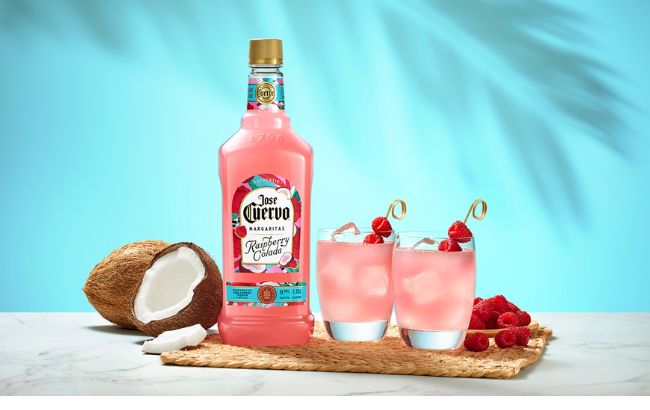
Becle’s RTD portfolio includes Jose Cuervo Authentic Margs, 1800 Authentic Margarita and Playamar seltzers.
He noted that the company had increased its focus and investment behind RTDs in the second half of the year.
“To further accelerate performance in this segment, we are building a stronger innovation pipeline and evaluating route-to-market alternatives that enhance coverage and execution.”
Herrera noted that shipments had fallen “more sharply than depletions on a quarterly basis” after the business took a “measured approach” to avoid inventory build-up.
He also warned that retailers had continued to cut their inventories to “historically low levels”.
The Jose Cuervo maker also shifted its distribution in the US and Canada from 1 February, ending its partnership with Republic National Distribution Company (RNDC) in all markets except for Georgia and New Mexico.
“These transitions may introduce some near-term volatility, particularly in the first half of the year, we believe this change will significantly strengthen our commercial foundation and position us to compete more effectively in an increasingly dynamic US marketplace.”
‘Impossible to estimate’ GLP-1 impact
On a question on the impact of GLP-1s on the Tequila category, Herrera said it was “almost impossible to estimate”.
“We do see evolving consumer trends,” he continued. “I think there’s a lot of different things happening in the market at the moment that consumers are looking for different alternatives.
“We see the emergence of RTD, we see changes in patterns of consumption. So attributing any sort of impact to GLP-1 becomes, I would say, almost impossible. So it’s something that we do monitor closely, but at this point, attributing any impact to that is really difficult.”
Herrera voiced optimism for the US spirits market, calling its long-term fundamentals “strong”.
“We believe Tequila is positioned to be the industry’s main growth category over the next decade, a trend that directly benefits Proximo as a category leader.”
Tequila is also “gaining momentum” across the rest of the world, according to Shane Hoyne, managing director of Europe, Middle East and Africa, and Asia Pacific.
But he notes that the region also faces the same inventory challenges: “Particularly in the first half, elevated inventory levels across the broader industry impacted shipment patterns as distributors and retailers focused on reducing working capital and operating with lower inventory levels.”
Pricing is also “highly competitive” in the region, but Hoyne said “discounting activity appears to have largely stabilised”.
He also noted that consumers in the region are switching to Tequila from other spirits categories, like whisky and Cognac, with some drinkers moving straight into aged Tequila.
‘Long-term potential’
Becle’s general director of administration and finance, Rodrigo de la Maza Serrato, also highlighted that the company’s rest-of-the-world business has doubled in size since 2019 in net sales value.
“Tequila remains a high-growth category with substantial long-term potential, particularly in markets where penetration remains low,” he added.
Using 2019 as a pre-pandemic reference point, he noted that Becle’s “net revenues are up 45%, driven by 10% volume growth and a 35% increase in average price per case”.
He believes this is driven by premiumisation, adding that the average price per case has risen at a 5% compound annual growth rate (CAGR) since 2019.
In terms of guidance for the year ahead, Serrato called 2026 a “transition year” due to the shift in its US distribution network.
“We expect the broader operating environment in 2026 to remain challenging with limited visibility given macroeconomic volatility and continued consumer uncertainty.
“Considering these factors, we expect net sales value to decline in the low-single-digit range in 2026 on a constant currency basis.”
Related news
CasAzar Tequila seeks $2m funding