

The rise of artist-designed bottles in spirits
The way in which high-end spirits are working with artists is increasingly important to catch the attention of fans and collectors.
*This feature was originally published in the December 2025 issue of The Spirits Business magazine.
In October, the Distillers One of One held its third biennial auction – a charity event supported by Sotheby’s that smashed records to raise £2.3 million (US$3.1m). The 39 lots were all one-of-a-kind bottles of whisky, where in many cases the packaging and artistic presentation was just as important as the liquid inside.
Old Pulteney’s Polaris was created for the auction, released ahead of the brand’s 200th anniversary in 2026. The 47-year-old whisky comes in a hand-blown, blue 1.5-litre glass bottle created by artisan glassmaker Glasstorm, encased in Caithness slate with a ‘secret’ copper disc, reclaimed from an old still, at the base.
The trend towards artist-led bottles and bespoke packaging is being driven by “collectability and a desire for authentic storytelling”, says Fiona Kennie, global marketing director at International Beverage, which owns Old Pulteney. “Consumers are increasingly looking for products that are both rare and meaningful, with limited edition bottlings like Old Pulteney Polaris offering the perfect marriage of a collectable art piece and an exceptional whisky.”
Polaris fetched £62,500 (US$82,744), smashing its top pre-sale estimate of up to £40,000, but was one among several striking bottles to have set paddles wagging. The Glenlivet Spira 60 Year Old, the oldest expression to be released from the distillery to date, was presented in a 1.5-litre spiral decanter, also crafted by Glasstorm. Its top estimate was £110,000, yet it sold for £650,000 – an auction record for The Glenlivet.
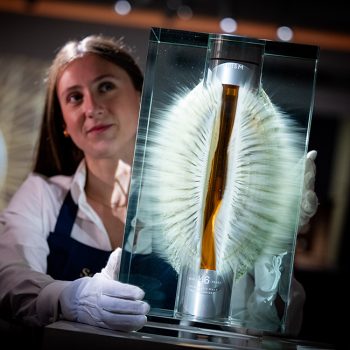
Port Ellen’s 46-year-old one-off Prism, created to mark its 200th birthday, was equally striking. Presented in a 1.5-litre glass decanter, created by glassmakers at Essex-based chemistry lab equipment manufacturer Radleys, is encased in a glass sculpture by artist Wilfried Grootens, which features individual sheets of painted glass creating a three-dimensional illusion that changes when moved. Its top estimate was £300,000 but went under the hammer at £375,000. High-end whisky auctions aren’t anything new, but Distillers One of One is reframing whisky not just as something to be consumed or traded, but as collectable art. The fact that the auction was so voraciously received is a further sign that the idea of packaging as ‘art’ is thriving.
This month, Scotch distiller Compass Box will host its first art exhibit in partnership with drinks design agency Stranger & Stranger. Called Imaginarium: The Fantastical World of Compass Box and Stranger & Stranger, the month-long exhibition will celebrate the brand’s 25th anniversary through visual exploration of imagination, design and storytelling at The Wolfsonian-FIU – a museum, library and research institute in Miami Beach, Florida.
Centre stage
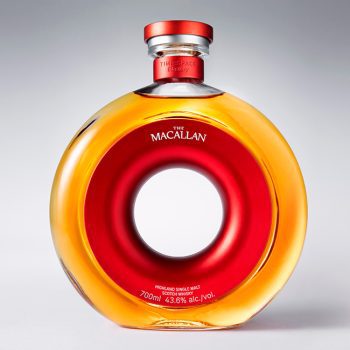
Last year, The Macallan launched its Time:Space collection to mark its bicentenary year – a pair of limited edition bottles priced at £150,000. The liquid was exceptionally rare, but it was the packaging that took centre stage. Time:Space is housed in a circular vessel protected by a ring of chieftain’s oak adorned with spikes, designed by Glasgow-based Irish designer and wood artist John Galvin. It sought to create “a new red spiky world; a visual language where time travel and nature connect and protecting spikes are the heroes” – a passage you’d expect to read on a gallery wall, not on the side of a whisky bottle.
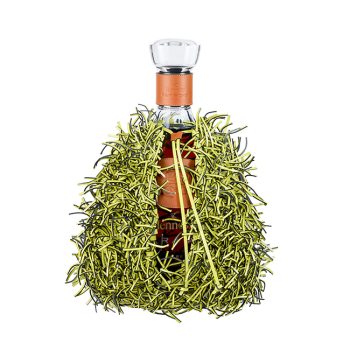
But this trend is not confined to Scotch. Plenty of spirits brands are seeing the value in releasing artist-led bottles. This year, Pernod Ricard’s Absolut, which has long released limited edition bottles, launched one that celebrated the late New York street artist Keith Haring, inspired by an original piece of art he created for a 1986 Absolut campaign. LVMH-owned Hennessy also unveiled a high-end collaboration with fashion house Loewe, which designed a limited edition bottle for its Paradis Cognac. The leather ‘nest’ that houses the bottle took Loewe designers more than 10 hours to create, and was intended to mimic a chestnut tree ‘burr’, in reference to the wood used to age the liquid. Each ‘nest’ features up to 850 intricate knots, mirroring the complexity of the spirit.
“Some people see these specials as investments, as rarity usually brings with it great value,” explains Kevin Shaw, founder of Stranger & Stranger. “And it needs to; it takes the same amount of effort for us to create a one-bottle SKU as it does to create a million-bottle SKU, and you have the cost of the artist on top. The unit cost of the bespoke dry goods goes through the roof, and the specials always come with lavish secondary packaging. We’ve even gone as far as designing a custom cabinet for one Scotch. The secret is making sure your PR comms is on point to communicate the rarity.”
High-end global brands might be able to justify the financial outlay required to create a one-off bottle, which also highlights a shift within luxury markets to justify rising prices through increasingly high-end craftsmanship. But what about smaller brands? What are the benefits of investing in an artistic collaboration? This year Renais Gin, founded in 2023 by siblings Alex and Emma Watson, partnered with London-based artist and print designer Frankie Penwill on a limited edition bottle and print that celebrated the seasons.
“The more cultural touch points a brand can create or lean into, the better,” explains Alex Watson. “What’s driving this movement is a desire for brands to live beyond the confines of their category, to exist in the real world and in culture. Whether that’s through sport, music, or art, the better your brand can show up outside the traditional product space, the stronger the connection with consumers.”
The addition of a printed piece of art with every purchase brings something “tangible and lasting” to each purchase, he adds. “I hope these partnerships keep pushing boundaries and getting more innovative, because it’s a challenging time for the industry, and creativity and collaboration will be key to its future success.”
Part of the appeal of artist-led packaging is how it can shape consumer perception because it offers a brand a “powerful way to express its values through culture”, adds Lander Otegui, executive vice-president of marketing and innovation at Proximo Spirits, which distributes 1800 Tequila in the US.
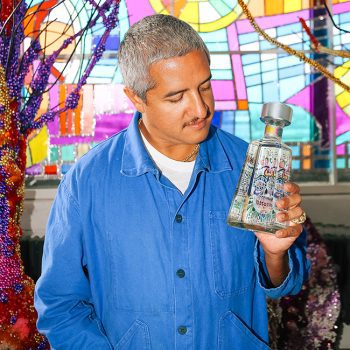
Building upon previous collaborations with artists Dustin Yellin, Okuda San Miguel, Shantell Martin, Enoc Perez, and the Basquiat and Haring estates, this year 1800 released its 12th Essential Artist Series. It showcased a set of six limited edition bottles designed by Mexican multimedia artist Raúl de Nieves. “When an artist’s vision authentically aligns with what a brand stands for, the packaging becomes more than design; it becomes a point of view,” Otegui adds. “That emotional connection elevates how consumers perceive the product, making it feel more meaningful, collectable, and worth exploring.” The hope is that some of the kudos gained from one-off collaborations with trendsetters transfers to the main brand, and perhaps attracts consumers from different cultural spaces who might not have engaged with spirits before. At the time of writing, a complete set of empty 1800 Tequila Artist Series 11 bottles was being sold on eBay for US$500.
Diageo has brought in Balmain’s creative director, Olivier Rousteing, to design bottles for Johnnie Walker, in partnership with Baccarat Crystal. And in September, Diageo-owned Don Julio launched a partnership with Mexican-American fashion designer, Willy Chavarria, for its second 70 Añejo Cristalino Artist Edition Bottle.
“Cultural storytelling and representation of Mexican traditions” was central to the collaboration, which not only brings the brand’s story to life, but helps to engage with different demographics and younger consumers, explains Sophie Kelly, senior vice-president of global Tequila and mezcal at Diageo. “Creative partnerships in the spirits industry are evolving into immersive, culture-driven experiences that go beyond packaging or promotion,” she says. “Today’s consumers seek authenticity, craftsmanship and storytelling, and artist-led collaborations deliver all three.”
In many ways, spirits packaging has already become a legitimate art form, reshaping how brands engage consumers and perceive value. For high-end collectors, there is reward in rarity and craftsmanship, in bottles that go beyond practicality and become art pieces. As Stranger & Stranger’s Shaw states: “Bottles have become collectors’ items and even empty bottles change hands on the secondary market – the humble drinks bottle has become covetable.”
For the more crowded middle market, visibility is everything. Often that doesn’t come down to the quality of the liquid, much as we’d like to believe, but whose influence you attract and the values they can ascribe to your brand. Be it the artist, or the influencers that latch on to promote it, collaborations can be a thorny, unpredictable path, but there is reward in the risk, says Shaw.
“No one wants to be described as cookie cutter, so these one-offs and limited editions bring a lot of kudos. There can be some trickle-down to the main brand, but not always. We’ve worked on a lot of specials and exclusives, including the 1800 Artists and One of One whiskies, and I’ve seen first-hand [at one of the 1800 Artist launches] how influencers and fashionable folk love them, just as much as their one-off running shoes.”
Related news
Top marketing moves from June 2026