


The big interview: Qiqi Chen, Cheng International
Fenjiu claims to be China’s oldest baijiu and one of the world’s most valuable spirits, but it is largely unknown outside of its home market. Qiqi Chen shares why she is determined to make baijiu a staple in cocktail bars.
*This interview was originally published in the January 2026 issue of The Spirits Business magazine.
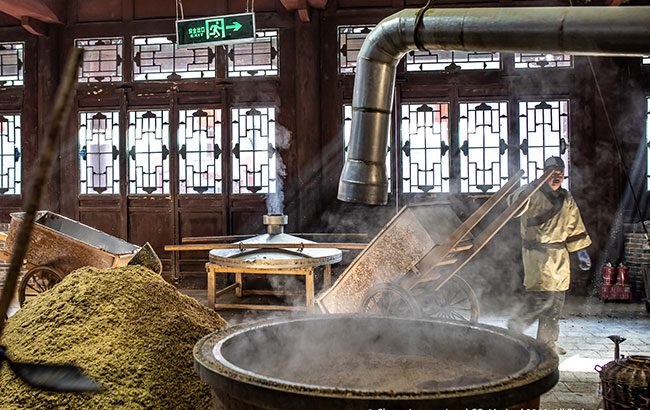
In Xinghua Village, a rural enclave near Fenyang city in north China’s Shanxi province, the air carries the faint, sweet grain aroma of fermenting sorghum. It is here that Fenjiu, which lays claim to being the world’s oldest Chinese baijiu brand, traces its origins back more than 6,000 years to the Yangshao period.
Today, it is also one of the world’s biggest spirits brands, with Brand Finance naming it the fourth most valuable spirit globally in its Spirits 50 2025 ranking, valued at US$5.87 billion, just behind fellow baijiu producers Moutai, Wuliangye and Luzhou Laojiao. Fenjiu is now on a mission to expand internationally.
Known for its light aroma style, Fenjiu uses organic sorghum and pure water drawn from 840 metres underground.
London importer and distributor Cheng International began distributing Fenjiu in the UK in 2018. Founded to challenge perceptions of baijiu, and build a premium market for the category, Cheng secured listings for Fenjiu at retailers including Harrods, Selfridges and Harvey Nichols.
Changing views
The company is now turning its attention to growing the brand through the on-trade, as managing director Qiqi Chen explains. She hopes to shift how consumers view and understand baijiu. “I want to see one cocktail with baijiu in every bar,” she says. “Then people will start talking about it.”
Chen likens baijiu’s potential to the fast-growing mezcal category. Despite being the biggest spirits category in the world, baijiu remains largely consumed in its home market, leaving significant growth opportunities internationally. Overseas expansion has become increasingly important as the category has slowed in China, due to curbs on government spending at banquets, and a growing consumer preference for lighter drinks.
“I don’t think any other brand has a strategy likes ours,” Chen says. “We were seeing baijiu in the UK long before we started distributing here. It was just randomly popping up here and there, in supermarkets in Chinatown and some high-end Chinese restaurants, you would see one or two bottles sitting on the shelf, but no one has ever introduced it or talked about it.”
She also points to a lack of education behind the bar, something Cheng is working to address through regular masterclasses and bar training, as well as the launch of the UK’s first baijiu cocktail competition in 2019. Leo Surovecs, the head bartender at China Tang, in five-star London hotel The Dorchester, also serves as a brand ambassador for Fenjiu, focusing on developing baijiu cocktails and hosting masterclasses. “Education always comes first,” says Chen, describing the company’s strategy.
Education is also central to the Fenjiu experience, as I discovered on a recent visit to the brand’s distillery and museum, accompanied by Chen.
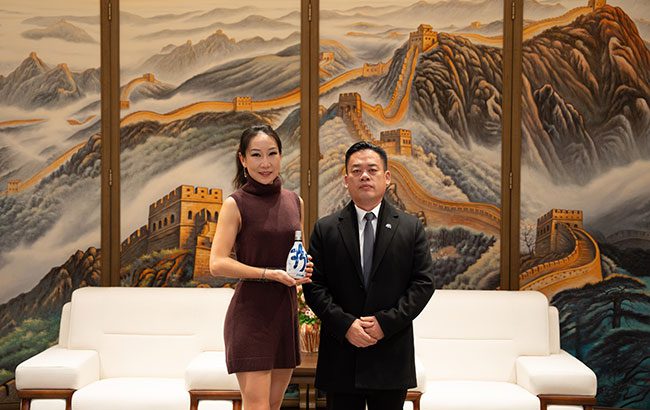
Zhenlong Wu, senior supervisor in the education and training department at Fenjiu’s parent company, Shanxi Xinghuacun Fenjiu Group, led a Fenjiu workshop. Wu (pictured with Chen in main photo) explored the origins of the spirit, the ancient stories behind it, and the ways baijiu is traditionally consumed.
According to Wu, Fenjiu was the first baijiu brand to expand internationally. Its global profile was raised significantly in 1915, when it was awarded a first-class grand medal at the Panama-Pacific International Exposition in San Francisco.
Different styles
Wu explains that Fenjiu’s light aroma style is “more accepted and appreciated by Western culture”, helping the brand appeal to drinkers outside of China. Baijiu is typically divided into four main styles: strong aroma (such as Wuliangye), light aroma, sauce aroma (including Maotai), and rice aroma, which is more common in southern China.
“Fenjiu’s mission is to share the knowledge and culture of baijiu with the rest of the world. I’ve spent 15 years learning about baijiu production, and 15 years educating about Fenjiu,” says Wu, whose father and grandfather were both master distillers for the brand.
To succeed internationally, Wu believes Fenjiu must continue to tell its story while embracing innovation and “looking for new ways to make the product better”. He also stresses the importance of deepening his own understanding of Chinese culture and its connection to the brand, ensuring consumers enjoy a meaningful tasting experience that connects on an “emotional level”. “Chinese hospitality is about bringing the best products and experience to guests,” he says.
Fenjiu’s cultural significance was underscored in 1949 when it was selected as the official spirit for the banquet celebrating the founding of the People’s Republic of China.
Reflecting on its importance, Wu says: “That conference and banquet was marked as the first ever political conference held in China. It was the first time that the country gathered all Chinese parties from all provinces to discuss national issues.”
Wu adds that the choice of Fenjiu signalled its status as a high-quality product with a “global influence”. Today, Fenjiu is present in around 70 international markets, with Southeast Asia representing its largest overseas region. Europe is now a key focus, particularly Germany and Spain.
In the UK, Cheng International also sees opportunities beyond London, including cities such as Manchester and Birmingham. Bar takeovers are planned in Manchester and Edinburgh, Chen says.
A central aim for Cheng has been to grow Fenjiu’s appeal beyond the Chinese community. “It’s about introducing the category to the local market. The Chinese already know what it is so we don’t need to educate them,” Chen says. She also notes interest from younger generations of Chinese families in the UK. “In the UK, people are always looking for something to try,” she adds, suggesting baijiu cocktails – and substituting baijiu into classic cocktail recipes – as a way to attract new drinkers.
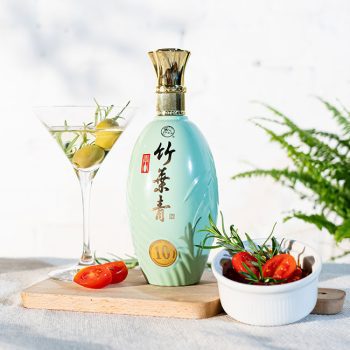
For the UK market, Cheng distributes several Fenjiu products, including aged and non-aged products at various ABVs (28% to 53%). The non-aged Silk Road range is a key focus for the on-trade, says Chen, with the Bamboo expression highlighted as a sweet, herbal ingredient for cocktails. Steeped with bamboo leaves, this baijiu is made from more than a dozen medicinal herbs, including angelica, sandalwood and cardamom.
Local culture
Baijiu has always been part of Chen’s life. Her mother worked for an alcohol distributor in Beijing, where Chen grew up, and she says the spirit is embedded in local culture. “It’s so deeply rooted in Chinese culture. If you want to celebrate marriage, weddings, success in your career progression, or you got into college, baijiu is just there.”
She adds: “In the past, baijiu brands have never really spent so much effort on the overseas market as the Chinese market is big enough.” That approach is starting to change, she says, as China places greater emphasis on cultural exchange with international markets.
Chen joined Cheng International in 2019, having previously worked as a pastry chef – including under Scottish chocolatier/pâtissier William Curley – and in the admissions office at Middlesex University. She moved to the UK more than a decade ago, completing a Master’s degree at the London School of Economics after studying biomedical engineering at Tsinghua University in Beijing. “I was a science engineering student, so I was interested in the scientific fact behind everything. That drove me to want to learn more about how baijiu is produced,” she says.
Later, her work as a pastry chef sparked an interest in flavour, motivating her to share baijiu’s complexity with a wider audience. She also points to a lack of understanding about baijiu production, even in China, noting that many people are unfamiliar with how the national drink is made.
Looking ahead, Cheng International plans to establish a UK Baijiu Association, and open a dedicated baijiu bar in London, similar to one in Taiyuan. The association, set to launch in 2026, will operate as a non-profit educational body, similar to the British Sake Association, offering memberships, masterclasses and tastings. Establishing such an association for baijiu will undoubtedly raise its profile among curious spirits drinkers and the UK’s influential bar industry, particularly if Chinese baijiu producers can work together to share their expertise and knowledge.
“It’s about sharing the knowledge and experience of the whole category,” Chen says. Drawing parallels with mezcal, she adds: “They [the mezcal industry] have been spending a couple of years with consumers and the trade to make sure they understand mezcal and what is it.”
This sustained focus on education, she believes, has encouraged drinkers to explore mezcal’s subcategories and styles. “It’s the same with baijiu,” Chen says, pointing to Cheng’s educational efforts over the past few years. But there is still a long way to go for a category as misunderstood as baijiu, as Chen notes: “We are still at the beginning stage.”
Related news
Is Diageo trying to sell its baijiu business?