


Now That’s What I Call Bar Design: Bunga 90
The design team behind Bunga 90, London’s new love letter to the last great analogue decade, explain how they turned nostalgia into cocktails and memories into a night out.
*This feature was originally published in the November 2025 issue of The Spirits Business magazine.
There is no better decade to have grown up in than the 1990s. That magical, slightly grainy era that sounded like boybands and dial-up tones, tasted like Bacardi Breezers and Sunny Delight, and toed the line between analogue and digital. So when Inception Group – the company behind immersive London bars such as 1980s-themed Maggie’s and 19th century-inspired Mr Fogg’s – announced it was giving its Bunga Bunga venue on Drury Lane a 90s makeover, I marked my calendar for its September opening and prepared myself for a night of sentimental time travel.
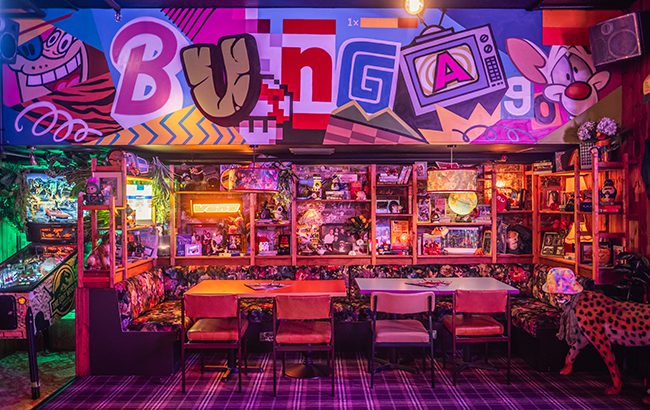
Bunga 90 is a ‘multi-sensory playground’ that celebrates the decade in full technicolour: retro cocktails, karaoke, pizza, Sega Megadrives, Spice Girls posters, and a soundtrack guaranteed to trigger repeated shouts of “what a tune!” through the night.
The sprawling space, complete with a handful of private karaoke rooms, is a time capsule so perfectly pitched that the Millennial nostalgia hits like a Celine Dion power ballad, thanks to Inception’s in-house design team, led by Alex Wilder, head of design and branding, and special projects manager Olly Draper.
Wilder, a decade-long Inception veteran, has helped shape many of the group’s venues, from post-war-themed Cahoots to the 1950s-style Control Room B at Battersea Power Station. Throughout his tenure, he has worked closely with company director Charlie Gilkes on new business proposals but, as the group has grown, he says: “There has been a need for someone like Olly to manage things directly. He’s been leading our new builds since the 2019 expansion of Cahoots Soho.”
Though the group has toured eras from the Victorian to the mid-century, Wilder says he’s surprised it took them so long to honour the 1990s – the “coming-of-age decade” for the Inception team. “We knew approaching this new era would unleash a special kind of creativity among the team.”
The team’s connection with the decade proved to be a real asset for Draper when it came to sourcing the props and decorations used throughout the space. “Bunga 90 is different from some of our more historical concepts as it references things in living memory rather than vague nostalgic notions, so we all have a clear and unique frame of reference for the 90s. For me, I found the easiest way was to lean fully into my own childhood and not worry too much about if it was a universal experience. Lara Croft, Spice Girls, Tazos, Beano, Buffy The Vampire Slayer, and WWF all speak to my childhood.”
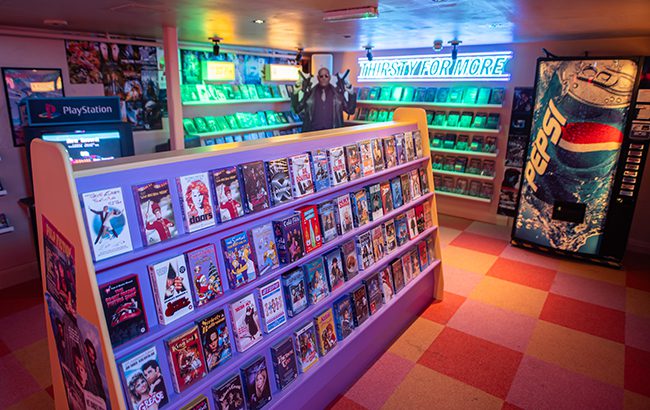
The result is an avalanche of nostalgia that feels both personal and collective. From the video store entrance lined with 3,000 real VHS boxes to the kitschy American-style living room reception where the host greets you with an enthusiastic ‘Wassssssup!’, almost every decoration, prop or movie reference peppered throughout the 3,444-square-foot venue captures the shared experience of pre-internet life – when everyone’s world looked more or less the same.
Sourcing for all of this, Draper says, was easy. “Props from the 40s for Cahoots have more challenges [than the 90s] as they loved to make things out of materials that are not acceptable now.” But after 10 years of sourcing, he has a feel for things he’ll be able to find again if something gets broken. Despite this, he says: “Sometimes you just have to accept that you’ve got a one-of-a-kind piece that looks great and one day will be damaged, which is a great excuse to refresh, revisit, and find the next great thing.”
Props to the team
While sourcing props from a decade still in living memory is easier than collecting artefacts from the 1950s, it still took “hours and hours and hours of painstaking trawling of car boot sales, eBay, attics, and a few donations from the creative team” to bring it all together. “Lots of the props came from my parents’ attic, some of which were painful to part with. There’s even my old, laminated maths certificates from primary school hidden on the wall,” Draper says.
The props don’t end with the decoration. The nostalgic detailing continues onto the Smashed Hits! cocktail menu, styled like a teen magazine. Drinks include reworked classics like Appletinis and Cosmopolitans, real-deal Bacardi Breezers, and shooter paddles – all served with a wink to the era.
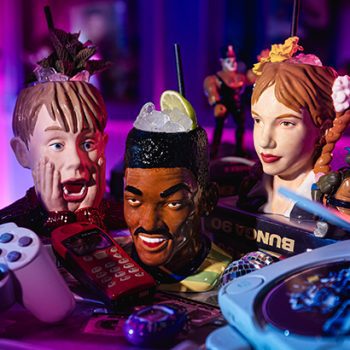
Guests are also offered the chance to sip their cocktails from the ceramic head of Will Smith or the straw aerial of a retro ‘brick’ phone. These showstopping serves are designed in house, the process of which, Wilder says, “always starts with a sketch, then mood board” for how the drinks are going to be presented, with countless options not making the cut. The glassware is manufactured by the company’s long-term partners in China, where they are moulded, hand-painted and fired in a traditional process. “One thing we love about these ceramic vessels is how resilient they are to life in a fast-moving bar. Throughout Inception Group, we always look for off-the-shelf solutions first, or make modifications to things that already exist, but sometimes those items just don’t exist. 3D printing has given us another tool to experiment with, but it’s only feasible in small quantities. Our sharing cocktail, the Slam Drunk, served in an oversized 90s trainer, is an example of this. There are five in the venue – in fact, the world – so we looked after them carefully.”
Bunga 90 is irresistibly Instagrammable. Guests enter through a Pepsi vending machine into a neon-lit bar, and even the route to the toilets takes you through a miniature “M25-style” warehouse rave just dying to be captured for socials.
As with all Inception Group venues, there’s a centrepiece feature designed to make jaws drop. At Cahoots: Postal Office, it’s a pneumatic tube system that sees cocktails whizz overhead as they are delivered to guests through air-powered tubes. At Mr Fogg’s Society of Exploration, it’s the world’s first ‘mechanical mixologist’ – a rotating wheel that crafts a precision-measured Negroni in under a minute. At Bunga 90, it’s a giant interactive claw machine, a nod to the green alien-grabbing claw in Toy Story, which selects soft toys and turns them into a canned cocktail dispensed from a fridge halfway across the room. With quality, ingenuity and wow factor all required to remain a constant in the group, Wilder explains the core design team at Inception remains the same, but sometimes “you need to call in some people with specific skills. We have an internal AV team with literally decades of experience – without them on this project, we would have been lost.”
This is just one of the challenges the team faces with each new venue build, though the biggest challenge, Draper says, is space and speed. “We build venues in unusual spaces that often have limits on what we can fit in once the boring stuff like toilets, cloakrooms, and cleaning cupboards are added. We start with the spaceship, then try and work out how the spaceship can fit in a one-metre-square floor space with a low ceiling and a plumbing pipe running through the middle. Then make sure it can handle high-volume and all the possible ways it can be interacted with; big groups, busy Fridays, private parties, someone shy, and someone loud.”
Related news
Scottish on-trade nets 40% business rates relief
Are Indian investors waking up to the power of the on-trade?