

Absolut Tabasco: 2026’s ‘hottest’ new vodka
The newest product from Pernod Ricard-owned Absolut Vodka is a collaboration that brings together two legacy brands to attract a new, younger audience.
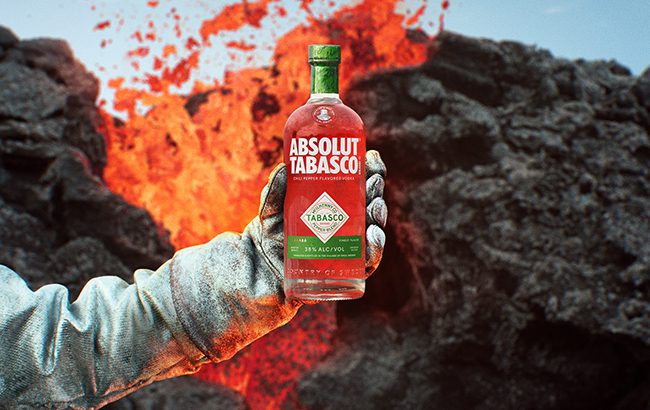
At its heart, Absolut Tabasco is a way for the brand to tap into the growing global trend for spicy flavours. Datassentials analysis from February 2025 predicts sales of spicy vodka will increase by 27% by 2029.
But according to Craig van Niekerk, vice-president of marketing for Absolut, Kahlúa and Malibu, the collaboration between the two brands was a natural fit regardless of what’s currently trending.
“It’s a bit scary when you look at the commonalities between the brands. There are so many different synergies,” he says. In particular, he’s referring to the brand’s similar founding dates (1879 for Absolut and 1868 for Tabasco) and the fact that both brands are community-made (in Åhus, Sweden, and Avery Island, Louisiana, respectively). Both brands have a similar bottle silhouette – which was a huge boon for the collaboration’s design – and claim to be made from ‘three ingredients’. In Absolut’s case, this means water, wheat and yeast, while Tabasco combines red peppers, vinegar and salt.
“With the spice trend globally, it was obvious to make a product together,” he adds. “The ultimate question is: how good a product can you make? How can you deliver the authenticity of that flavour? That’s the hard part, and it was not without headache to get there.”
But more than just creating a new flavour for Absolut fans, van Niekerk sees the collaboration as a way to recruit new consumers and innovate within the category. “The biggest opportunity for us is to make vodka top of mind again,” he says. “Vodka is perceived as a one-dimensional category in a four-dimensional world. The neutrality of vodka is its biggest strength and its biggest weakness – it’s not always in the foreground, but it’s an ultimate elevator of flavour.”
He takes the Espresso Martini as an example: “Everyone loves Espresso Martinis, but what’s not top of mind is that it’s a vodka cocktail. That’s a great illustration of the vodka conundrum.”
Asked about whether the brand sees competition from rival expressions like Smirnoff Spicy Tamarind, van Niekerk laughs: “This is the first conversation we’re having about Smirnoff. We had not even thought of that as an opportunity.” He points to Absolut’s slightly higher price point globally, with certain markets – such as Brazil – seeing Absolut two or three times the price of Smirnoff.
“The product proposition was not designed to capture share from Smirnoff Tamarind,” he says. “It was designed to tap into the spicy global flavour trend, connect with Gen Z and use it as a platform to fulfil our role, which is to make the world more interesting, starting with vodka.”
That connection with Gen Z is a key focus for the launch: “Absolut has an incredibly strong connection with older millennials and above. When you speak to Gen Z consumers, they know of Absolut from a brand point of view, and they know that it’s an iconic spirits brand, but they haven’t grown up with it.”
The vodka’s key advertising campaign features a volcano, which the team decided to create in real life rather than using AI. “We want to capture consumers’ imaginations, and we know that Gen Z are much more open to exploration and discovery,” he explains. “And what better metaphor to talk about a Bloody Mary than looking at lava from a volcano?”
Creating the vodka
Given Absolut’s history as a pioneer of flavoured vodka, you’d imagine it to be the driver of the collaboration; however, the team is quick to credit Tabasco for kicking off the partnership.
“They were the ones who knocked on the door first, but at a moment when we were looking for exactly that kind of partnership,” says CEO Stéphanie Durroux. Tabasco had been spurred by Absolut’s viral partnership with Heinz, which saw the two brands come together to create a Tomato Vodka Pasta Sauce.
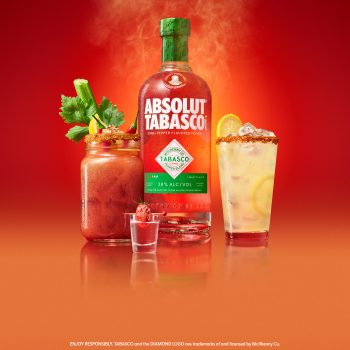
“When we had the collaboration with Heinz, we thought: well, Heinz is well-known for tomato; it could be a natural way to go into the Bloody Mary,” she adds. Durroux and the team believe the Bloody Mary is on the verge of a comeback, which made Tabasco’s proposition extremely enticing. Another benefit was that the two brands were already in communication, owing to a previous Bloody Mary pack that paired a mini Tabasco bottle with the vodka – which meant the project timeline was just under a year.
The idea was presented to Durroux “quite early” given the size of investment in terms of both time and money, “just to see if there was good alignment,” she says. “It’s not always the case, but in that instance, I would say there hasn’t been the slightest doubt.”
The only real question in Durroux’s mind was whether the product would be a limited edition or permanent. “The more we thought about it, and the more we discussed it with our markets, the more we realised it had the potential to be something really big, permanent and global.”
In terms of financials, Absolut buys raw product from Tabasco – specifically the pepper mash that it barrel-ages to turn into hot sauce – as well as paying out in a licensing deal.
The two brands have made a three-year commitment to each other. “It doesn’t mean it will stop there,” teases Durroux. The partnership may also develop beyond the flavoured vodka, with the brands exploring other options, including a ready-to-drink (RTD) product. Two signature serves for an RTD come to Durroux’s mind – Bloody Mary and Spicy Lemonade – with no decisions made yet. “Frankly, right now, nothing is excluded,” she says. The question of timeline is a little more certain, with Durroux expecting a product to be released within the first three years. “There’s momentum – why wait?”
Are there more collaborations on the horizon? “It can be replicated only if it’s as organic as this one,” says Durroux. “It taps into something that [already] exists. People will combine Absolut and Tabasco to make a Bloody Mary or a spicy drink. It’s not something we’ve created in an artificial way.”
The future of flavoured vodka

There’s an argument that flavoured vodka reached its peak in the early noughties, before it was overtaken by flavoured gin – which is now also on its way out. But for Absolut, which released the world’s ‘first’ flavoured vodka, Peppar, in 1986, flavoured expressions have remained steady.
“Flavours have more or less always been about 20% to 22% of Absolut’s total. I’m pretty sure there has never been a significant drop,” says Durroux. The flavour range is meticulously managed, with SKUs currently totalling 14. “It is a lot, but we had many more in the past. We decided to cut some that were not relevant anymore, not so fitting trends or consumers’ palates.”
Another way that Absolut keeps its flavours relevant is by linking them to established cocktails. “Or to put it differently, our most successful flavours are very clearly associated with existing drinks,” she says, pointing to Absolut Citron as a base for a Cosmopolitan and Lime for Mules. Citron has historically been the brand’s top-selling flavour, but Vanilla has been closing in on it in the past two or three years, due to the popularity of Espresso Martinis.
“I don’t think the way we manage flavours is just linked to trends. In general, what remains and what is a significant part of the range is more long-term and based on real cocktails,” she says. “That’s why I have confidence in Absolut Tabasco. There’s a very obvious way of having it, which gives us confidence about consumer adoption.”
Absolut Tabasco will launch in more than 50 markets from February with an ABV of 38%.
The spicy vodka rollout arrives amid a legal clash in the US, where Tasbaco’s parent firm McIlhenny Company is suing Stoli Group over its jalapeño vodka, claiming its packaging could infringe its hot sauce brand’s trademark.
Related news
Stoli vodka pops up at Dubai Duty Free