

Is Black Friday just a race to the bottom for spirits brands?
The cost-of-living crisis is enough to drive a country to drink… but only at discounted prices. We explore how consumer demand for retail promotions like Black Friday can affect a brand’s bottom line.
*This feature was first published in the December issue of The Spirits Business magazine.
Studies indicate a 20% discount can make consumers twice as likely to purchase a product compared with a full‐priced one. That likelihood rises dramatically to 99% when the discount offered is 50%, according to research firm 2 Visions’ Q2 2023 Ecommerce Discounting & Promotions report. So, as we approach the festive gifting period, which comes at the end of a year that has seen spirits prices rise by approximately 6% to 8%, according to procurement consultancy Commercial Purchasing, brands are going to have to pull out all the stops to get consumers to open their wallets this year.
For many people, that means joining what has become an annual Black Friday race to the bottom – one that is increasingly dividing the spirits industry into those who thrive on discounting and those who feel trapped by it.
According to The Guardian, in October 2025 retailers suffered the slowest sales growth since May, as expected autumn Budget tax rises and the impending 28 November Black Friday sales caused shoppers to purchase with caution. “Everyone is waiting for Black Friday to do the majority of their Christmas shopping,” explains Katherine Saunders, co‐ founder of London’s Doghouse Distillery. But while the seasonal discount period is a win for consumers looking to fill their liquor cabinets before granny arrives to drink it dry, it leaves spirits producers with little choice but to slash prices, lest they be passed over for a cheaper competitor. “If you don’t take part, you miss out on too many sales, and, let’s face it, with the market the way it is right now, we can’t afford to miss out,” Saunders says.
A November 2024 Savvy Shopper Panel found a quarter of consumers consider Black Friday the perfect opportunity to stock up on booze, and will actively search for deals on their favourite bottles over the promotional period, which now typically bleeds into the first week of December. Additionally, more than half (53%) of Brits expect alcohol to be a top spending priority this year, and so for retailer The Whisky Exchange, Black Friday is non‐negotiable. “It has become so important in the retail landscape, and not to play in it would be a huge detriment to sales,” says commercial buying director Dawn Davies MW. “Today, if you mess up Black Friday, you potentially mess up your growth for the year, so it is very important, and we now plan for it as part of the Christmas strategy.”
That, Davies says, is what Black Friday is all about for retailers and brands: strategy. “It’s like a game of chess. You have to think five moves ahead of everyone [to] manage price and margin expectations,” Davies adds.
Paul McDougal, merchandising manager for The Whisky Exchange, explains: “We start planning for major promotional periods like Black Friday about 11 months in advance, allowing plans to develop and evolve as market conditions change throughout the year, which enables us manage our promotional position carefully.”
James Kerslake, founder of ready‐to‐drink (RTD) cocktail brand Tom Savano, takes the view that “you’ve got to be in it to win it” when it comes to deep promotions at this time of year, “otherwise you’ll lose loyalty to other brands. I think it’s very important to participate, to make sure that people can buy you on discount, and they don’t go to your competitors instead.”
A rock and a hard place
But Daniel Humphrey, founder of Summerton Whisky Club, says Black Friday puts spirits brands between a rock and a hard place. “Two years ago, Master of Malt ran a series of deep deals over Black Friday week that killed sales in smaller retailers, followed by a discount that ran to New Year’s. It was impossible to compete with what they were offering, and everyone suffered during what is the most important period of the year for whisky sales. After that, we felt we had no choice but to take part in Black Friday if we wanted a chance to clear the shelves of our warehouse and reinvest back in the club.”
Kerslake says he always feels the pressure to discount deeper than the brand is comfortable with, noting it starts to become a self‐defeating prophecy, “because once you start discounting, it’s hard to get people buying at full price. Unfortunately, we’re in that loop, and when we’re in a consumer spending crisis, we’re not likely to get out of it.” However, he says there are ways of playing Black Friday to a brand’s advantage: “The main thing we want to drive with Black Friday is basket size. We don’t want to be giving away 30% on a £20 order – we want people ordering big.” Implementing minimum spending amounts or offering buy‐one‐get‐ one‐free deals typically means Tom Savano sees order sizes rise from around £35 to £80 during Black Friday. This, he says, allows the brand to offer a deeper discount because it has more margin to play with.
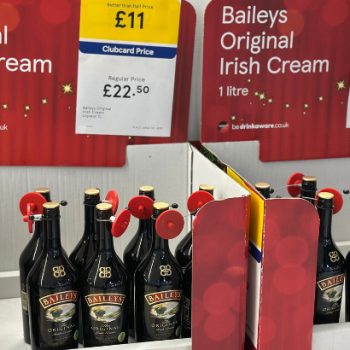
But this isn’t the strategy for all brands. Throughout the Black Friday period, Diageo’s seasonally popular Irish cream liqueur Baileys is available in Tesco supermarkets for more than 50% off – a discount that will be considered too good to resist for many spontaneous shoppers. Meanwhile on Ocado, its stablemate The Singleton single malt whisky dramatically dropped in price by £18 in the online retailer’s Black Friday promotion – its “best price this year”. These discounts, compared with those offered by independent brands, are far more dramatic, and likely to drive larger sales over the coming weeks, leaving the question: how can smaller brands, without the portfolio scale to absorb such losses, compete in a price war they can’t hope to win?
For Rhona McKeran, UK marketing manager for RTD brand Moth, deep price cuts like these can devalue a young brand and train consumers to only buy when products are heavily reduced. “That’s not the kind of relationship we want with our customers,” she says. “At Moth, we focus and prioritise staying true to our brand, range, pricing and creating moments or limited releases that feel purposeful for our customer. We don’t benchmark our pricing against major players. We choose a price point that is right for the brand and our consumers.”
Sustainable offer
For Saunders, discounting offers a chance to reach new consumers, so she pays less attention to competitors’ pricing and more to what her business can sustainably offer. Kerslake agrees, and for both brands the ideal outcome is to break even by the end of the promotional period and, with luck, turn one‐ off bargain hunters into long‐term customers.
Looking ahead, the challenge only deepens. As we go to print, this year’s Black Friday promotions are in full swing, but the outlook for the spirits sector remains unsettled. With no sign of spirits duty relief and interest rates still unstable, the question is whether consumer demand for ever‐deeper discounts will push independent brands beyond the point of what they can realistically afford in 2026. Couple that with an economic climate suppressing sales year round, and discounting might start to look less like a strategy and more like a lifeline. As Humphrey puts it: “We’re all reducing our margins to nothing because it’s better to get the cash back in hand to reinvest than have those bottles sitting on the shelf for months.”
So for now, Black Friday remains both a blessing and a curse – a vital visibility and sales boost that simultaneously risks eroding long‐term value. Unless consumer behaviour shifts, independent spirits brands may find themselves running the race to the bottom simply to stand still.
Related news
Ten biggest moments in gin history