


Bourbon sector fights for fairer taxes
Kentucky Bourbon producers are trying to change the way in which taxes are levied on ageing barrels of spirits, fearing their huge outlay will dissuade new businesses from operating in the state.
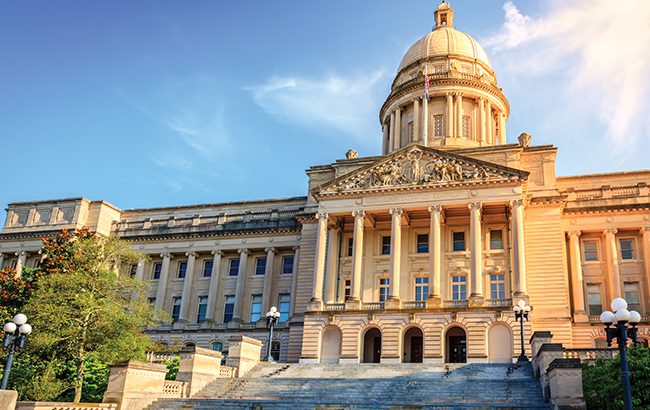
Kentucky is widely known as the home of Bourbon, but a decades‐long tax structure is threatening the state’s distilling industry and its future growth.
The state remains the only place in the world that taxes ageing barrels of spirits, according to trade body the Kentucky Distillers’ Association (KDA). In January 2022 barrel taxes for Kentucky’s Bourbon industry hit their highest in history at US$40 million, with the number of Bourbon barrels in the state reaching 11.4 million. Kentucky distillers were said to be paying nearly US$7m more in barrel taxes in 2022 than in 2021.
The state taxes ageing barrels of the spirit years before it becomes a finished product. Including other ageing spirits, the state’s total inventory is almost 12m barrels – a ‘milestone’ in the 200‐year history of Kentucky Bourbon, the KDA said.
The revenue collected from this property tax largely goes to school districts, cities, counties, libraries, fire districts, and other local government entities in Kentucky.
The Bourbon industry in Kentucky generates US$9bn each year for the state’s economy, and sustains more than 22,500 jobs with an annual payroll topping US$1.2bn a year, the KDA said.
The KDA’s president, Eric Gregory, said the industry has been paying these high taxes for 50 to 60 years, but over the past two decades the Bourbon industry has experienced huge growth.
“We would have never anticipated double‐digit increases in production and inventory like we’re seeing these days; it was just unimaginable,” he noted. “In 2014, we might have had about four million barrels in Kentucky, and barrel taxes were about US$12m a year. And now we’re at 12m barrels, and US$40m in federal taxes a year. So it has skyrocketed in the past eight years.”
The tax puts the industry at a “competitive advantage”, Gregory noted, as well as being a “barrier to entry for new distillers looking to locate in Kentucky”. Despite Kentucky being known worldwide for its Bourbon, it can be made anywhere in the US. Gregory said the taxes were “a major disincentive” that has caused some distillers to postpone expansions or decisions because of the immediate cost of overheads.
Kentucky produces 95% of the world’s Bourbon, he noted, including major brands and producers such as Jim Beam, Maker’s Mark and Heaven Hill. “In 10 years, if one of these distillers in Texas or Colorado becomes the next Maker’s Mark, suddenly that number could be 90% or 85%, Gregory said. “And then, not only have we lost our image and identity as the one true authentic home for Bourbon, we’ve lost jobs and investment.”
The Alcohol and Tobacco Tax and Trade Bureau (TTB) reports that Kentucky has fallen to 12th place in the US for the number of distilling operations in the state.
Its share of distilleries nationwide has fallen from 24% to 6%, and Kentucky’s percentage of distilling jobs has dropped from 43% to 30%, according to TTB data cited by the KDA in September 2022. “We are stopping new distilleries from wanting to open here, and instead they’re going to Indiana, Tennessee, or Texas,” warned Chad McCoy, former Kentucky state representative.

High taxes
To tackle the high taxes being paid by distillers, last year the Bourbon Barrel Taxation Task Force was set up to discuss the ways in which the tax could be removed or lowered. Local governments in Kentucky rely on the billions of dollars of annual tax revenue that the Bourbon industry brings in.
The task force hears from industry stakeholders, including the KDA, as well as schools and local governments to discuss ways to provide relief for distillers while limiting damage to the budget of the school districts. McCoy, who served as co‐chair of the task force until the end of 2022, said the group had met monthly since June of last year. A meeting in October saw several ideas put forward, including several from the KDA, McCoy said.
These included stopping taxation on any new barrels after 2024, and a refundable tax scheme, similar to that in the film industry. “It’s important to note that none of the suggestions were to just get rid of the tax,” McCoy added.
He explained how one idea could work: “If you were going to freeze it, all the barrels that are in a warehouse right now would continue to be taxed but any new barrel going into the warehouse wouldn’t be taxed. Even if you do that, what you end up seeing is still an increase in revenue over the next 10 years because a one‐year‐old barrel becomes a two‐year‐old, then they just get more valuable, so the tax revenue goes up. And it ends up being a bell‐curved shape on what the revenue would look like. So that’s one possible way to do a phase‐out.”
He added: “Or what if we cap it and say to Heaven Hill ‘you’ve been paying US$4m in federal tax, continue to do that for the next 10 years, and then we can phase it out’.”
Gregory said distillers were considering whether it was beneficial to use land in Kentucky for barrel warehouses.
McCoy said some people were asking why the distilling industry should be given a break. “It has nothing to do with giving existing people a break, and instead has everything to do with economic development and growth,” he explained.
“We’ve fallen behind in the percentage of distilleries and percentage of workforce in the distilleries. We’re losing our grip on the Bourbon Trail, which is a huge economic tourism driver for our state.”
Wally Dant, founder of Log Still Distillery in Kentucky’s Nelson County, is hopeful for a change to the tax structure on barrels. “Phasing it out over the course of years, stopping the new taxes on new barrels of new make is a smart way to do it. We have a lot of smart people that can certainly figure it out at the state legislative level,” he said.
Dant is also considering moving some of his barrel warehousing to neighbouring Indiana.
The good news is progress is being made on the issue, as McCoy tells me. The task force came to an end on 31 December, and the potential solutions to the tax structure are being discussed in the Kentucky General Assembly’s 2023 legislative session, which began on 3 January and is due to run until the end of March.
It is hoped a bill featuring one of the discussed solutions will be introduced by the deadline, McCoy said.
“The Bourbon industry has a lot of supporters among representatives in the House,” he said. “I’m very confident we’ll see something happen. If it doesn’t happen by 31 March, then it can’t happen until next year.”
Related news
Are national drink days creating too much noise at the bar?