

Colombian firm ILC on building a circular spirits model
Recently certified as carbon neutral, Industria Licorera de Caldas (ILC) is on a mission to be recognised as a global leader in sustainability within spirits by 2030.

Based in Colombia, ILC has a spirits portfolio spanning rum, aguardiente and other traditional categories.
It recently became the nation’s first business to be awarded a Carbon Neutral Footprint certification for its entire portfolio.
It is also the first alcohol company in the country, and among only 10 worldwide, to have achieved verified Water Footprint certification.
Sustainability has become part of the way the business operates, according to ILC CEO Diego Angelillis Quiceno, who spoke to The Spirits Business ahead of Earth Day (22 April) this week.
“It is embedded throughout the entire value chain, from responsible water management and the protection of its natural reserve, to the use of renewable energy and the implementation of circular economy models,” says Angelillis Quiceno.
Furthermore, 100% of the electricity used by ILC comes from certified renewable sources, supported by solar solutions in specific operational areas.
Angelillis Quiceno adds that its recent carbon-neutral and water-footprint certifications reflect a “structured and continuous approach to sustainability management”.
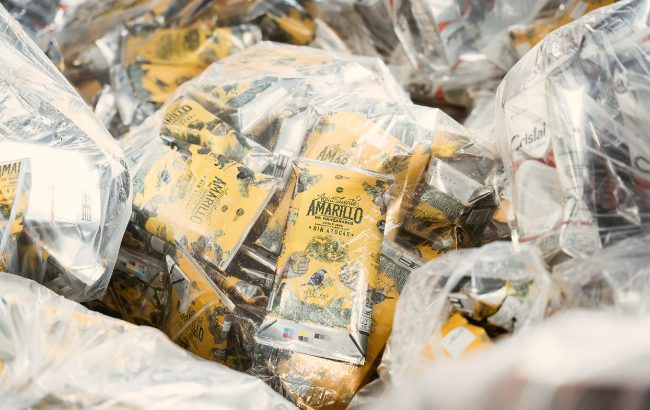
ILC is currently recouping approximately 20% of its multi-material packaging (cartons, caps, labels) across Colombia, with its recovery efforts extending beyond major cities into geographically isolated regions.
“One of the main logistical challenges has been effectively reaching remote and hard-to-access territories, where infrastructure limitations make operations more complex,” he says of the challenges in reaching remote locations.
“In areas such as San Andrés or the Pacific coast, transportation relies heavily on maritime or river routes, with limited frequency, higher costs, and longer lead times. Additionally, land connectivity is often limited or non-existent, making both collection and transportation of recovered materials to processing centres more difficult.”
To overcome these challenges, ILC has strengthened partnerships with local stakeholders while adapting its corporate social responsibility (CSR) strategy to ensure operations remain both efficient and socially responsible.
One other risk, notes Angelillis Quiceno, is that some of the company’s empty bottles could be used for counterfeit alcohol. “This has required complementing logistical efforts with education, awareness, and community engagement initiatives to promote proper disposal and return of materials,” he explains.
Community efforts
Within its sustainability efforts, ILC has also focused on repurposing materials into products to support the community.
A major example is its partnership with Proplanet-Tetra Pak, whereby recycled materials are transformed into desks and school furniture. Distribution decisions are made in cooperation with the government of Caldas, with requests coming directly from communities and educational institutions.
There are also plans to scale this programme beyond school furniture. The company is “expanding it into other types of community infrastructure through circular economy-based initiatives”, according to ILC’s CEO.
One example is the Glass Sand scheme. Recovered bottles are transformed into sand used in infrastructure projects (such as parks, housing, and paved paths), as well as in coral restoration processes through its partnership with BlueIndigo Foundation.
Through the ConexiónREP programme, which collects and recovers post-consumer packaging, ILC supports 2,000 recycling families and organisations across Colombia. It directly improves the quality of life and wellbeing of the families, according to Angelillis Quiceno.
Angelillis Quiceno says the programme “generates real social value, positioning recyclers as strategic allies in building a more sustainable environmental model”.
Currently, approximately 18% of ILC’s glass packaging comes from recycled material, which is “recovered and reintroduced into the production process through our supplier, contributing to the manufacture of new bottles,” says Angelillis Quiceno.
The company intends to increase this over time, supported by the scaling of ConexiónREP and improved national collection systems.
Oak initiative
The company’s sustainability vision also extends into forestry and long-term resource independence. One of its most ambitious projects is a 50-year initiative to cultivate Colombian white oak, with the goal of producing its own barrels in the future.
The plantation was established in 2010 within ILC’s 24-hectare reserve, where 18,777 trees have been planted. After 16 years, the plantation has around 15,666 trees, following controlled forest management practices such as thinning to optimise growth and wood quality.
ILC’s rum brand, Ron Viejo de Caldas, is said to be the leader in its category in Colombia with a market share of around 85%. It is produced in white oak barrels grown in the mist forests of the Colombian Andes and crafted with pure spring water.
“Over the next 10 years, success will be measured by the growth and quality of the remaining trees,” Angelillis Quiceno notes. “It is expected that by year 30, trees will reach a DBH [diameter at breast height] of around 45cm, progressing toward optimal conditions for high-value wood production.
“Each tree is estimated to yield at least 40 barrels, supporting the long-term sustainability and viability of the project.”
Angelillis Quiceno warns that decarbonisation remains a major challenge, particularly as the biggest emissions driver comes from outside of ILC’s facility. ILC’s footprint analysis shows that approximately 87% of emissions come from the supply chain, including inputs such as glass production. Internally, direct emissions predominantly come from natural gas use in the production process, alongside areas like corporate travel and wastewater.
Future targets
ILC’s portfolio also includes Aguardiente Amarillo de Manzanares. The brand saw sales soar by 87% to 25.9 million units in 2025 compared with 2024.
For 2026, ILC is aiming to reach total sales of nearly 54m units for its aguardiente across both domestic and international markets.
The company is also seeking to expand into new markets and enhance its presence in Europe and the US, particularly ahead of the Fifa World Cup.
Looking to 2030, the CEO says the goal is to become a “global leader in sustainability within the spirits industry, known for its tangible contributions to ecosystem conservation and social development”.
The long-term ambition is to lead on ocean protection, circular economy models that support education and community dignity, and strong carbon and water footprint management across the value chain.
However, he notes that the biggest challenge is “scaling these initiatives and ensuring consistent impact growth, particularly through stronger partnerships and supply chain transformation, while continuing to meet evolving global environmental and social expectations”.
Related news
On-trade experts give free sustainability advice